
Marriage Advice for New Parents: 18 Small Habits That Keep You Close

Nobody warns you that the strangest part of new parenthood isn’t the baby. It’s looking across the couch at your favorite person — the one you chose, the one who makes you laugh like nobody else — and realizing you’ve spoken forty words to each other all day, and every single one was about feeding times, laundry, or whose turn it is to rock.
That’s the roommate phase, and nearly every couple we know has lived in it for a while. It doesn’t mean your marriage is broken. It means a tiny new person moved in and rearranged everything, including the two of you. The fix isn’t a grand romantic gesture or a weekend away you have no childcare for. It’s small, repeatable teamwork — the kind that fits inside a life with a baby.
This guide collects 18 pieces of marriage advice for new parents that actually survive contact with real life: how to talk like teammates instead of opponents, how to split the load so nobody keeps score, how to stay sweethearts in ten-minute installments, and how to protect your little team from the well-meaning chaos outside your front door. You don’t need all 18. Pick three, and you’re already doing it on purpose instead of by accident.
Heads up: this post contains affiliate links. If you buy through them, MamaKinder may earn a small commission at no extra cost to you — it helps keep these guides free.

Talk Like Teammates, Not Opponents
1. Hold the 10-minute check-in. Once a day — over coffee, on the evening walk, whenever the baby gives you a window — ask one question: “How are you doing today, really?” Then actually listen to the answer. Ten honest minutes do more for a marriage than an hour of logistics ever will, because most of us don’t drift apart from lack of love. We drift from lack of news about each other.

2. Say the small thing before it becomes the big thing. The diaper pail that annoys you, the comment from his mother that stung, the loneliness you felt at 2 p.m. — say it today, while it’s small and sayable. Little frustrations stored up don’t disappear; they ferment. Brought up early, most of them are five-minute conversations. Brought up at month three, they’re a whole evening.

3. Ask for what you need, skip the verdict. Compare “You never help at night” with “I’m wiped out — could you take the first wake-up so I can get one solid stretch?” Same need, completely different landing. Requests with a clear ask give your partner something to do; verdicts about their character only give them something to defend. Couples researchers call this a soft start-up. We just call it asking like you’re on the same side — because you are.

4. Make the 3 a.m. rule. Nothing said at 3 a.m. counts. Sleep deprivation turns minor irritations into what feel like deep truths, and neither of you is your real self in that hour. In our house, anything sharp said overnight gets a free pass and a daylight revisit: if it still matters at breakfast, it gets a calm conversation. If it doesn’t, it never really mattered — it was just exhaustion talking.

5. Repair fast, and repair out loud. You will snap at each other. Tired people do. What separates couples who recover from couples who accumulate is the repair: “Sorry. That came out sideways. Reset?” Said within the hour, not the week. A quick, honest reset tells your partner the relationship outranks your pride — and saying it first, even when you weren’t entirely wrong, is a strength move, not a surrender.

Share the Load So Nobody Keeps Score
6. Make the invisible list visible. A huge share of new-parent friction isn’t the work — it’s the remembering: the pediatrician appointment, the outgrown onesies, the thank-you note, the diaper stock. Once a week, get the whole list out of one head and onto paper or a shared note. Half the resentment in this season is one partner carrying a list the other has literally never seen.

7. Own a job end-to-end. “Helping” still leaves one person managing. Owning is different: the owner notices, decides, does, and finishes — no assignments, no reminders. Bath time, bottles, laundry, the night feed, the pediatrician booking: pick whole jobs and trade ownership, not tasks. This is also how partners bond with the baby in their own right — our guide to helping a husband bond with the new baby has the gentle version of this for the early weeks.

8. Sleep in shifts, and put it on paper. “We’ll take turns” dissolves at midnight into two zombies negotiating. A written shift plan doesn’t: one partner is off-duty and off the hook — earplugs, guest room, no guilt — while the other is on point. Trade blocks that match how each of you actually sleeps, and protect the plan like an appointment, because the rested version of your marriage is noticeably kinder than the wrecked one.

9. Swap one job you each hate. Everyone has the chore that drains them out of proportion — for one of you it’s the 4 a.m. resettle, for the other it’s washing pump parts forever. Trade your worst for theirs. It’s a small deal that carries a big message: your misery is my problem too. Couples remember these swaps long after they’ve forgotten the chore itself.

10. Re-split the whole thing every month. The arrangement that worked for a sleepy newborn collapses under a rolling, teething, starting-solids baby. Expect that. Once a month, over the check-in coffee, ask: what’s heavier than it used to be, and what can move? A load that’s re-balanced regularly never gets the chance to quietly crush one of you.

Stay Sweethearts, Not Just Co-Parents
11. Keep the at-home date night. You don’t need a sitter, a reservation, or matching energy levels. You need one recurring slot — Friday after bedtime, Sunday nap time — where the two of you do something that isn’t parenting: a board game, a show you only watch together, takeout eaten while it’s actually hot. Phones in the other room. Some weeks it will collapse into both of you asleep on the couch by nine. That still counts. The appointment is the romance.

12. Let small touches do the heavy lifting. A hug at the door, a hand on a shoulder while passing in the hallway, coffee made the way they like it — in this season, these tiny things are not the appetizer to connection. They are the connection. And if you’re the one who’s held a baby all day and feels honestly touched out by evening, say so with love: “I adore you, and my skin needs a rest — come sit with me instead.” Closeness has a hundred forms; pick the ones that refill you both.

13. Flirt like beginners. The text you’d have sent in year one. The compliment that has nothing to do with parenting — “you looked unfairly good in that shirt” beats “great job on the bottles” (send both, honestly). A note in a lunch bag. An inside joke revived. Flirting tells your partner they’re still seen as a person, not only relied on as a parent — and it takes about thirty seconds.

14. Protect one ritual that’s just yours. Ours is a slow walk with the stroller after dinner — the baby sleeps, and we get twenty minutes of actual conversation at walking pace. Yours might be Saturday pancakes, a shared chapter of a book in bed, ten minutes on the porch. Whatever it is, guard it like it matters, because it’s quietly holding the “us” together while everything else is about the baby. If you’d like a nudge for the book version, And Baby Makes Three by Drs. John and Julie Gottman was written for exactly this season of life — a chapter a week, read side by side, gave us better 10 p.m. conversations than any amount of scrolling.

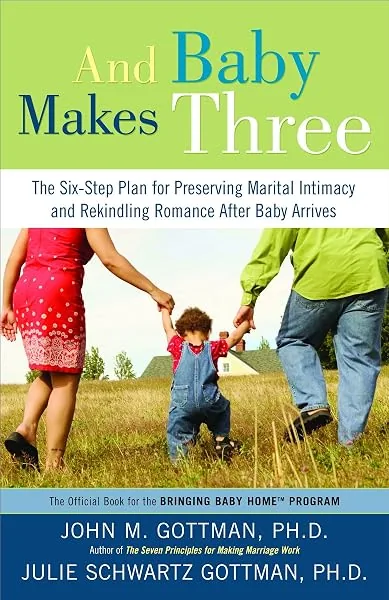
And Baby Makes Three — John & Julie Gottman
The book written for this exact season — the Gottmans’ six-step plan for preserving intimacy and rekindling romance after the baby arrives, with short exercises built for tired parents.
Guard the Team From the Outside World
15. Answer the world with one voice. Visitors, advice, grandparents with opinions — decide together, present together. If the plan is no unannounced drop-ins or a two-week bubble before visits, both of you say it, so neither becomes the villain alone. Your partner should never have to fight your family by themselves, or you theirs. United front outside, honest conversation inside — that order matters.

16. Ask for help before you desperately need it. Name your village now, while things are calm: who can bring a meal, hold the baby while you both nap in shifts, take the toddler to the park, sit with the baby so the two of you can take that walk. People genuinely love being asked for something specific. And here’s the part couples miss: asking for help is marriage advice — every hour of support you accept is an hour of patience you get to spend on each other.

17. Lower the bar together — on purpose. The house will not run at pre-baby standard, and the fastest route to resentment is one partner quietly keeping the old standard while the other has let it go. Decide together what slides this season: paper plates are fine, the laundry can live in the basket, guests get a home that’s lived in. A bar you both agreed to lower can’t be failed by either of you.

18. Assume the most generous story. When your partner seems distant, short, or checked out, there are two stories available: they don’t care — or they’re running on empty and don’t know how to say it. In this season, it’s almost always the second one. Leading with the generous story — and checking it kindly: “You seem far away today. Tired, or is something on your mind?” — turns a dozen would-be fights into the check-in conversations from item 1. It’s the whole guide in one habit: interpret each other like teammates.

Quick Picks: Start Where It Hurts
| If This Is Where You Are | Start With | Why It Helps First |
|---|---|---|
| You feel like efficient roommates | The 10-minute check-in (#1), flirt like beginners (#13) | Puts real conversation and being seen back on the daily menu |
| Resentment is quietly building | Make the invisible list visible (#6), own a job end-to-end (#7) | Most score-keeping is an unseen list, not an unfair partner |
| You’re both too exhausted to be kind | Sleep in shifts (#8), the 3 a.m. rule (#4) | Rest returns faster than goodwill does — fix the input first |
| Date night feels impossible | At-home date night (#11), one protected ritual (#14) | Small and scheduled beats big and someday |
| Everyone has an opinion about your baby | One voice for the world (#15), ask for help early (#16) | Boundaries set together don’t cost either of you the villain role |
More Marriage Guides on MamaKinder
When things feel rocky
Everyday friction, handled kindly
Trust & other people
Family & big decisions
Little gifts, big message
Shop This Post
The one thing we recommend in this guide, in one place:
| Product | Used For | Price |
|---|---|---|
| And Baby Makes Three — Gottman & Gottman |
The chapter-a-week ritual from #14 — staying sweethearts on purpose | Check Price |
Marriage Questions New Parents Actually Ask
Is the roommate phase normal, or is something wrong with us?
Normal — so normal it should come up at the six-week checkup. A baby temporarily reorganizes your whole life around feeding and sleeping, and the couple part gets squeezed into the margins. What matters isn’t whether you land in the roommate phase; it’s whether you keep doing small things on purpose while you’re in it. Couples come out of this season closer all the time.
We have literally no time. Where do we even start?
Start with the check-in (#1) — ten minutes is the whole price. If ten feels impossible, start with item 12: one real hug and one kind sentence a day. The smallest version done daily beats the perfect plan done never, and small starts have a way of making room for bigger ones.
What if my partner won’t read lists or do “relationship stuff”?
Then don’t lead with the list. Most of this guide runs on one person’s initiative: you can start the check-in, make the generous assumption, send the flirty text, propose the shift plan as a sleep fix rather than a marriage fix. Invite, don’t assign — and let results recruit them. A partner who sleeps better and gets thanked tends to become a partner who joins in.
Is it normal to be this annoyed with each other?
Yes — sleep deprivation is a world-class irritability machine, and you’re both running it. Annoyance is weather; contempt is climate. If the eye-rolls ever start feeling like the whole forecast, that’s worth real support — plenty of couples talk it through with a counselor for a few sessions and call it maintenance, not crisis. We wrote more on the harder version of this season in Husband Says He Loves Me but Is Unhappy.
Should we keep our pre-baby date night going out?
If you have childcare you trust and it recharges you — absolutely, go. Just don’t let the going out version become the only official date, because it’s the first casualty of a rough week and then the guilt piles up too. Keep the at-home version as the floor and the night out as the bonus.
Start With Three
If this whole list feels like one more assignment, here’s the entire system in miniature: one talking habit, one load change, one sweet ritual. The check-in, the visible list, and the after-dinner walk will carry a marriage through the newborn season more reliably than any grand gesture — and a year from now, when the baby is a toddler and you catch yourselves laughing about the 3 a.m. era, you’ll realize the team never actually left. It just needed tending. Our Mom Life Tips guide is the companion for the you side of this season — because the mom doing all this tending deserves some tending too.
You’ve got this, mama. The marriage doesn’t need rescuing. It needs the same thing the baby needs: small things, done with love, on repeat.