
46 Cozy Nursery Ideas for Calm Nights and Easy Days
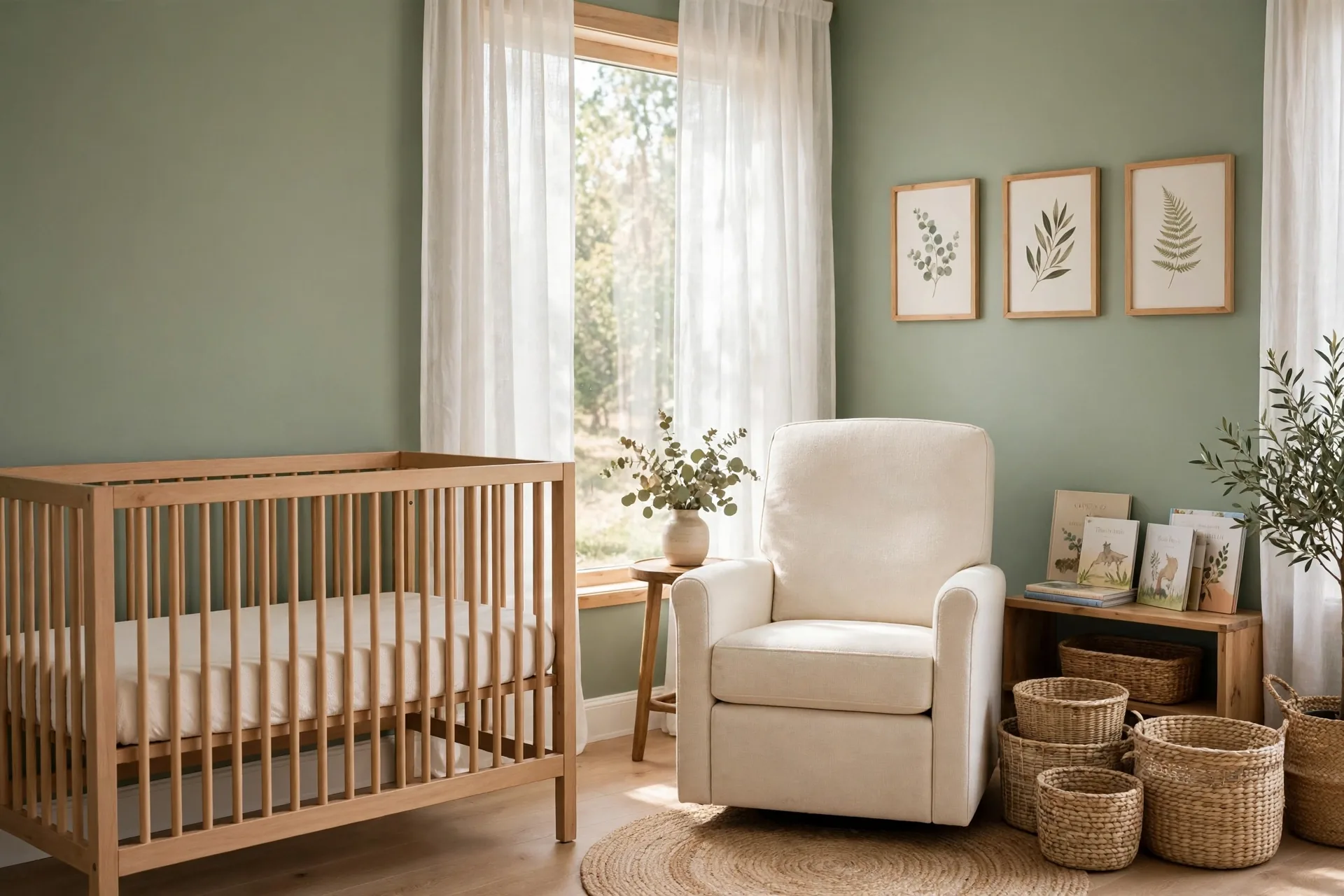
Somewhere around the seventh month, the nursery stops being a Pinterest board and becomes a question: where does everything actually go? Here is the honest starting point most guides skip. Your baby will most likely sleep in your room for the first months anyway, and the nursery you use at 3am — half asleep, baby in one arm — matters far more than the one that photographs well at noon. So this guide builds the room the way you will live in it: a sleep zone, a feeding corner, a changing station, and storage that survives real life. The pretty part comes after — and it absolutely still comes.
Both of my babies started in a bassinet beside our bed, and the nursery grew up in stages around them. That is not a compromise; it is the sensible order. Zones first, crib bare, furniture anchored, theme last. These 46 ideas follow that order.
Affiliate disclosure: This post contains affiliate links. If you buy through them, we may earn a small commission at no extra cost to you. It keeps MamaKinder running — thank you.
Start With the Layout: Four Zones, Not a Theme
Before you pick a paint color, decide where four things happen: sleeping, feeding, changing, and storing. Walk the room and assign each one a home, even if “zones” means four corners of one small room. Sleep goes on the quietest wall, away from the door swing. Feeding wants a corner with room for a chair and a small table. Changing works best on top of a dresser, so the storage lives inside the same furniture. Everything else — rug, art, theme — layers on top of that skeleton.
Choosing the room itself comes first, though. Our guide to which room should be the nursery walks through the seven things that decide it — distance from your bed, street noise, morning sun, and the floor the laundry lives on. Pick the room for 3am you, not for the photos.
The Sleep Zone
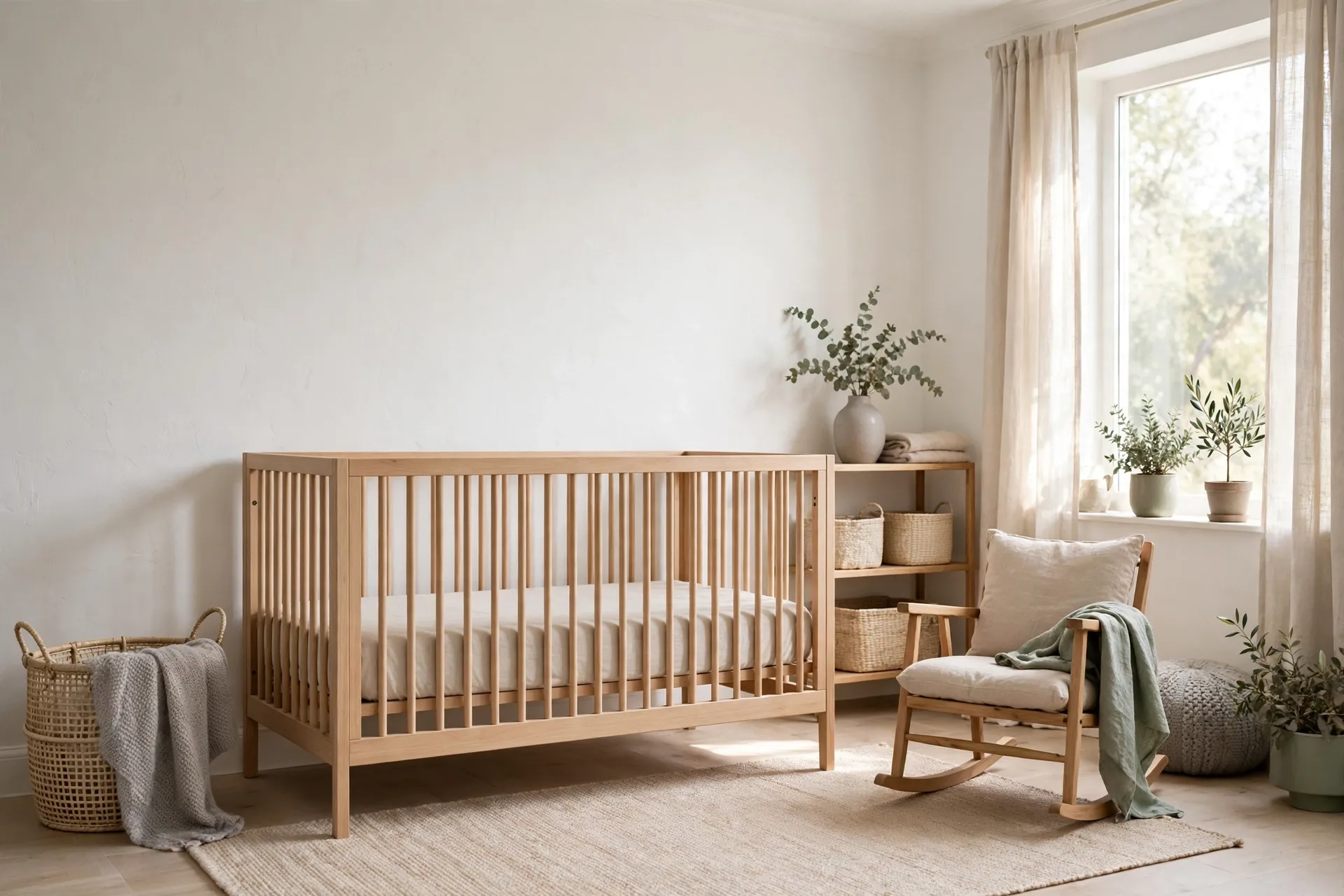
1. Place the crib on an interior wall, away from windows
The crib’s address matters more than its style. Put it against an interior wall, away from windows — window coverings come with cords, older windows can be drafty, and a climbing toddler plus a window is a combination nobody wants. Keep it clear of radiators and direct sun. Everything else in the sleep zone arranges around this decision, so make it first and make it boring.
2. Keep the crib bare — this is the hill to die on
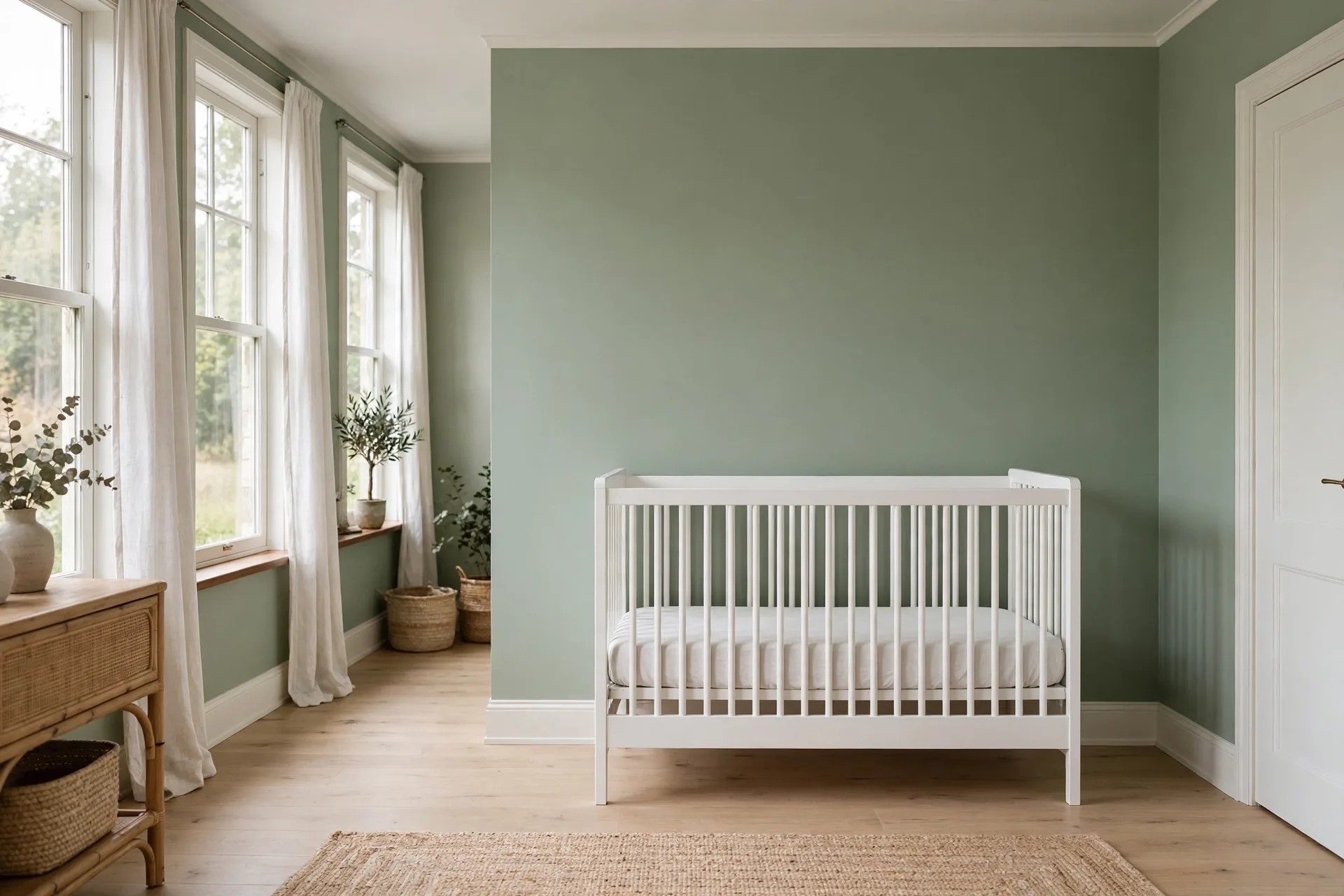
A safe crib looks empty, and that is exactly right: a firm, flat mattress with a fitted sheet, and nothing else. No bumpers, no pillows, no loose blankets, no stuffed animals, however beautiful the styled photos look. Babies sleep safest on their backs, on that firm flat surface. Stock two or three fitted sheets so a 2am leak never means laundry math.
3. Blackout the windows for daytime naps
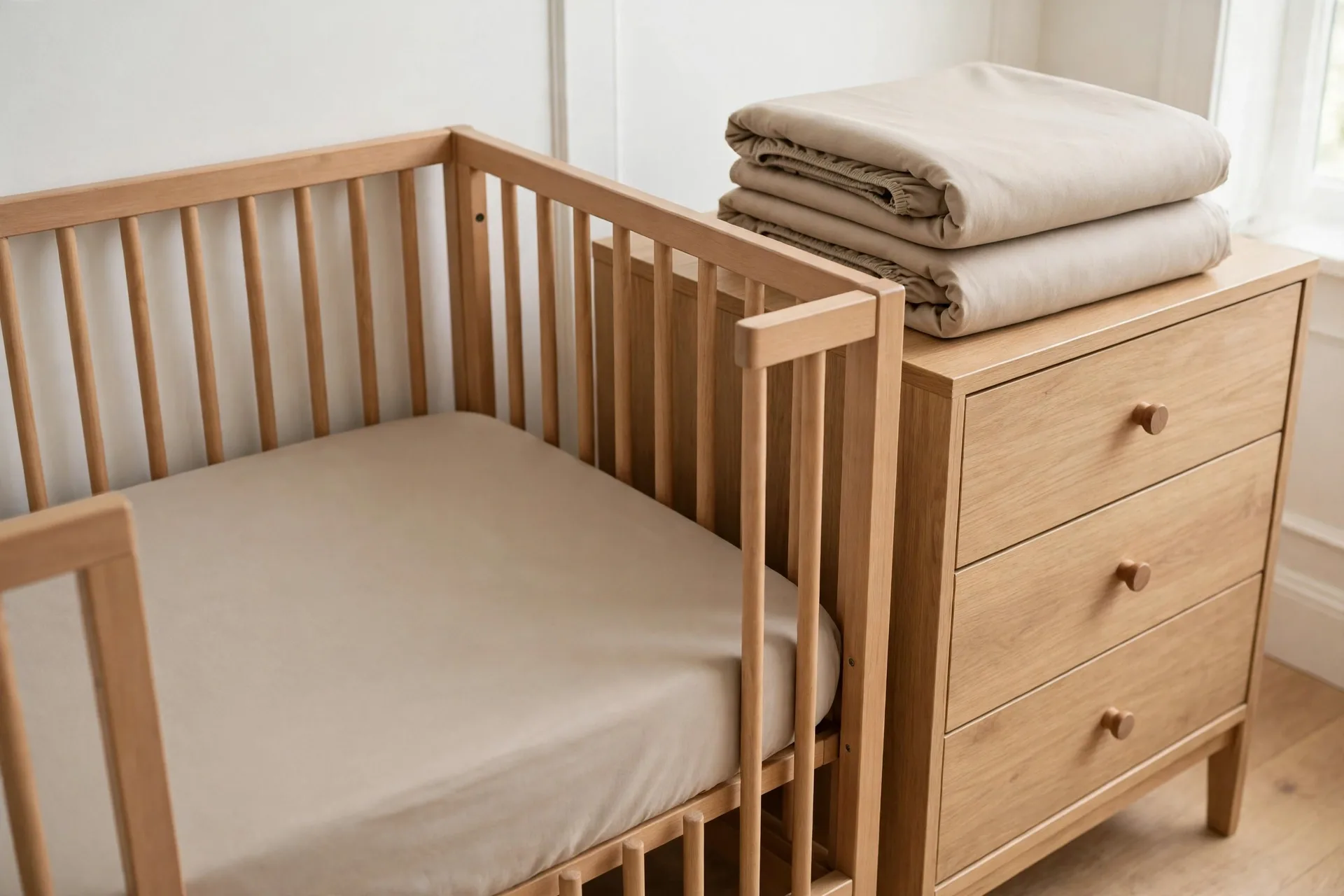
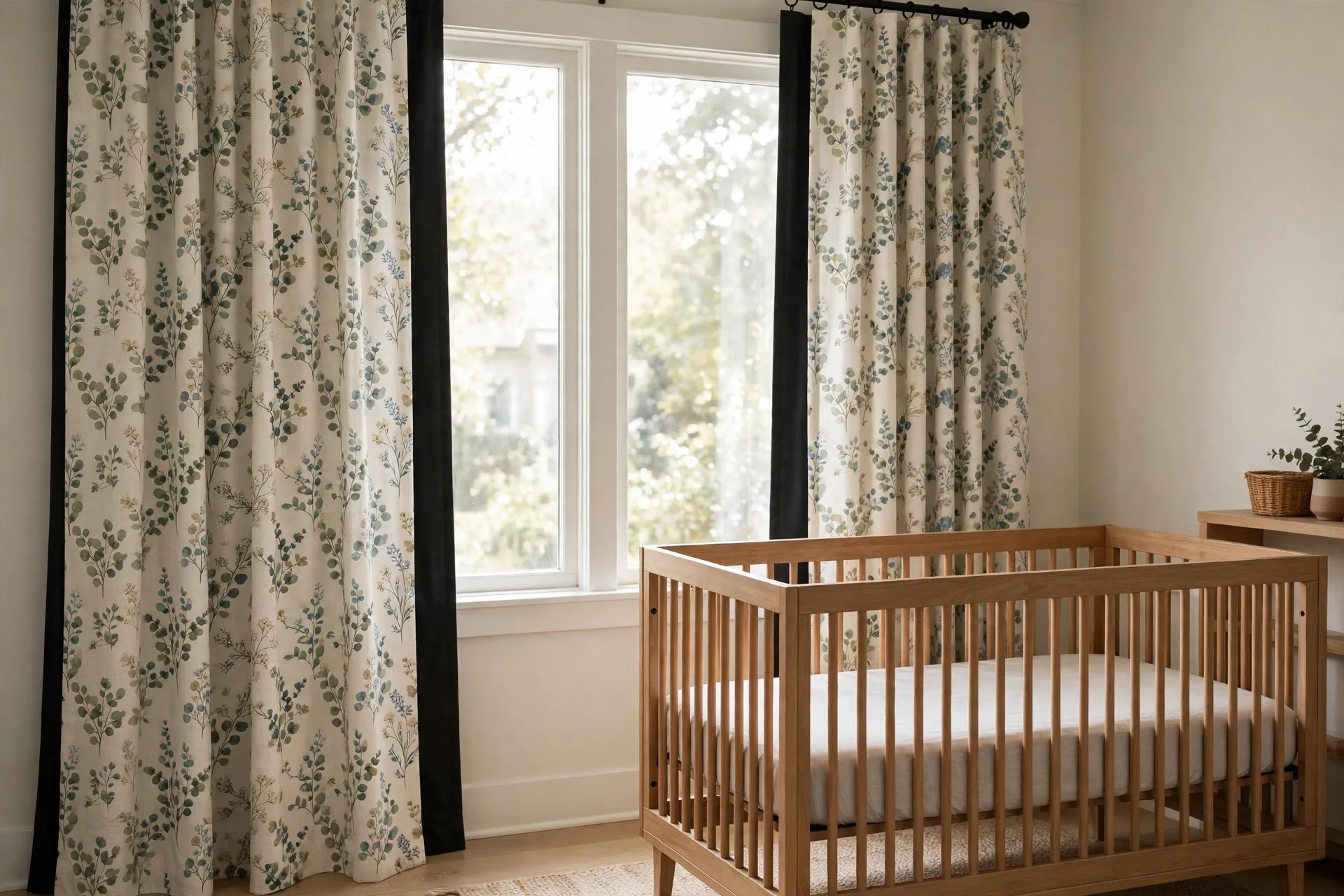
Once naps become a schedule, light is the enemy. Blackout curtains or a blackout blind turn a bright afternoon into nap darkness, and thermal-lined panels take the edge off street noise. My shortlist starts with these NICETOWN blackout curtains — a two-panel rod-pocket set, thermal insulated, machine washable. One safety rule rides along: cords stay completely out of reach, always — with looped cords, choose cordless blinds or keep the crib well away.
4. Add a sound machine, placed across the room
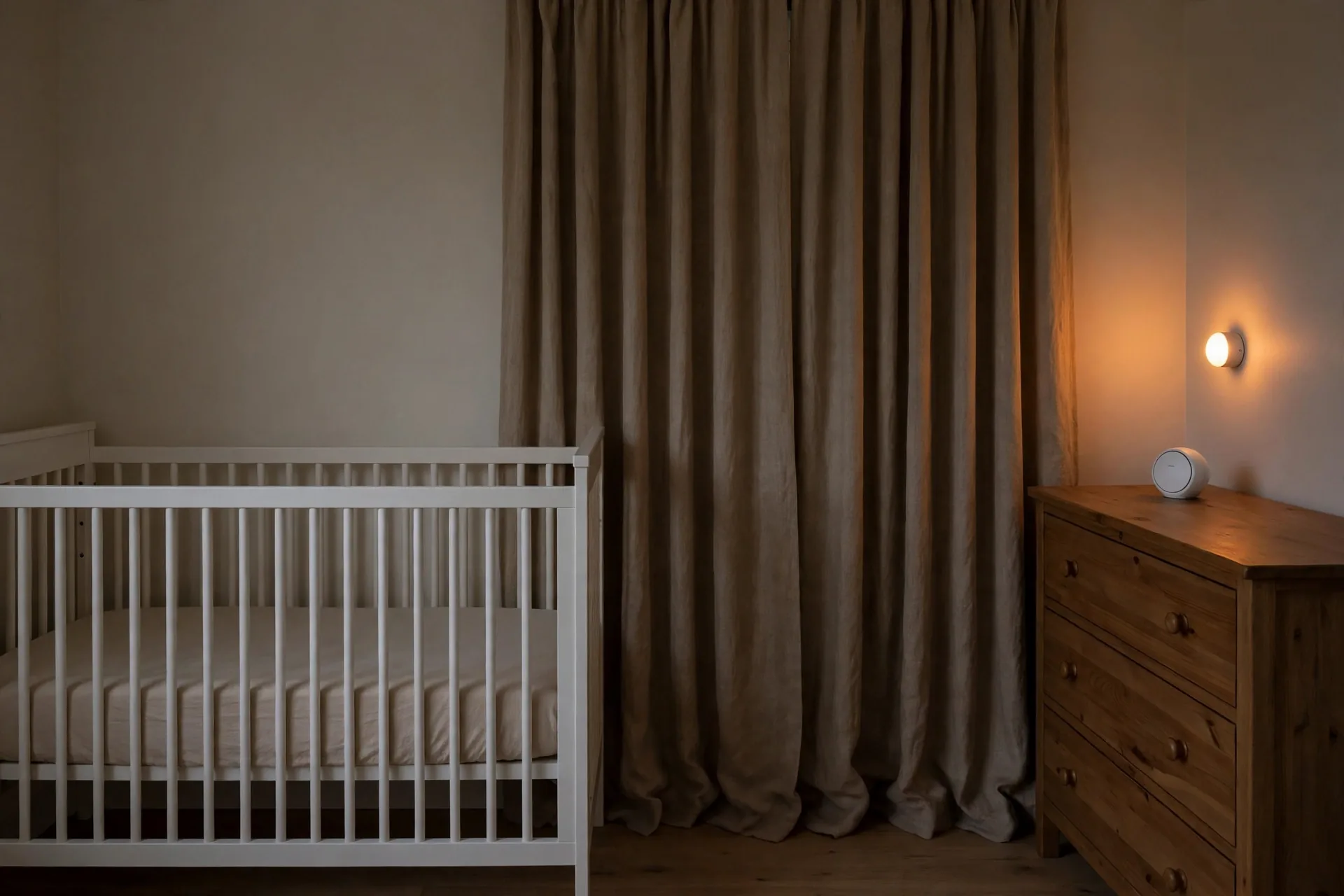
The womb was loud, and total silence is not what most babies settle in. A steady fan sound masks the doorbell, the dog, and the older sibling, and becomes a sleep cue all by itself. The classic is the Yogasleep Dohm — a real fan inside, so the sound has no loops — set across the room from the crib, at the lowest volume that still covers the house noise.
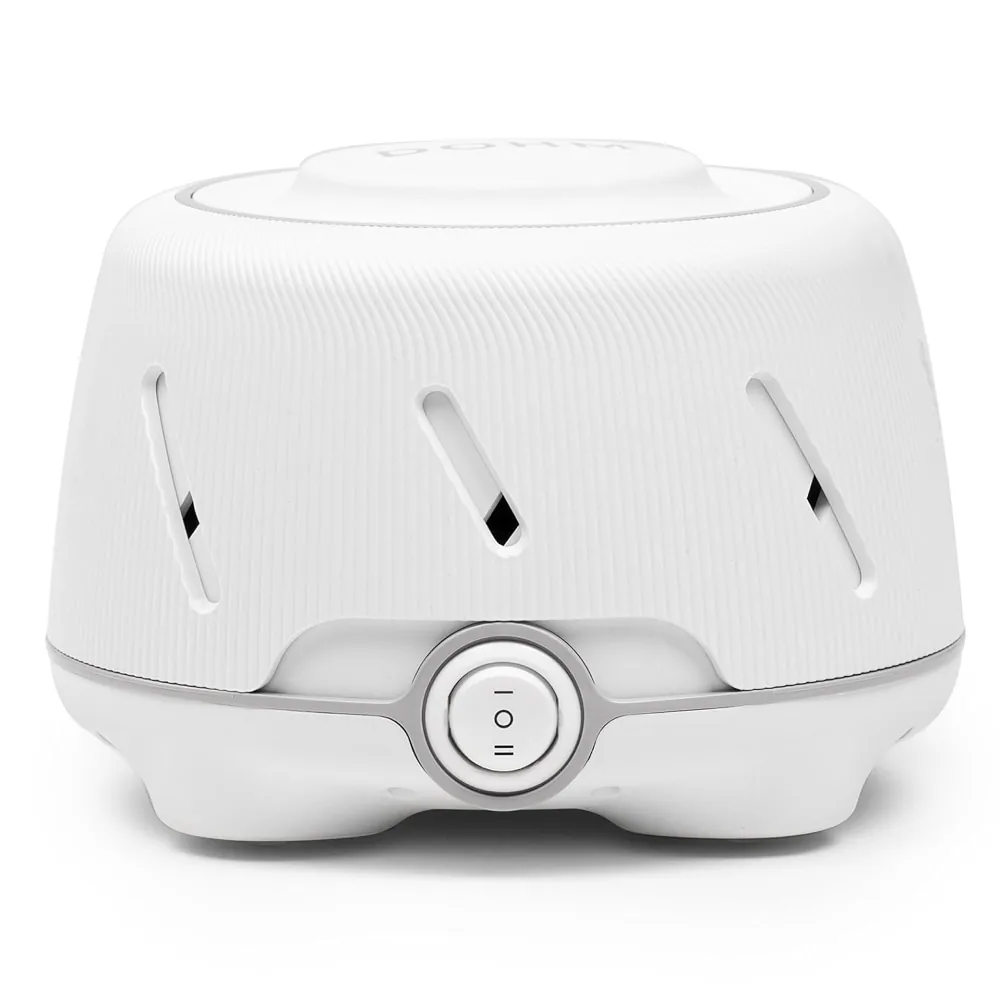
Yogasleep Dohm Classic White Noise Machine
The original fan-based white noise machine, around since 1962: a real fan creates the sound, so there are no loops and no moving air. Two speed settings let you fine-tune the tone and volume, it runs on a 7-foot cord, and it is assembled in the USA. Set it across the room from the crib, at the lowest volume that masks the house noise.
5. Give yourself a warm, dim night light
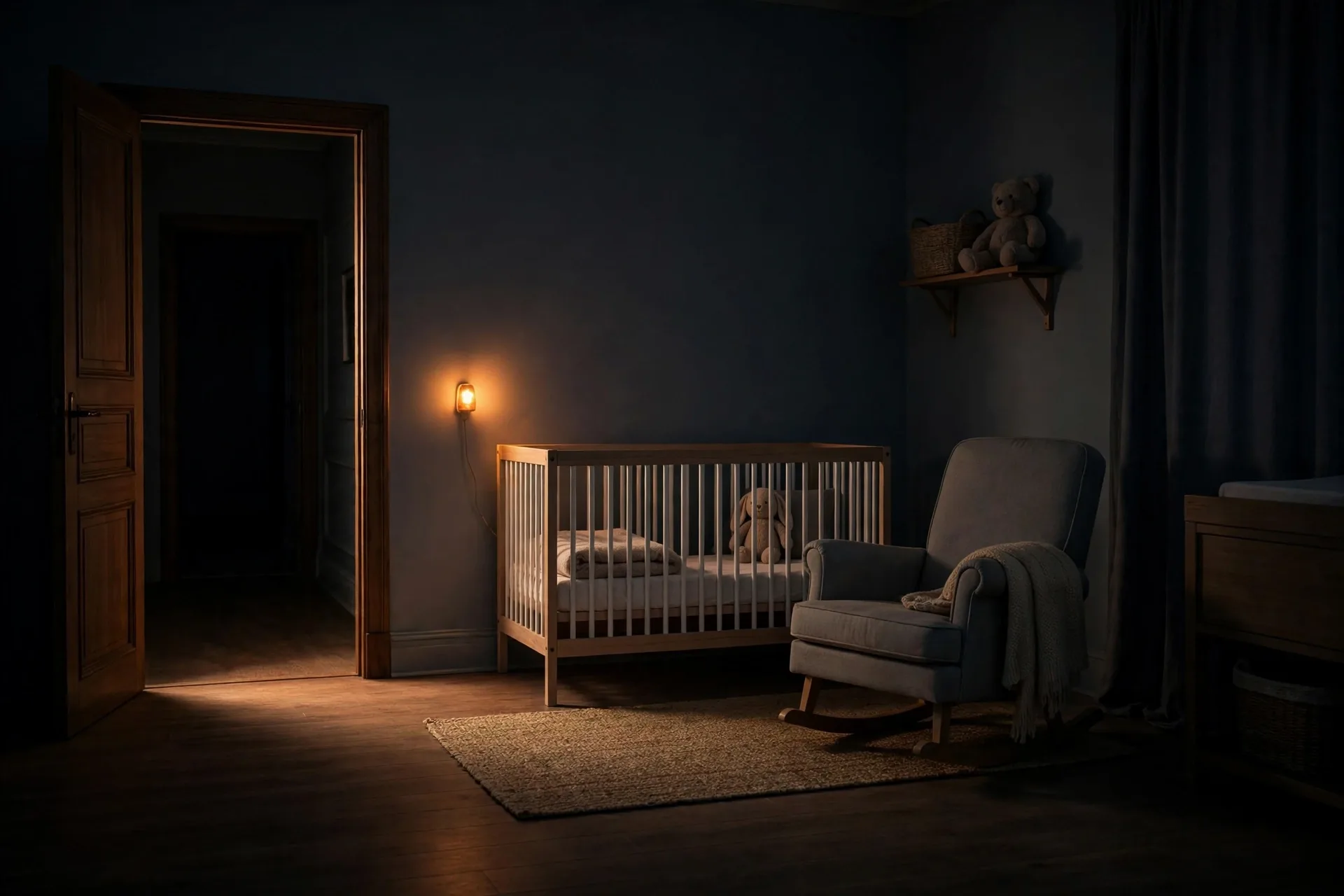
You will do feeds and changes here at hours when overhead light feels like an interrogation. A warm, dim light — a small wall light or low lamp — lets you see without fully waking either of you, and amber tones are kinder than blue-white at 3am. Place it to light the path from door to crib to chair; a touch switch you can work with your elbow counts as genius.
6. Plan the room-sharing months honestly
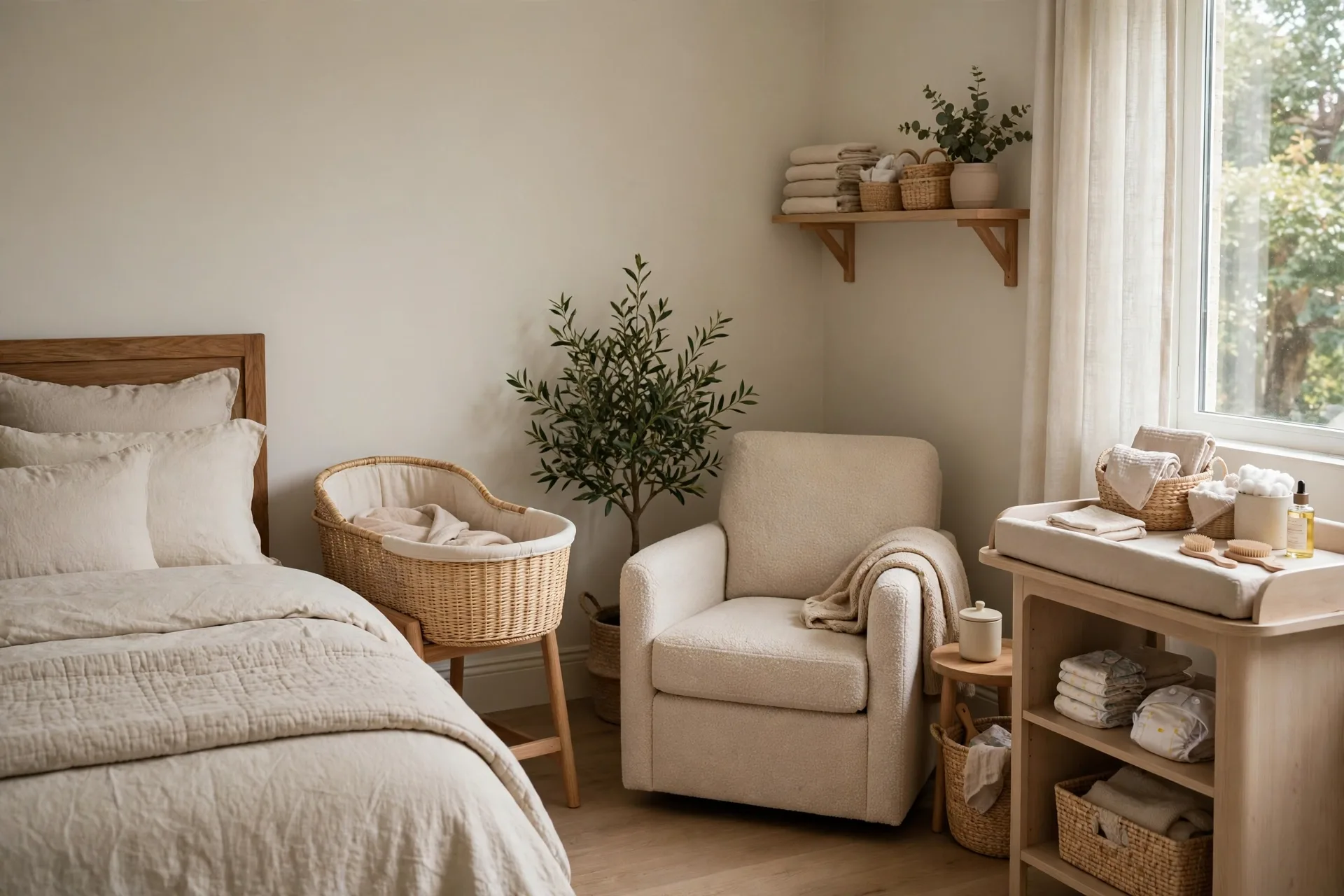
Because most babies start out in their parents’ room, your nursery can phase in: the corner where the bassinet lives now becomes the sleep zone later, and the chair and changing setup earn their keep from day one. Do not pressure yourself to finish by the due date. A working changing station, a comfortable chair, and a safe sleep surface are a complete newborn setup.
The Feeding Corner
7. Choose the chair for your back, not the photos
You will spend hundreds of hours in this chair, so sit in as many as you can before buying. What matters: lower-back support, armrests at a height that holds your arms while you hold the baby, and enough width to shift positions at hour three. A small footstool earns its floor space every night. The prettiest chair in the store loses to the one your shoulders vote for.
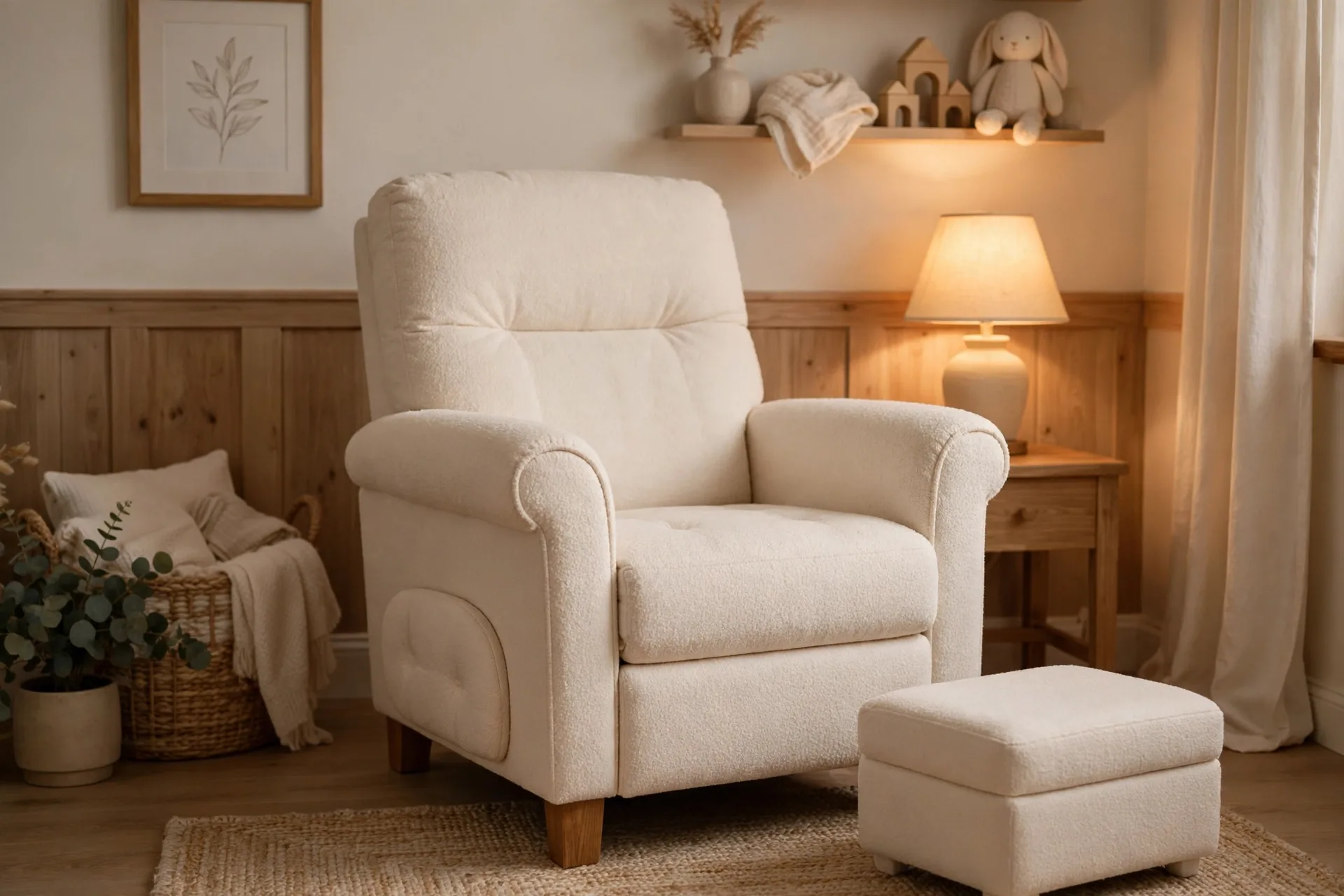
8. Put a table and a lamp within one arm’s reach
Everything in a feed happens one-handed, so the side table is load-bearing furniture: water bottle, burp cloth, your phone, the book you swear you will read. A small warm lamp on it — or the night light from idea 5 doing double duty — means never choosing between the overhead light and the dark. If the table has a lower shelf, that is where the spare burp cloths live.
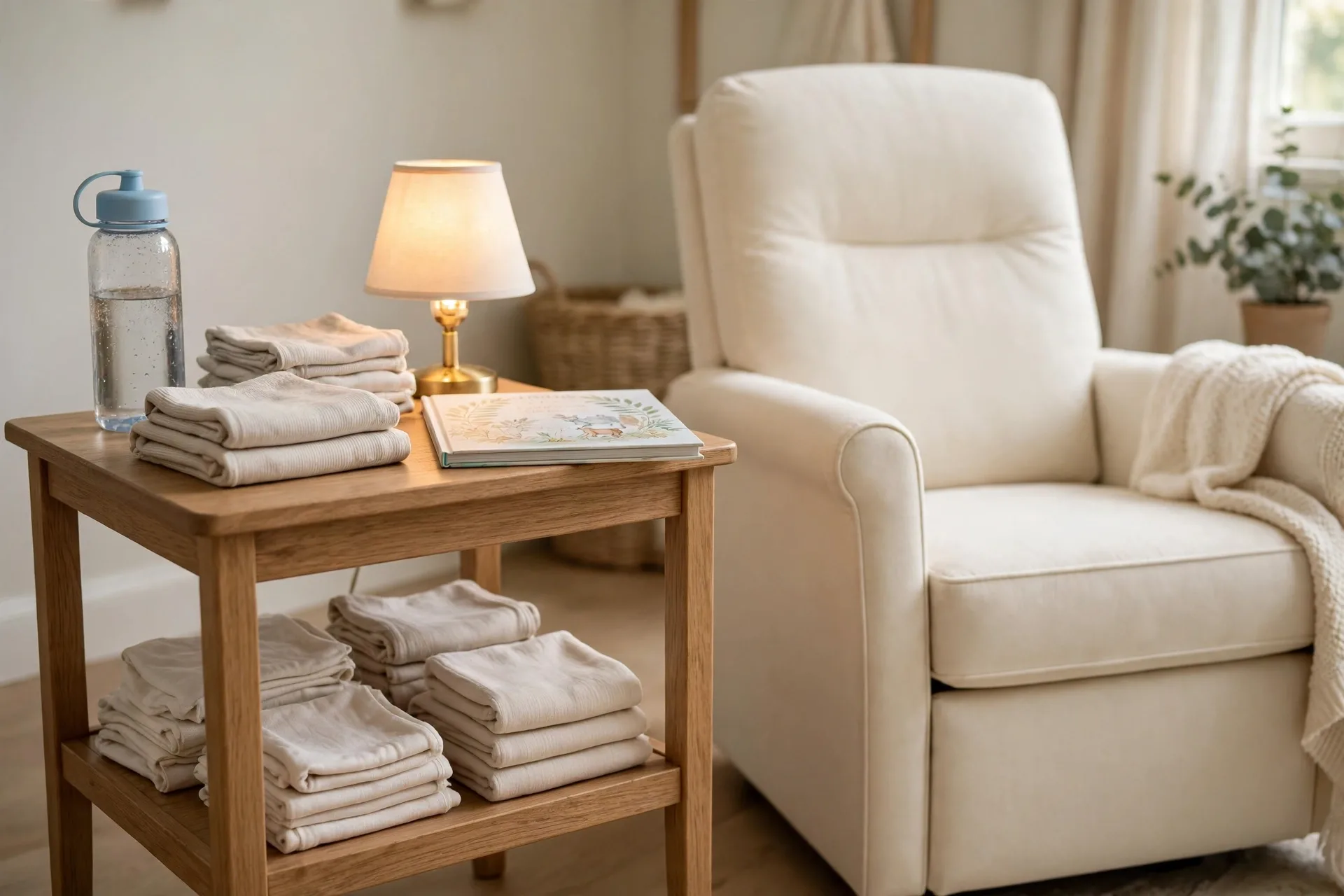
9. Keep a feeding basket stocked at the chair
One basket, always in the same place, restocked during the day: burp cloths, a water bottle, a snack bar for you, nipple cream or bottle parts, a hair tie. It sounds small until a growth spurt turns feeding into a marathon and everything you need is within reach. If the basket travels to the couch by day, it comes home to the corner at night.
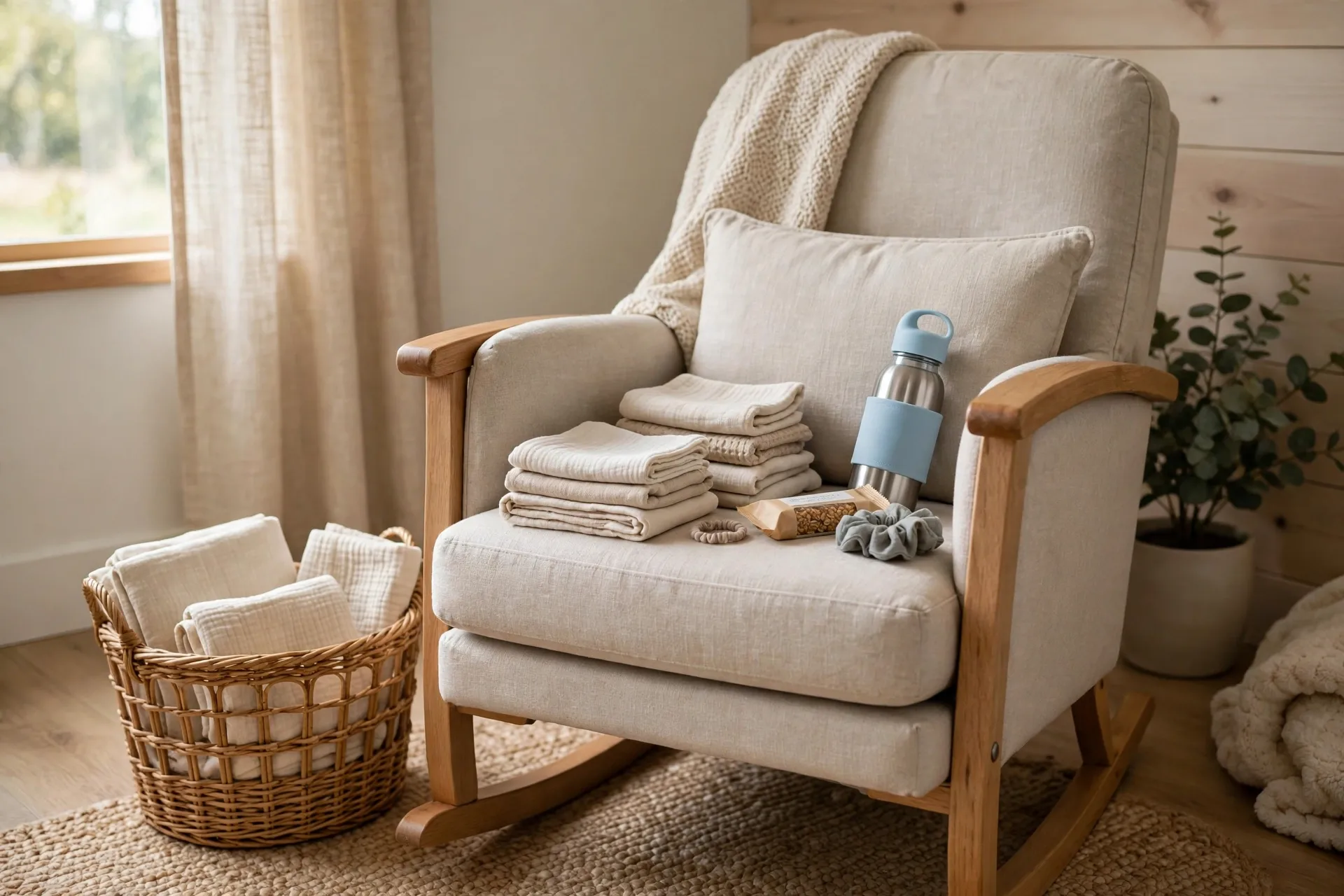
10. Start the first library in the corner
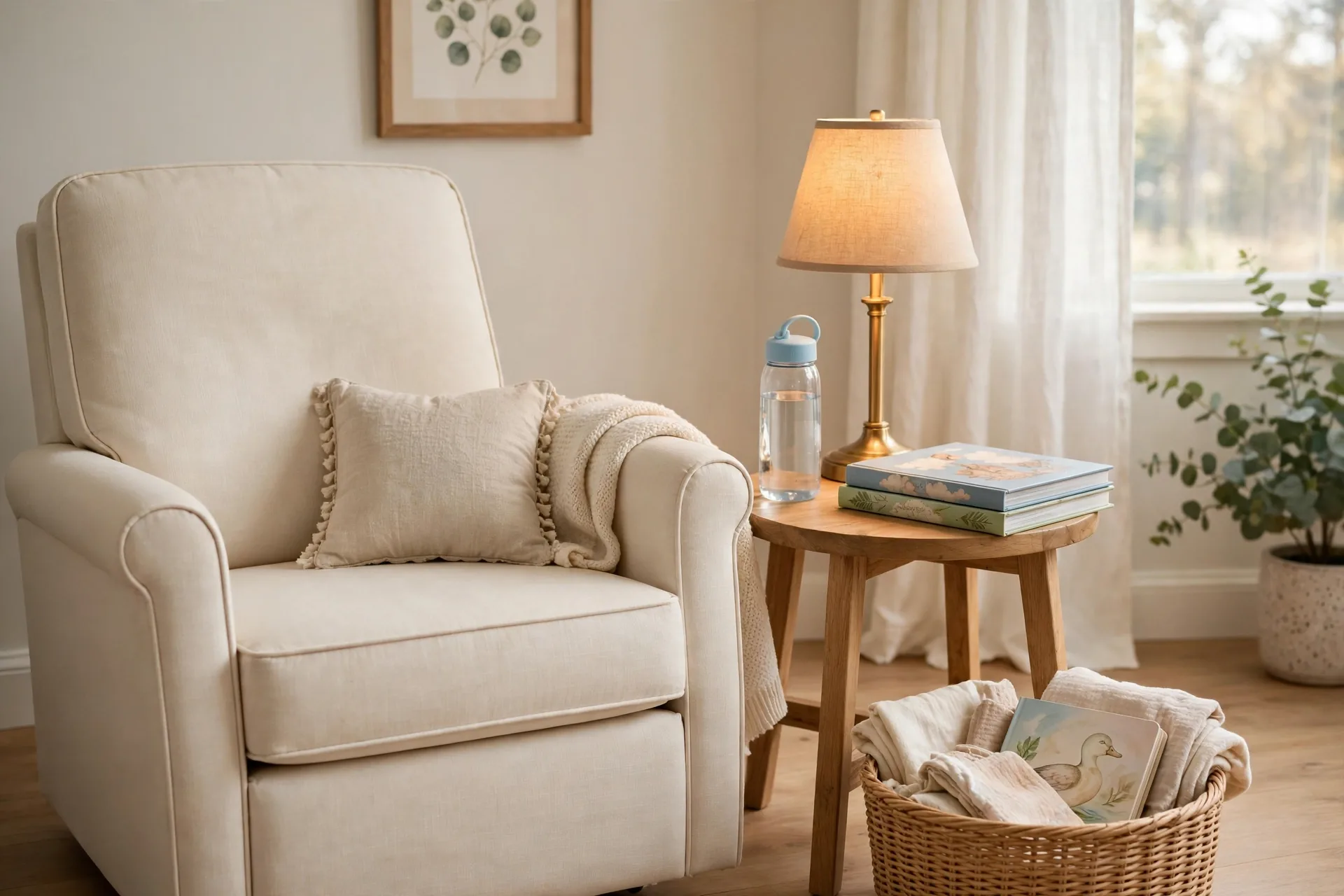
Feeding time becomes reading time sooner than you think, so give the corner a tiny library from the start: a small shelf or basket of board books you can reach one-handed. Reading the same beloved book in the same chair every night becomes part of the wind-down. Ours began with The Night Before Christmas in the big illustrated edition — it comes out in December here, but the ritual it started runs all year.

The Night Before Christmas: The Classic Edition
Clement C. Moore’s beloved poem in the classic Charles Santore illustrated hardcover, the big, beautiful edition made for reading aloud in a chair with a small audience. A first-library anchor, and the start of a nightly ritual.
Changing & Storage That Survives Real Life
11. Change on the dresser, not on a changing table
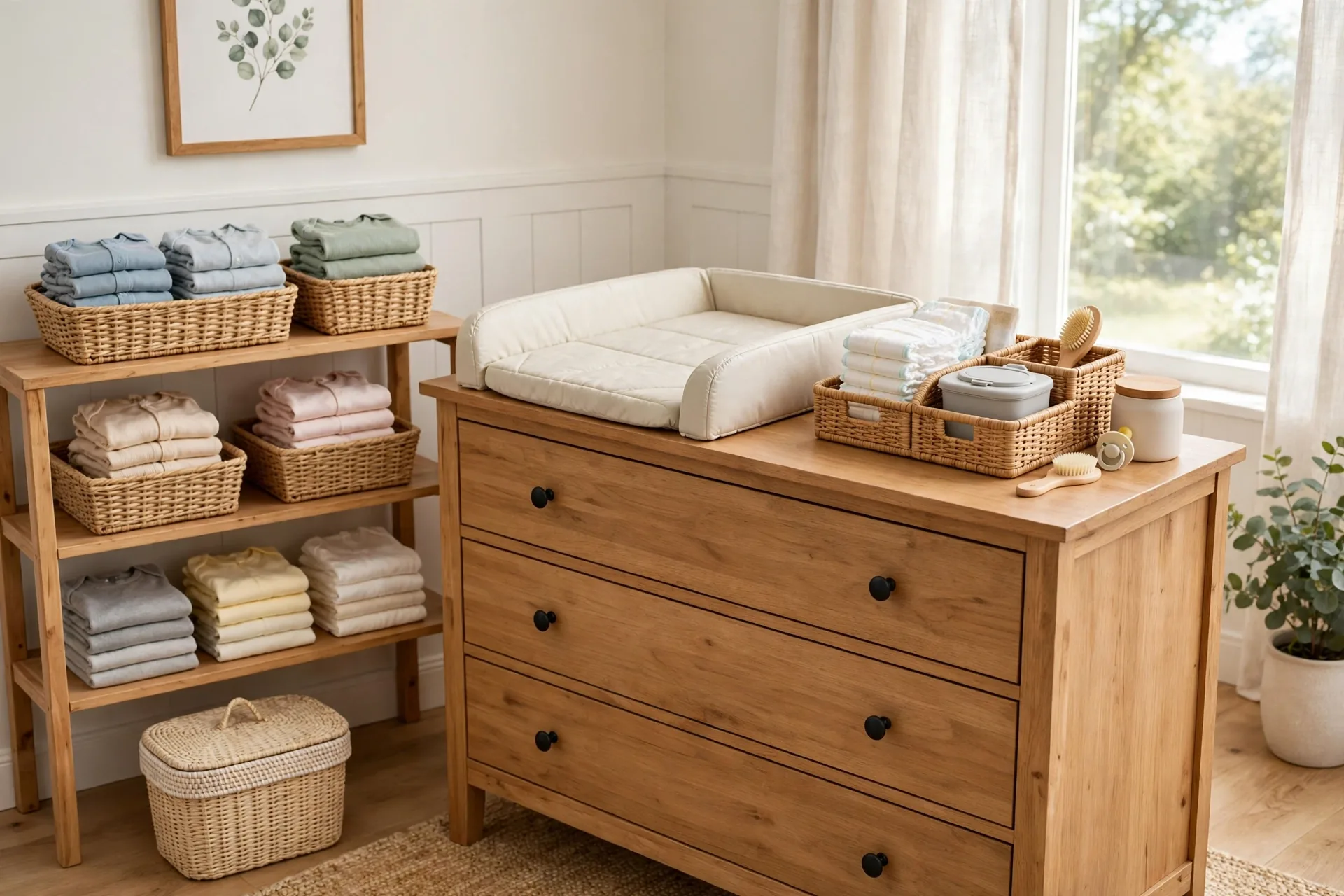
A wide dresser with a changing pad or topper on top beats a dedicated changing table for one reason: when the diaper years end, you still own a dresser. The pad goes at a height that saves your back, the top drawer holds the current diaper size and clothes, and nothing about the setup expires. Choose a dresser you genuinely like — it is the hardest-working piece in the room.
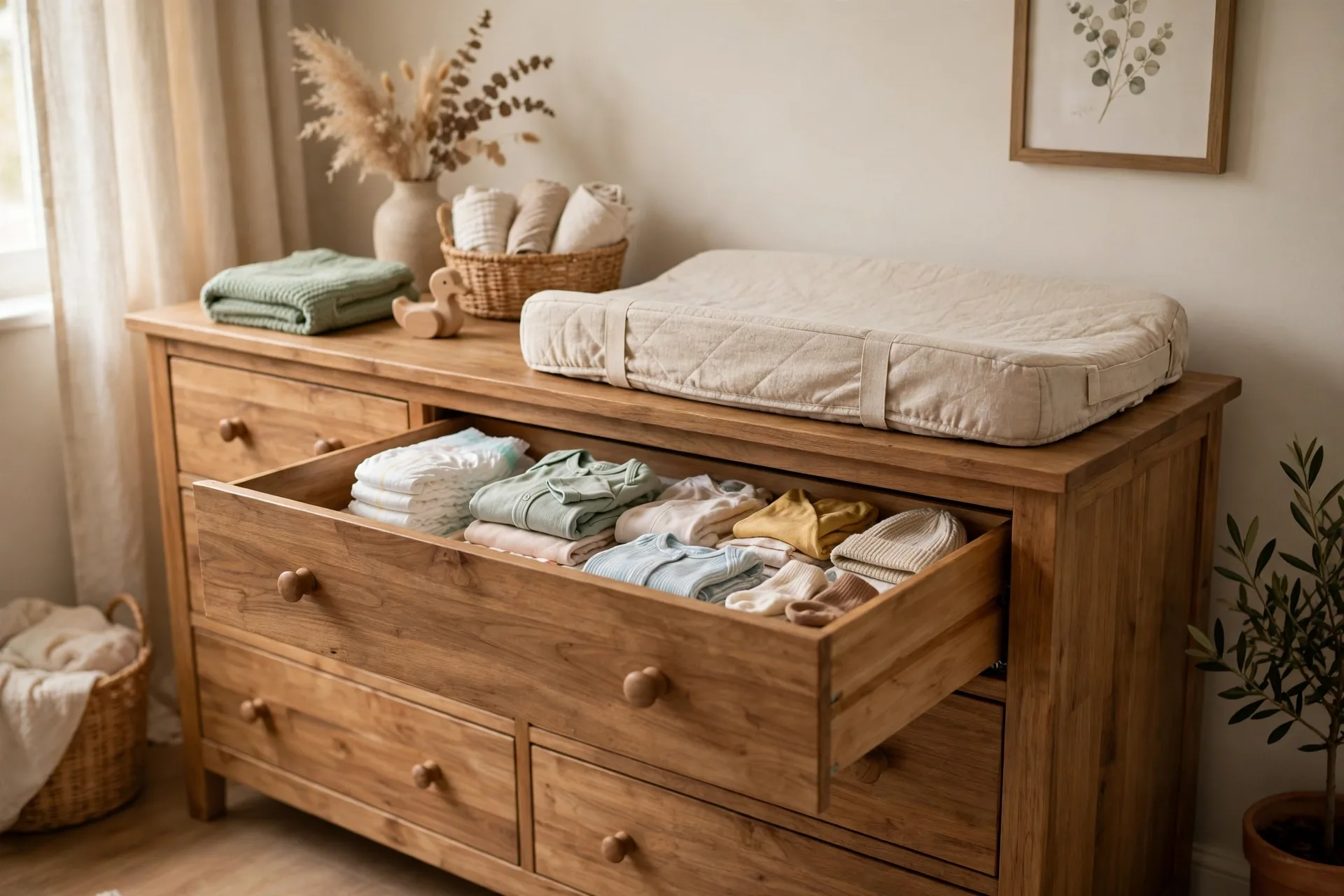
12. Keep everything within arm’s reach of the pad
The rule of the changing station is simple: a hand stays on the baby, so everything the change needs lives within arm’s reach — diapers, wipes, cream, a change of clothes for the inevitable blowout. A small caddy on the dresser top corrals it all. If you have to step away mid-change, the baby comes with you, every time. Set it up like a cockpit and 3am changes become muscle memory.
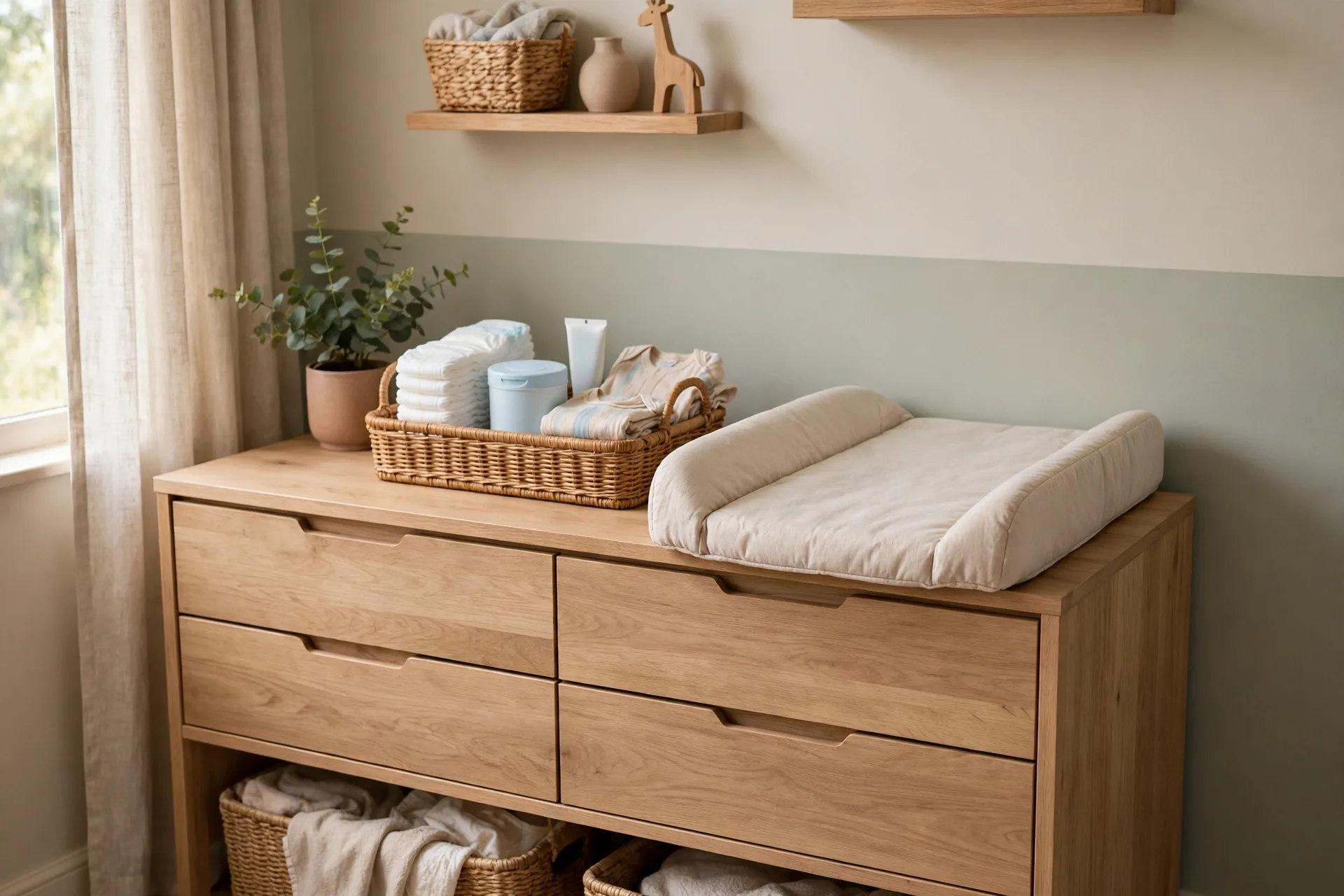
13. Sort clothes in baskets by size, not by outfit
Babies outgrow sizes faster than outfits wear out, so store clothes by size in open baskets or drawer dividers: current size in front, next size behind, outgrown behind that. When a size turns over, one basket swaps out — no refolding marathon. Open storage wins in this season of life because you can see everything and grab one-handed.
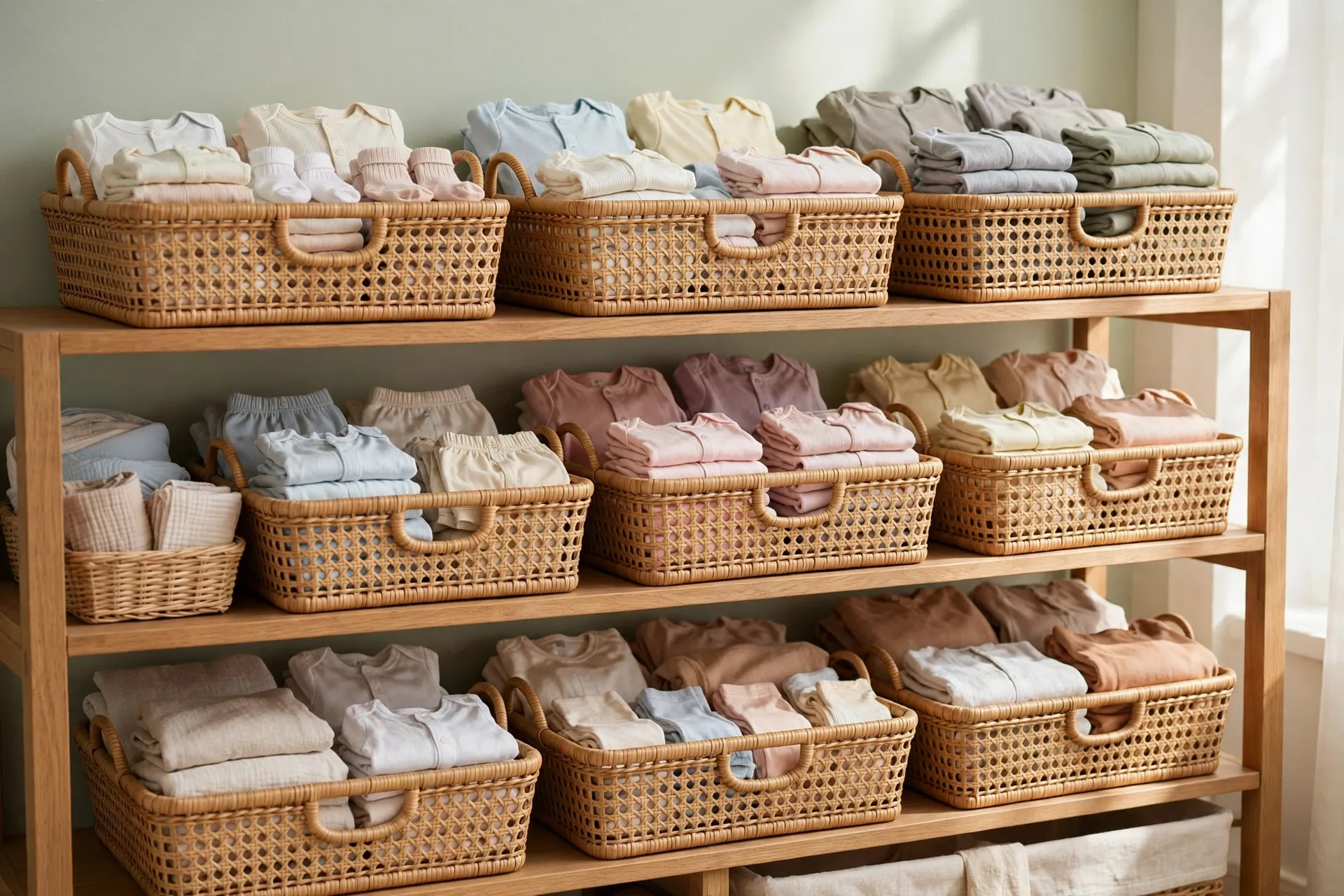
14. Give laundry and trash a home at the station
A small lidded hamper within tossing distance of the changing pad, and a small trash bin beside the dresser for wipes and packaging, will save you a hundred nightly trips. Nursery laundry is constant and tiny; when the hamper lives at the station, dirty clothes never colonize the feeding chair. Small, unglamorous, completely transformative.
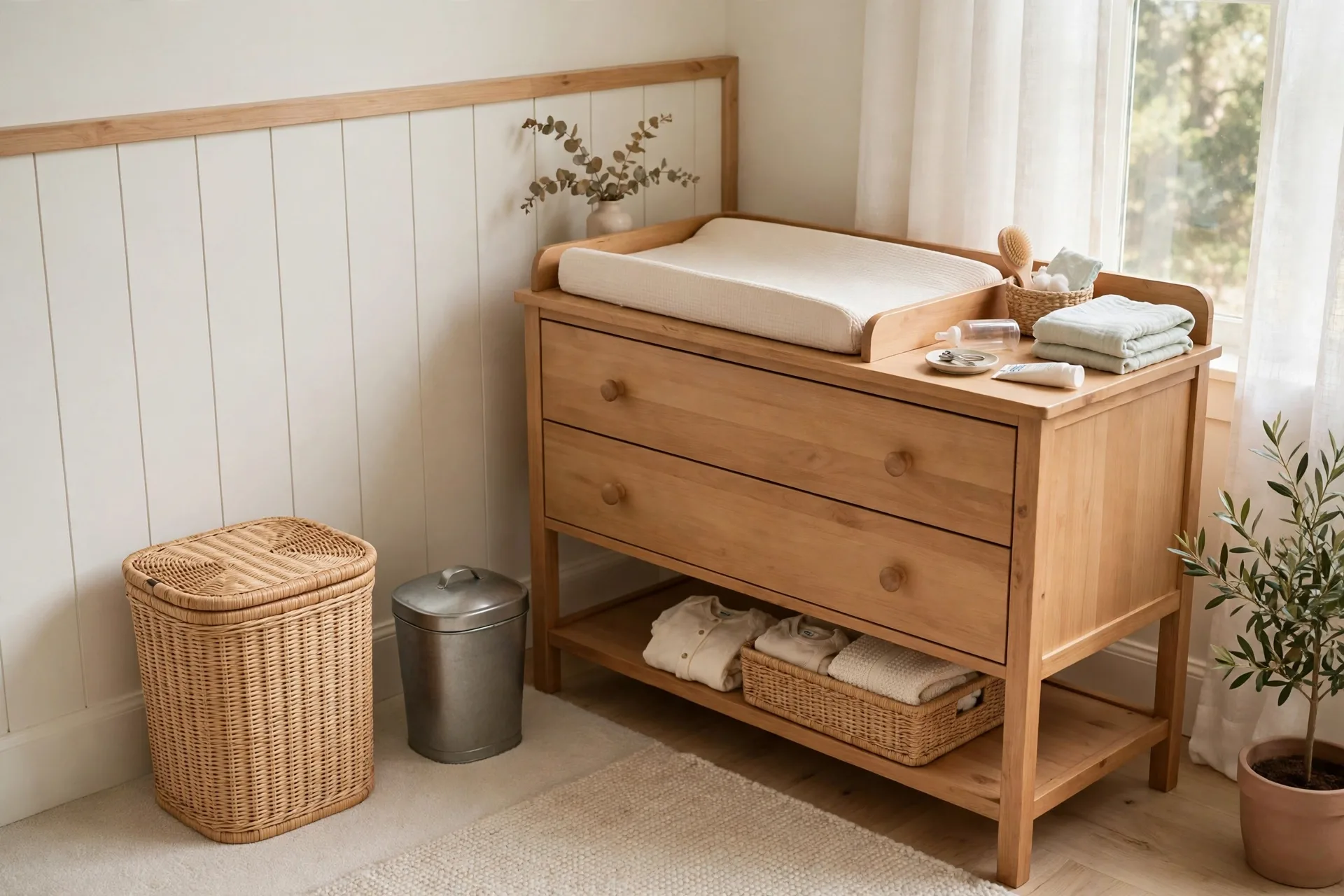
15. Anchor the dresser, the shelves, and the bookcase
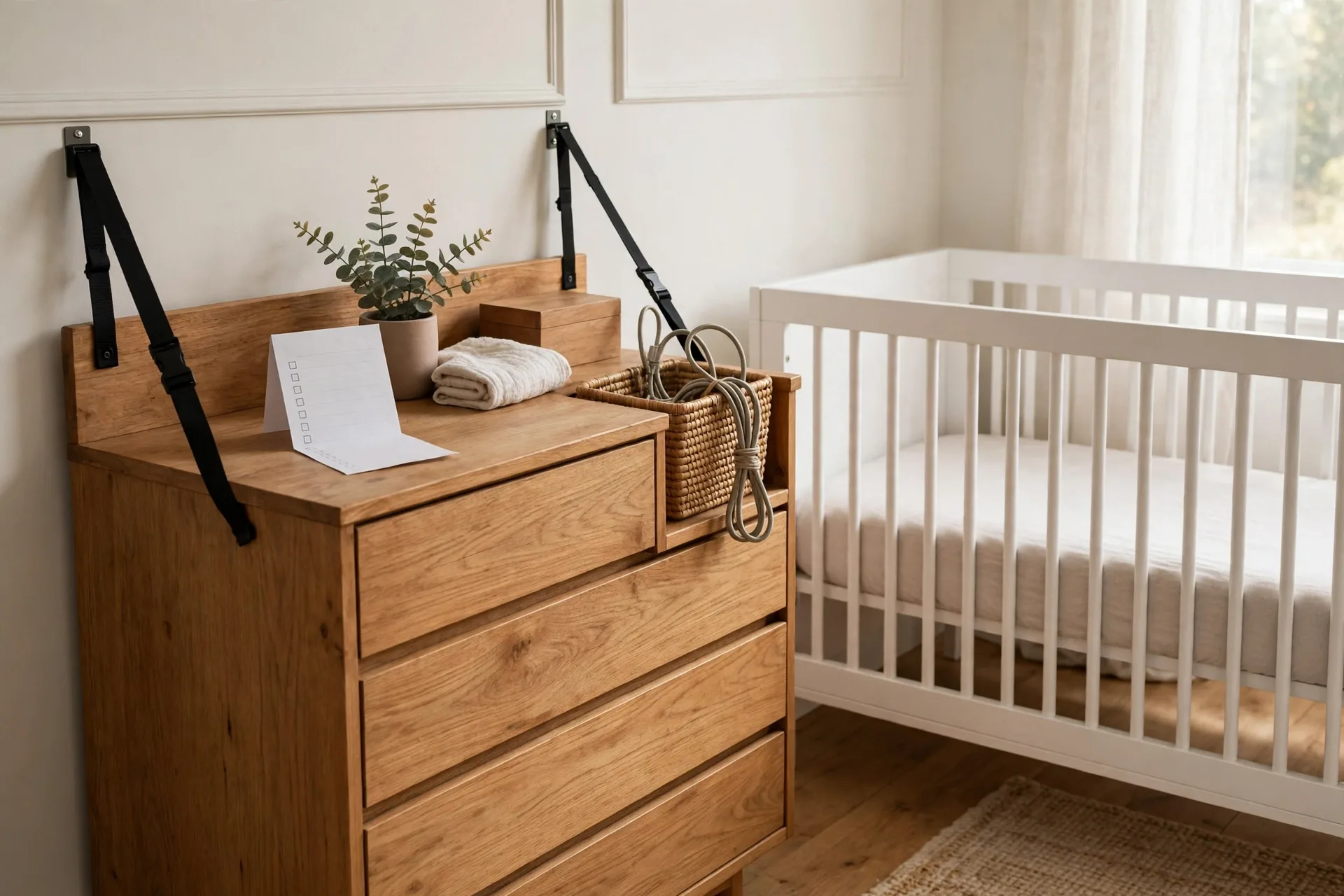
Here is the storage idea that is really a safety idea: every tall or climbable piece — dresser, bookcases, shelving units — gets anchored to the wall with anti-tip straps the week it enters the room, not when the baby starts pulling up. Drawers are ladders to a determined toddler, and dressers tip. Twenty minutes a piece, while the tools are already out.
The Look: Color, Theme & Texture
16. Start with a neutral base that can grow
Paint and the big pieces are the expensive layer, so keep them neutral — warm white, soft beige, gentle gray, sage — and let color live in the things that are cheap to change. A neutral base also survives the unknown: if you are keeping the baby’s sex a surprise, our gender neutral nursery ideas show how much personality a neutral room can hold. New textiles and art later beat new paint every time.
17. Give one wall the moment
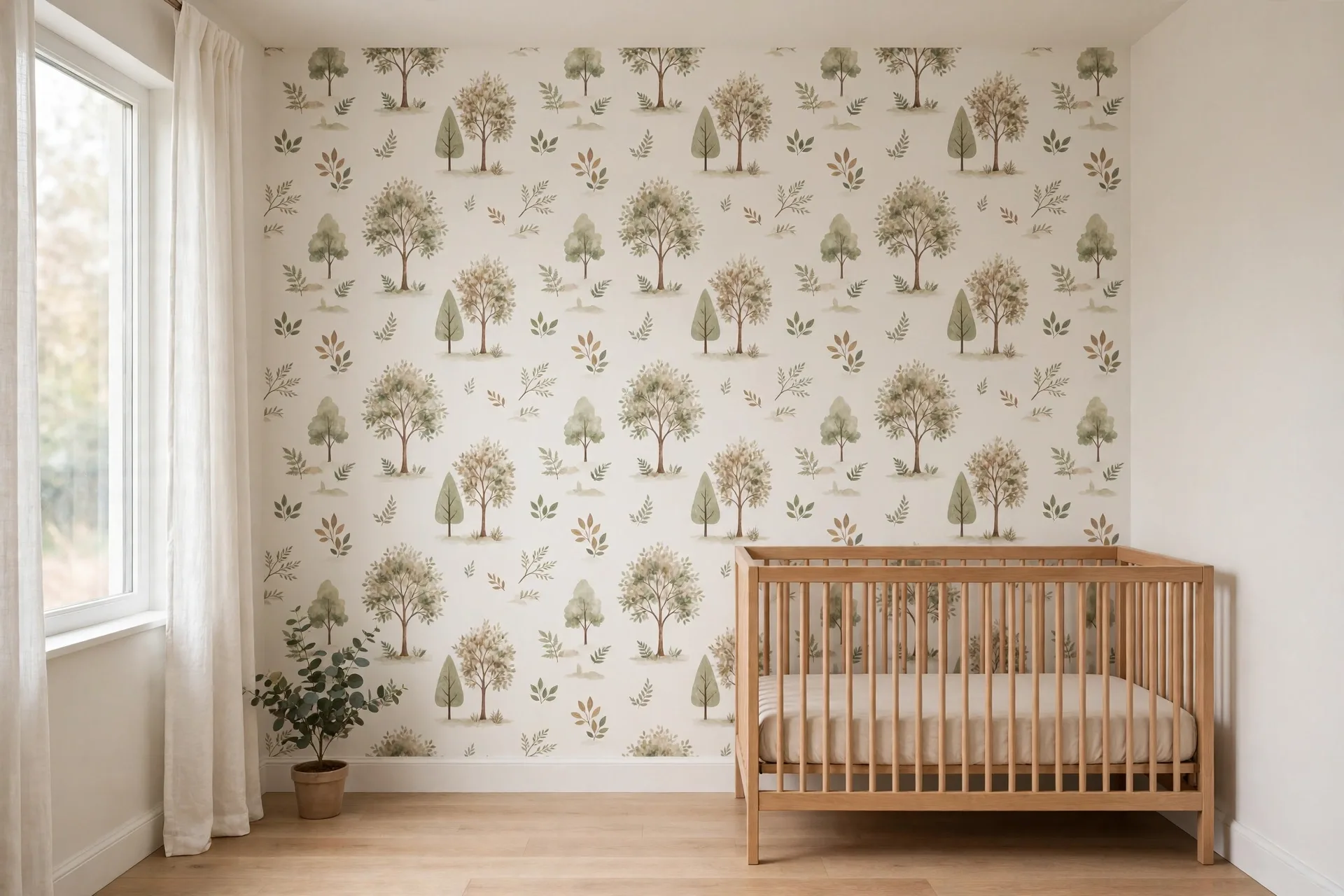
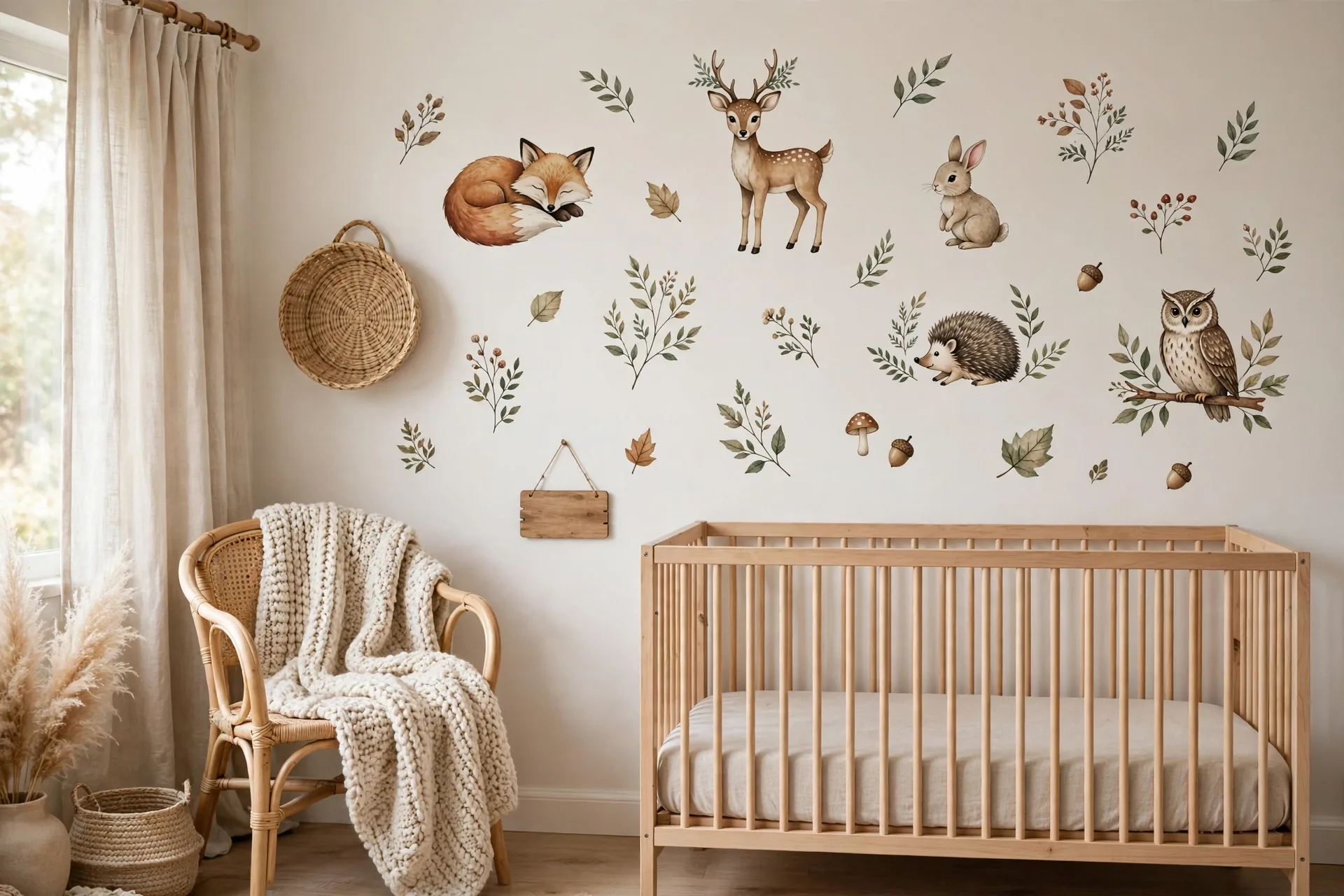
One feature wall carries the whole room’s personality: peel-and-stick wallpaper, a painted arch or color block, or a set of large removable wall decals. Removable is the magic word — renters get their deposit back, and everyone gets to change their mind when dinosaurs replace bunnies. Keep the other three walls quiet so the one wall can be loud. It is also the budget move: one wall of pattern costs a fraction of four.
18. Pick a theme-lite, not a theme-everything
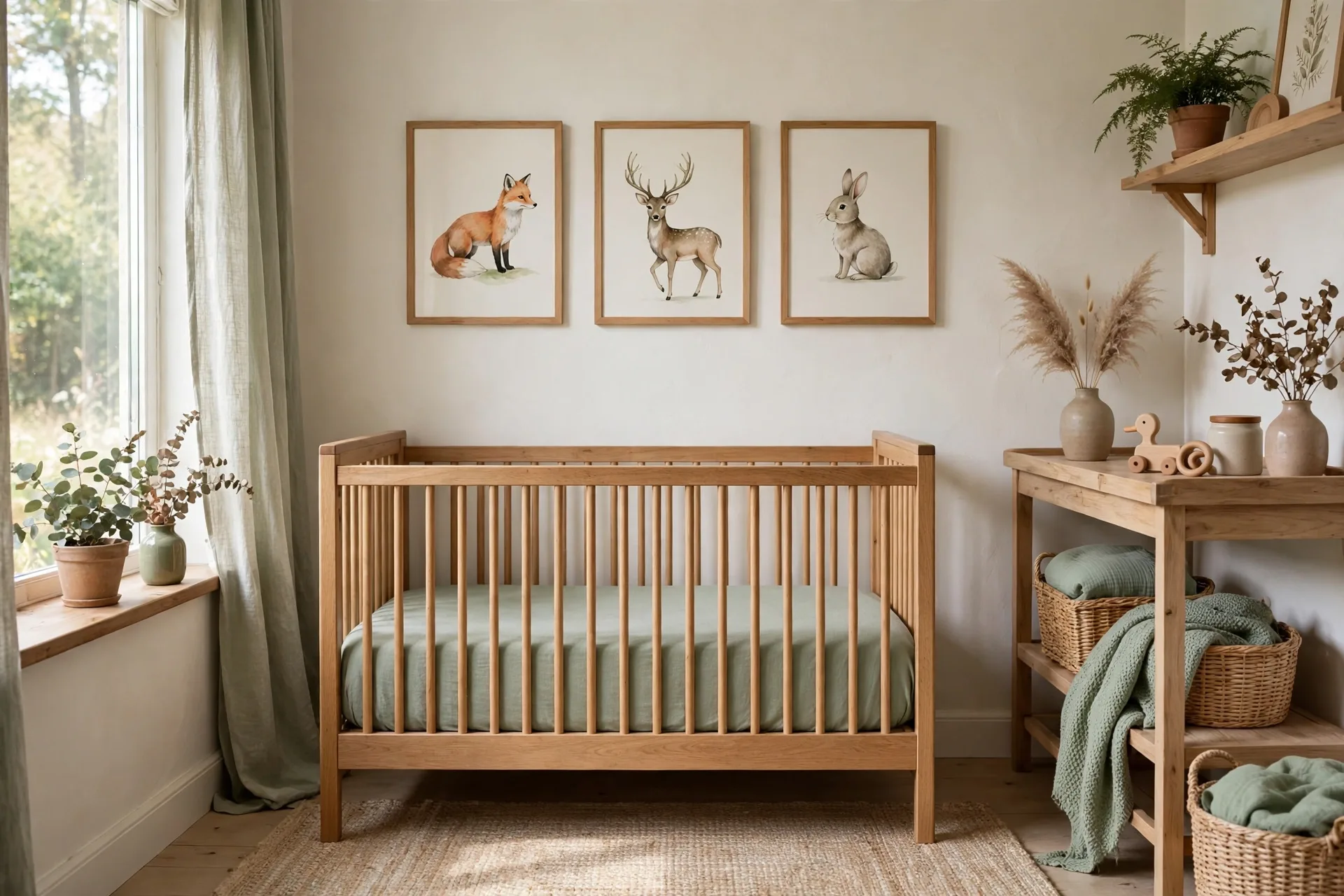
The rooms that age best borrow a theme instead of marrying it: woodland touches in the art and textiles, a boho layer of texture and natural fibers, a storybook corner — present, but not printed on every surface. Our boho nursery ideas are a master class in this restraint. A theme-lite room bends as your child grows; a full theme has to be evicted, usually at age three, usually loudly.
19. Layer texture where color stays quiet
In a soft, neutral room, texture is what makes it feel finished: a woven rug underfoot, a knit throw on the chair, linen curtains, a rattan basket or two. Texture reads as warmth in photos and in person, and natural fibers in creams and woods all get along without a color scheme meeting. Add it last, in odd numbers, and stop one basket before you think you should.
20. Add the name — beside the crib, never above it
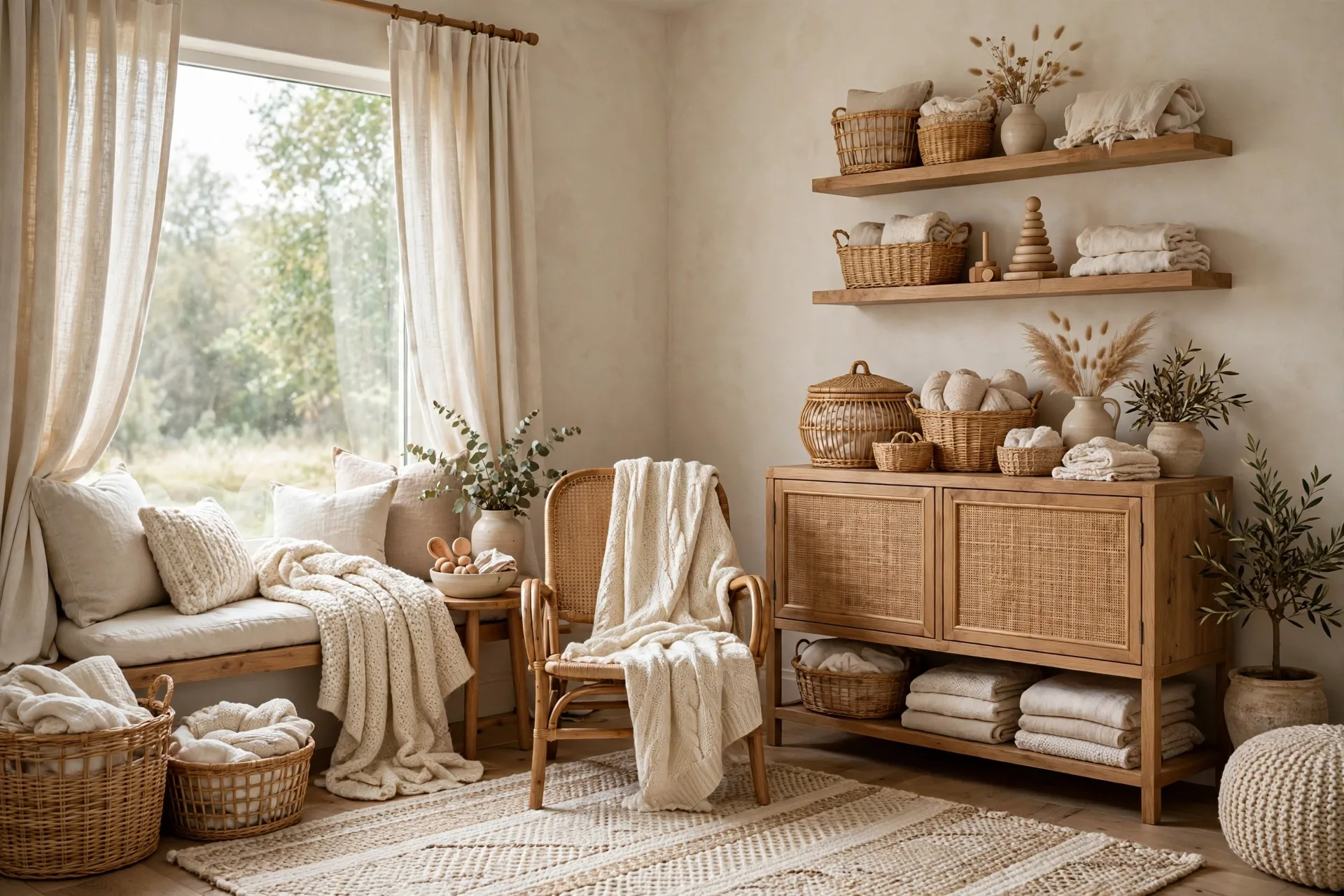
A name sign, initial letters, or a small gallery of family photos makes the room unmistakably your baby’s. Place it with one rule: nothing hangs over the crib. Things fall, toddlers reach and pull, and the wall above the crib stays empty on purpose. The wall beside the crib, over the dresser, or by the feeding chair gives the same moment with none of the risk.
21. Hang high-contrast art at baby height
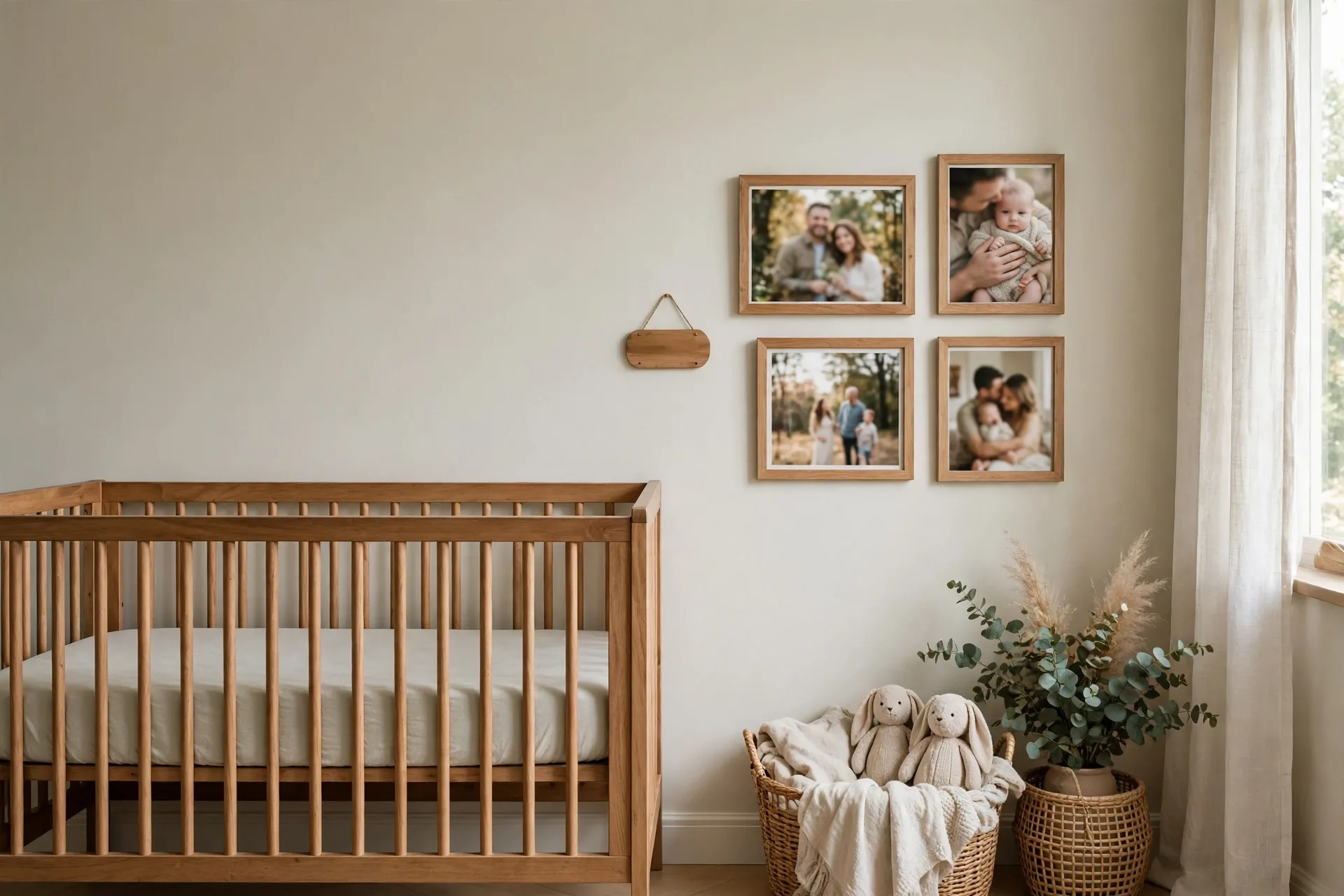
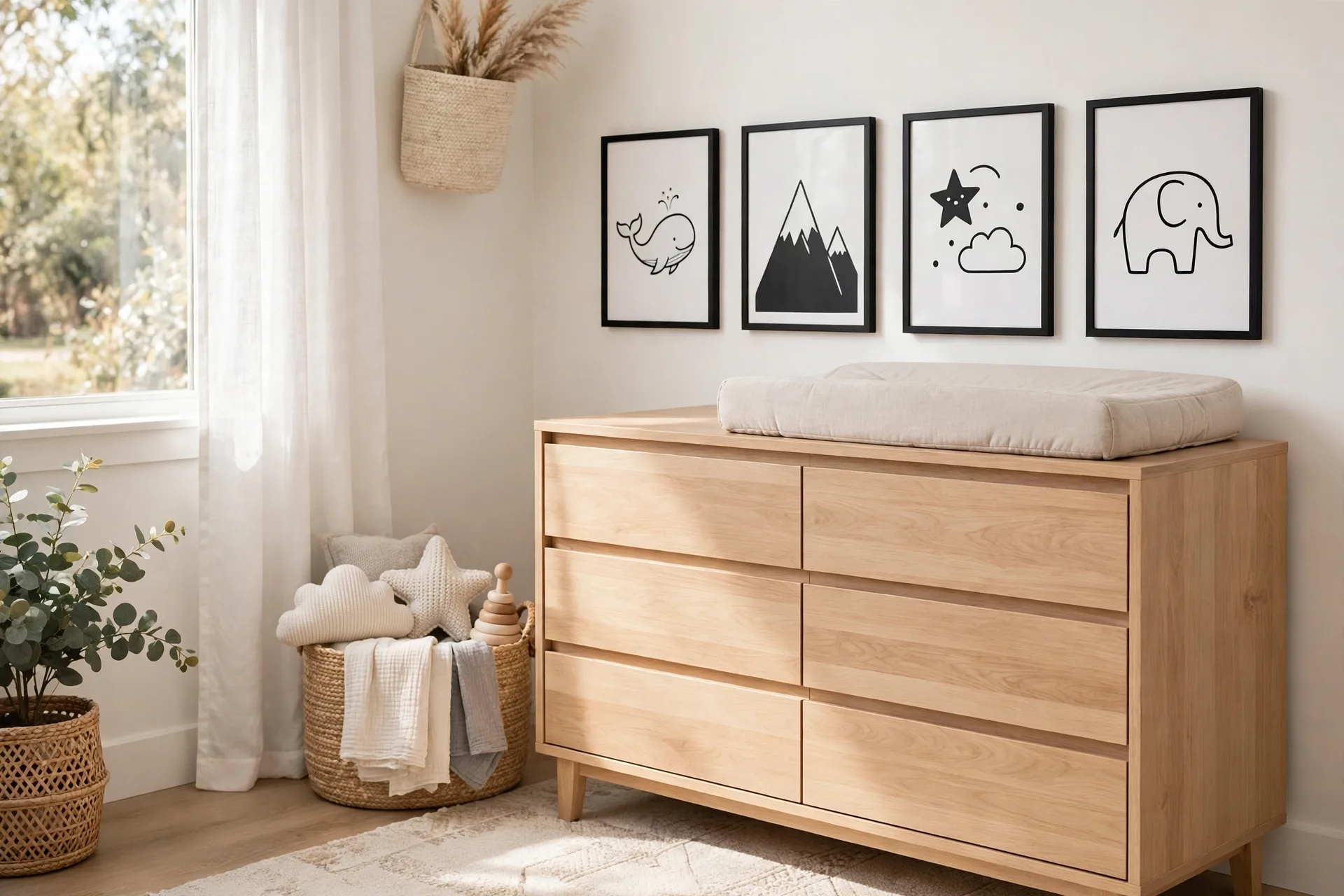
Newborn eyes see bold contrast best, so black-and-white prints, simple shapes, and strong patterns are not just a modern look — they are entertainment with a job. A few high-contrast cards or prints near the changing pad give your baby something fascinating to study mid-change, and the same pieces freshen a monochrome scheme later. Low, simple, and sturdy beats high and precious at this age.
Small Rooms, Shared Rooms & Smart Budgets
22. Turn a closet into the nursery nook
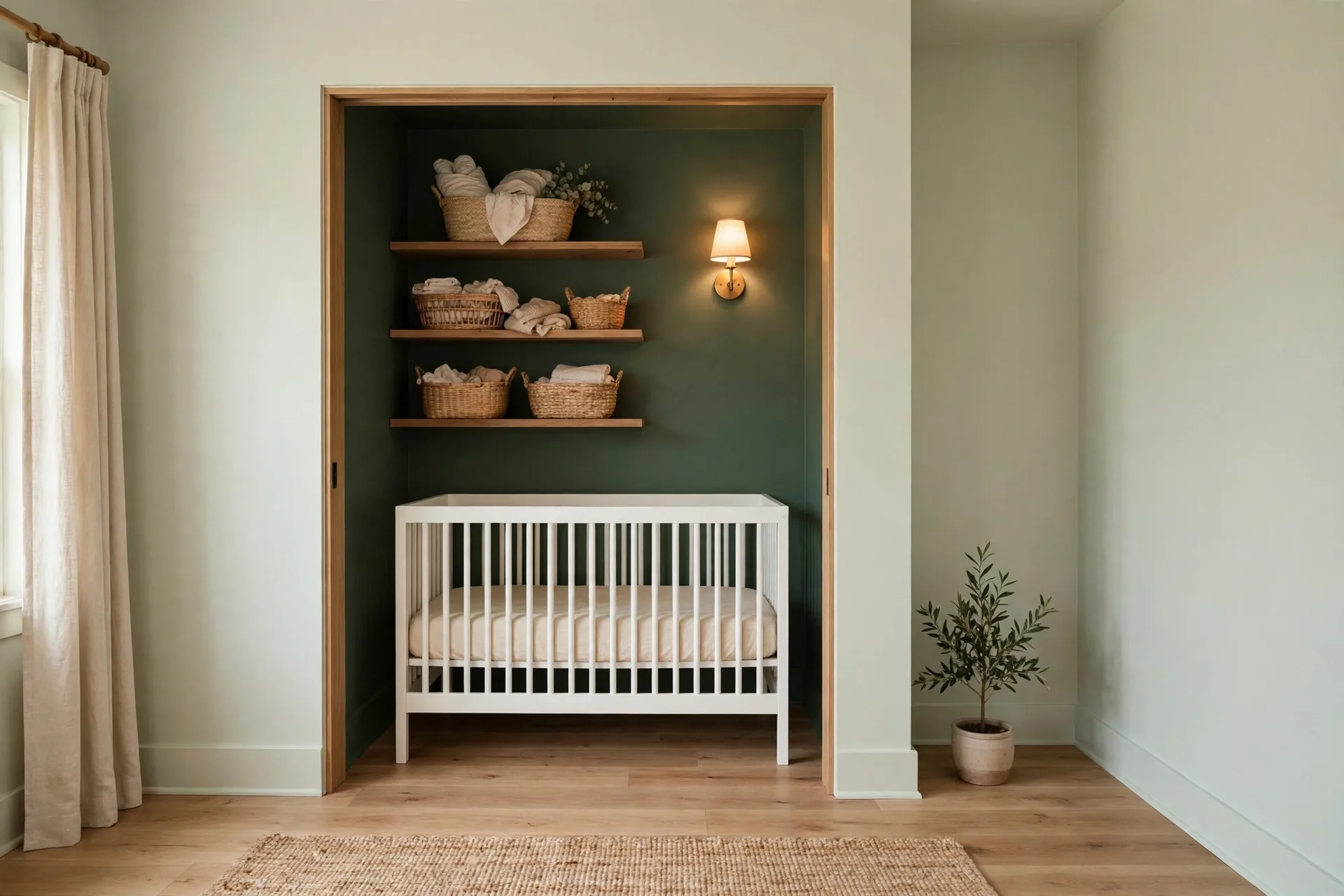
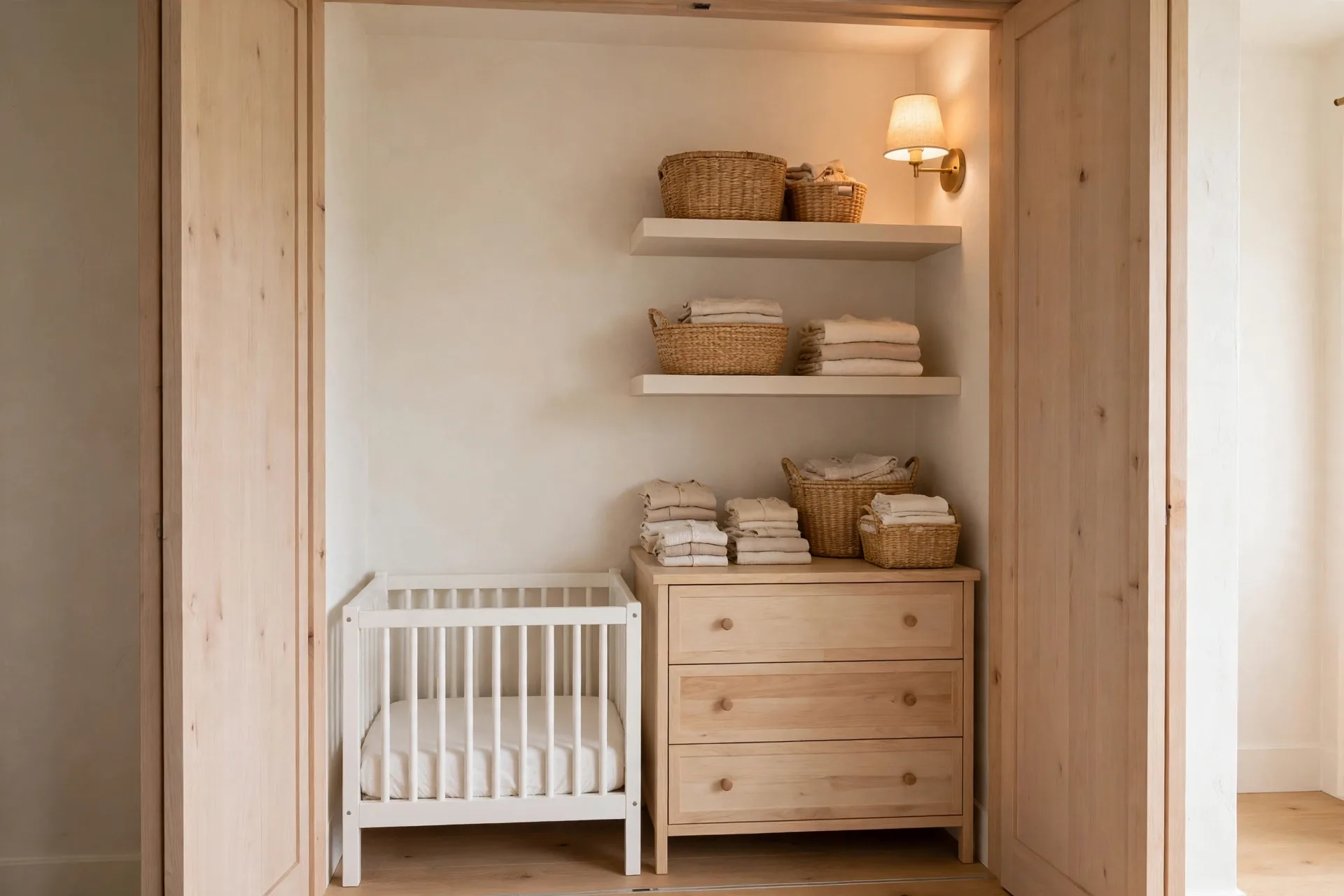
A closet with the doors off fits a mini crib, a compact dresser, and shelves above — a complete nursery in six feet of width. Paint the inside a shade deeper than the room for a cocoon effect, add a soft wall light, and keep the floor clear for your knees. Some of the most saved nursery photos anywhere are closets; small is not a limitation here, it is the aesthetic.
23. Claim one corner of your bedroom
If the baby will room-share for a good while anyway, one corner of your room can be the nursery for real: the crib or bassinet, a compact changing setup on your dresser, the chair angled in, a rug to draw the boundary. Night feeds become a shuffle instead of a commute. Our minimalist nursery ideas are full of corners doing exactly this job beautifully.
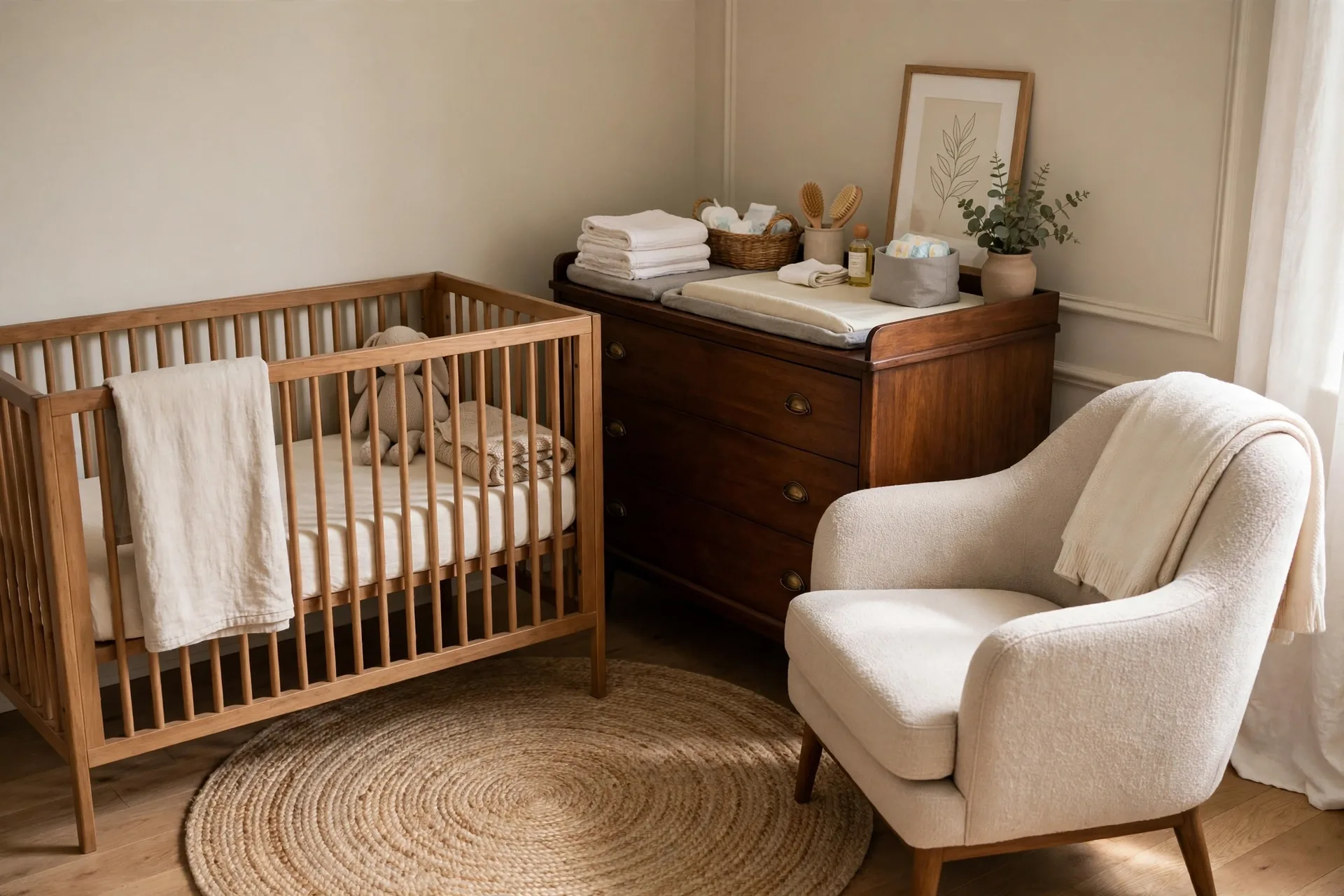
24. Do the minimalist edit before you buy
List what the baby will touch in the first three months — a safe sleep surface, a place to change, a place to feed, clothes, diapers — and let everything else audition for its place. Most of the registry is “later” wearing a “now” costume. The edit saves money, floor space, and the overwhelm of gear bought for a seven-pound person. You can add anything in a day; un-buying takes a yard sale.
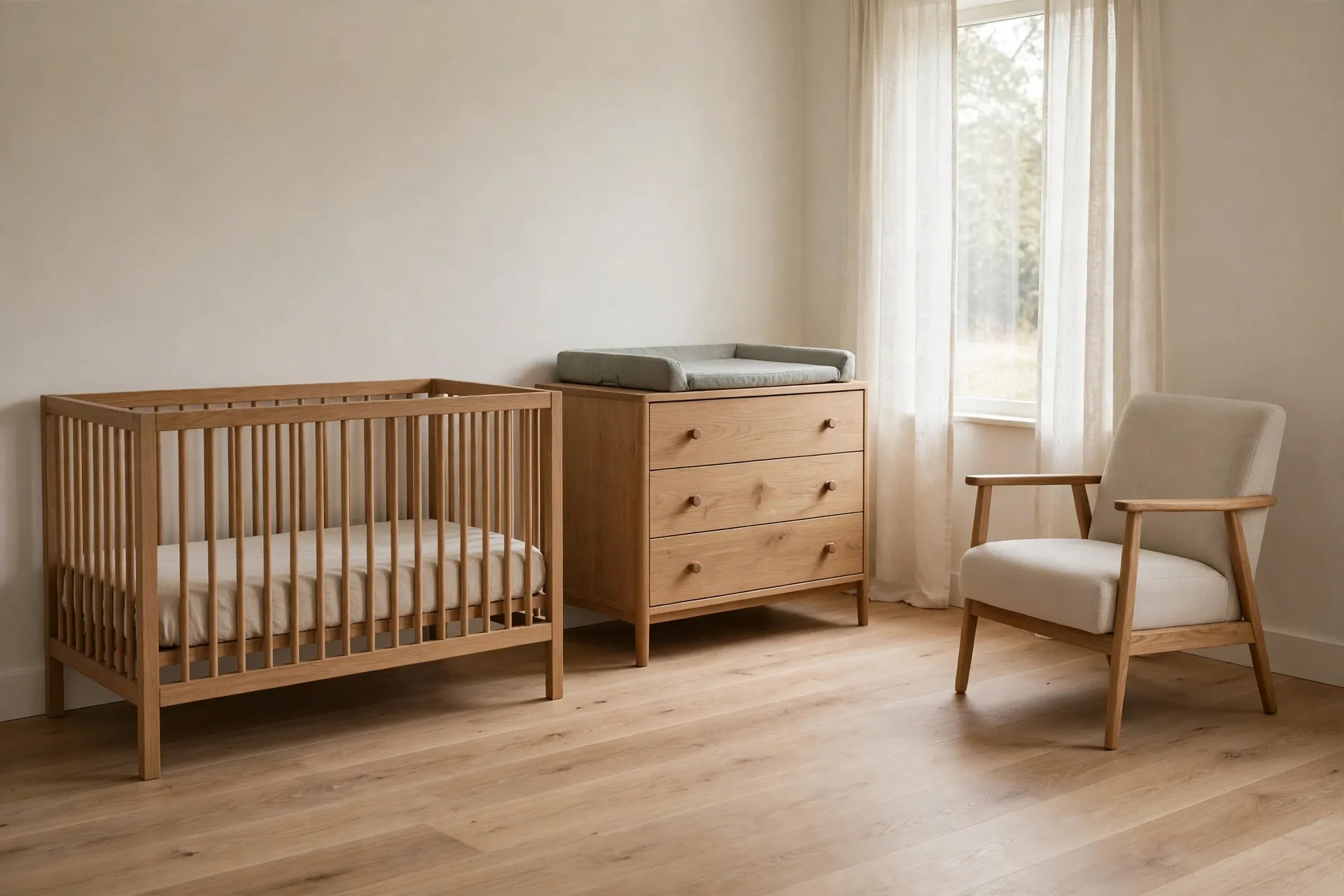
25. Buy secondhand smart: what to grab, what to skip
Secondhand is a gift to the budget — with two non-negotiable rules. The mattress is always new: you cannot see its history, and a firm, clean, correctly fitting mattress is the heart of the safe crib. A used crib is fine only after homework: check it against current safety standards and recall lists, confirm every screw and slat, skip anything with a drop side. Dressers, chairs, and decor? Preloved is perfect — just anchor tall pieces the day they arrive.
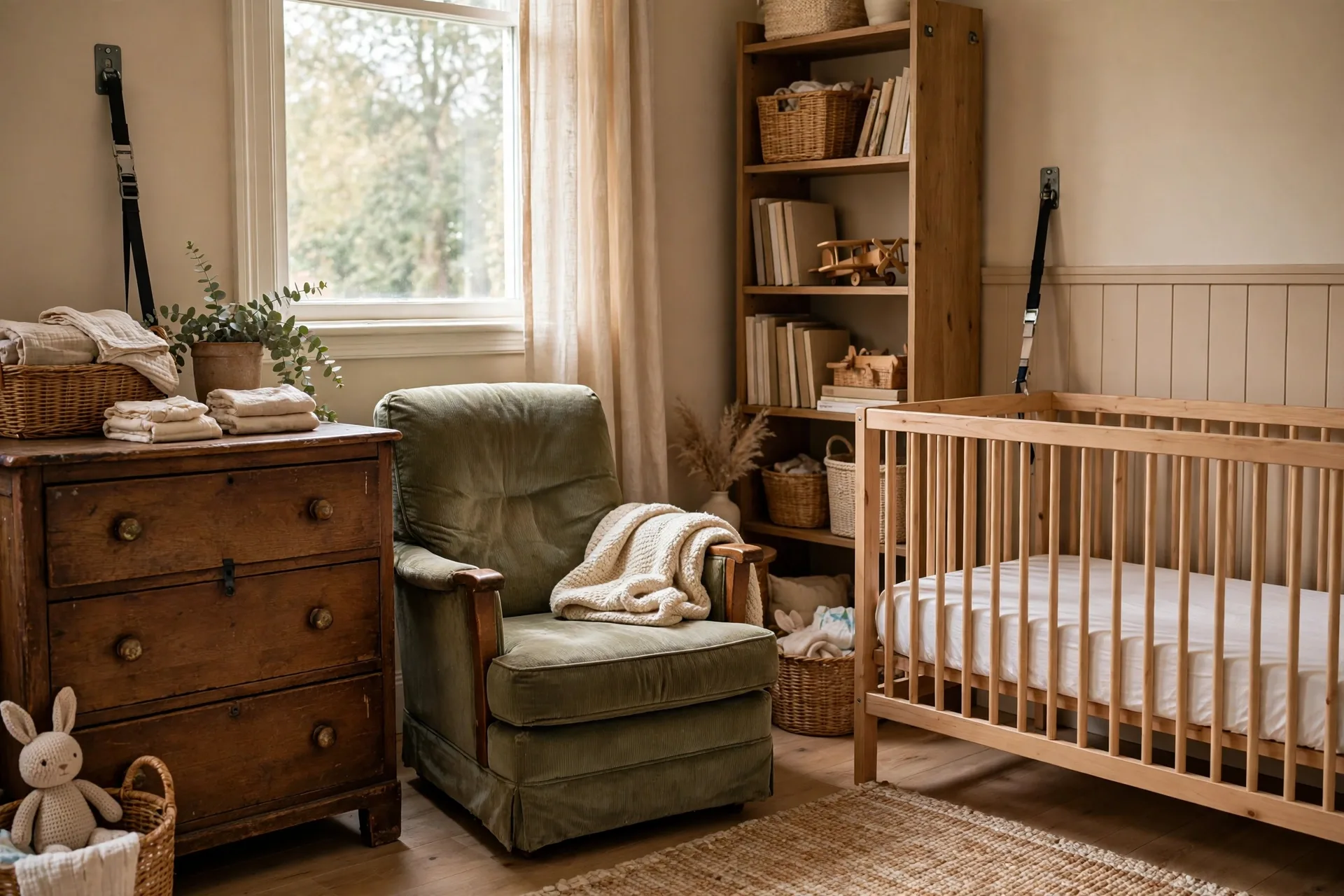
26. Twins: double the anchors, not the furniture
Two babies share more than people expect: one changing station, one chair (wide enough for tandem feeding positions), one storage wall — but two safe sleep surfaces, each bare, each with its own fitted sheet. Anchor everything twice as early, because two toddlers pull up together. The full playbook, including layouts for two cribs in one room, is in our twins nursery guide in the index below.
The Everyday Systems: Ten More Ideas
27. Put the monitor where you can see it from the door
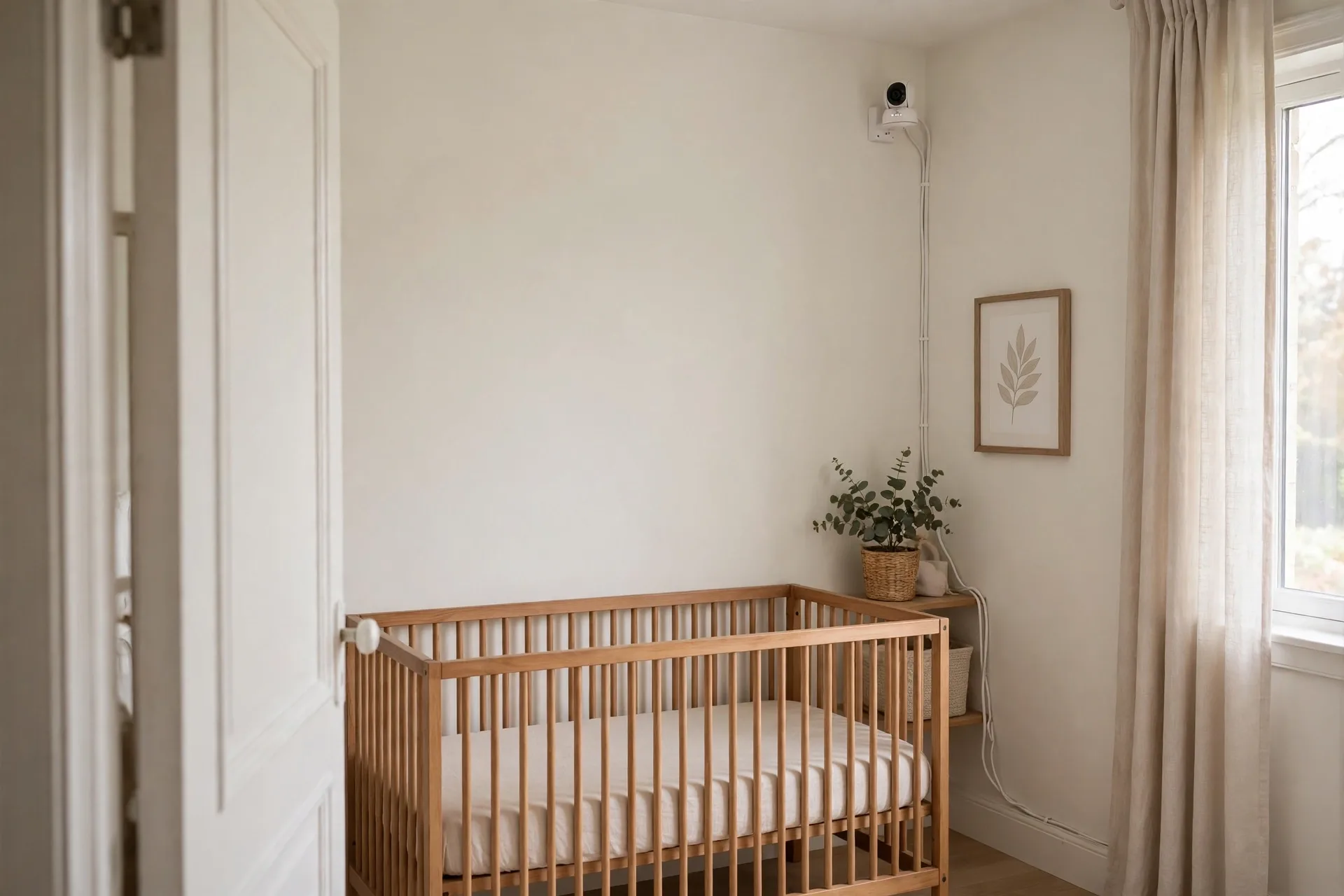
The monitor is for you, not the baby, so mount it where you can glance at it from the doorway without walking in. A high corner mount gives the full crib view and keeps the cord completely out of reach, which is the part that matters most. Run the cord along the wall and behind furniture, never across the crib rail or near the mattress. Test the view at night, when the infrared picture is the one you will actually use, and check that the crib stays bare in the frame. A monitor that shows you a safe, empty crib is doing its job. A monitor angled at a pile of blankets is showing you a problem to fix, not a baby to watch.
28. Keep a spare set of sheets in the nursery, not the linen closet
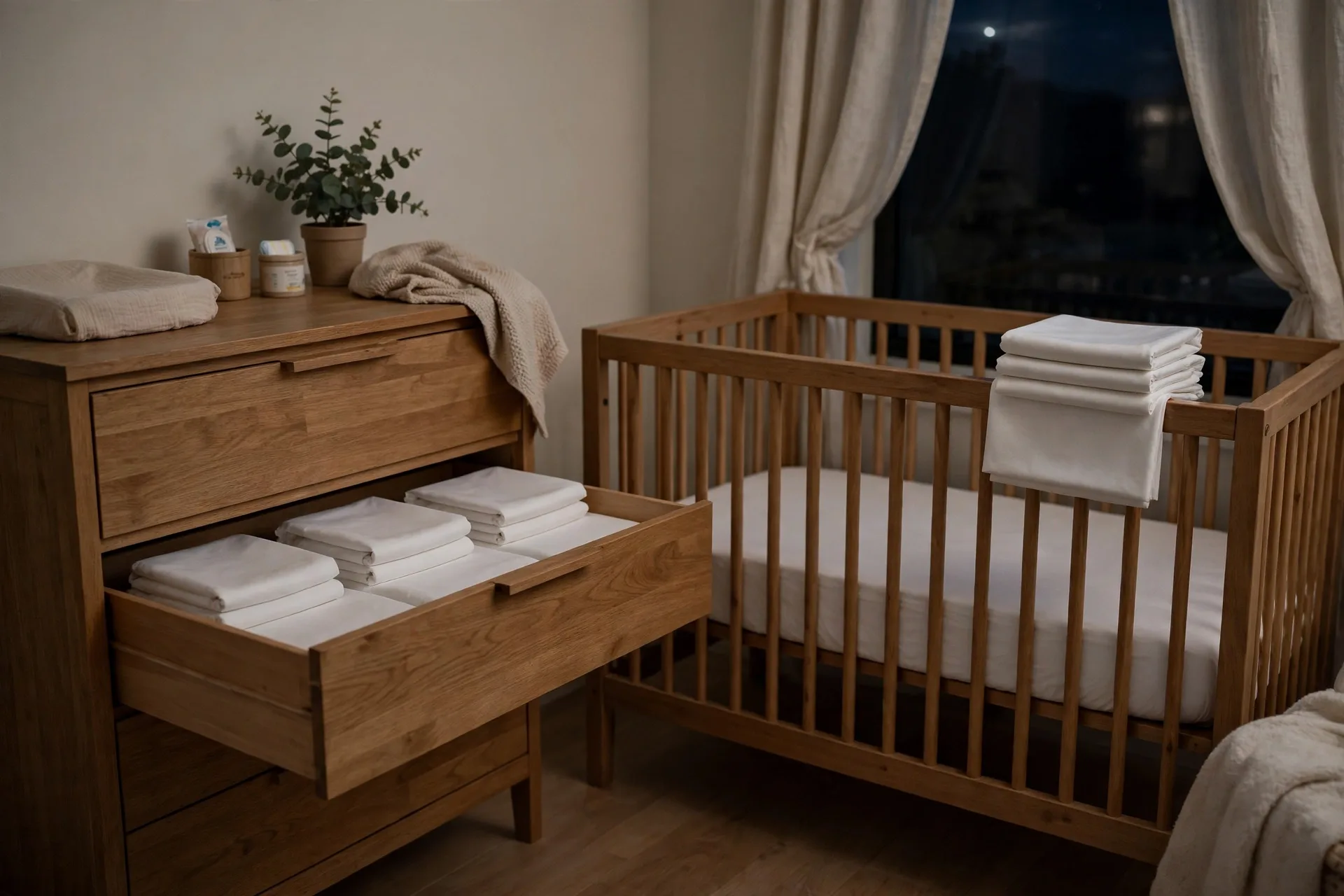
At 2am, a leak means a sheet change, and the linen closet down the hall is a country away. Keep two spare fitted sheets in the nursery itself, in the top dresser drawer or a basket beside the crib, so the change takes ninety seconds and the baby stays half asleep. The same drawer holds a spare sleep sack and one clean change of clothes, because leaks travel. Wash the spares the next morning and put them straight back. A nursery that restocks itself is a nursery that never leaves you stranded at the worst hour with a wet baby and no plan.
29. Label the drawers with pictures, not words
Drawers labeled with words help you. Drawers labeled with pictures help everyone: the grandparent on duty, the babysitter, the partner who has never once opened the right drawer first try. A simple picture of a shirt on the shirt drawer and a picture of diapers on the diaper drawer turns the dresser into a map anyone can read at 3am. Use photos or quick drawings on removable labels, and update them when the sizes change, so the map never lies about what lives inside. The nursery runs on tired people, and tired people read pictures faster than words, especially with a baby in one arm and a decision to make.

30. Hang a small shelf at chair height for the book you are reading
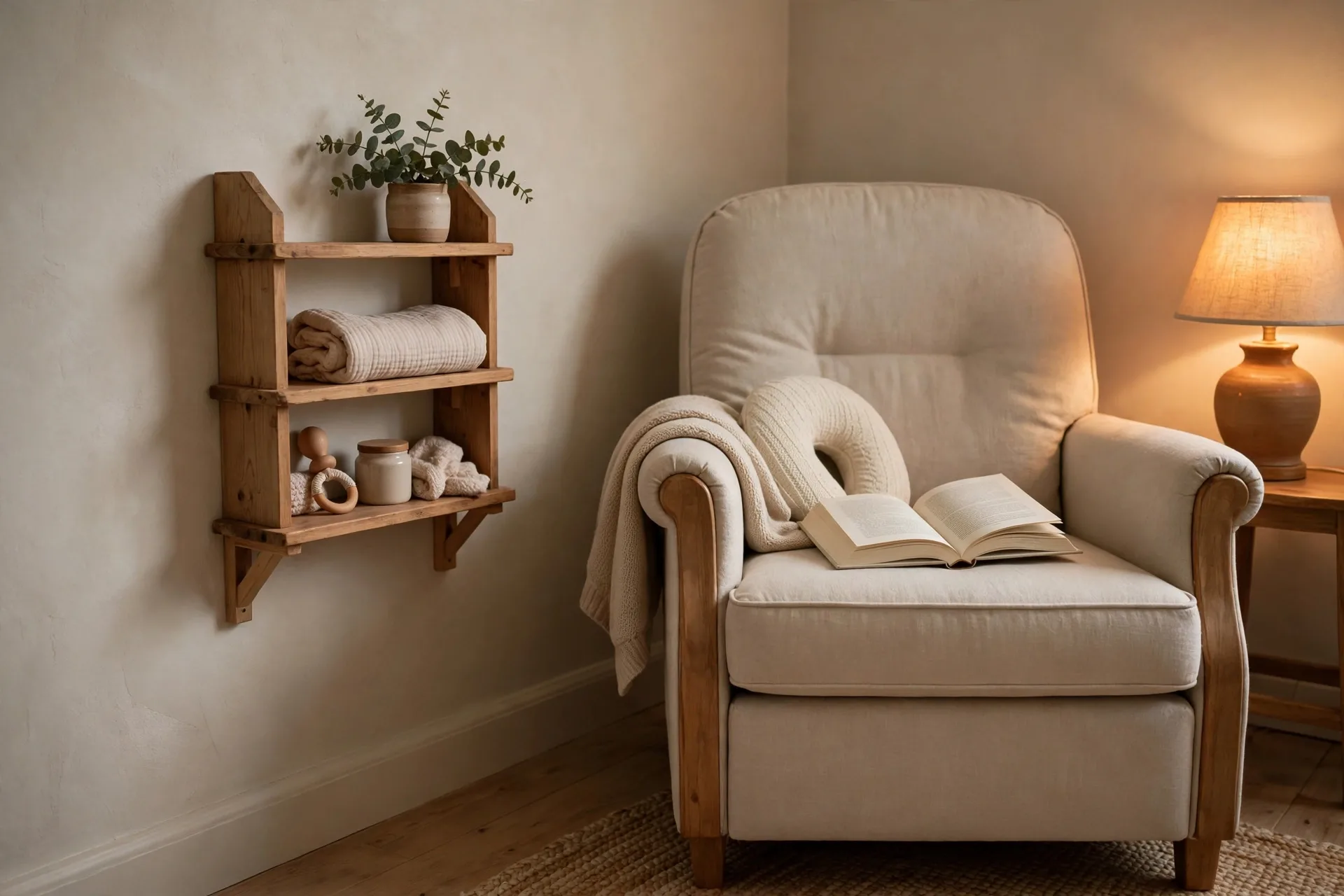
The book you are reading aloud lives on a small shelf at chair height, not in the basket across the room. A tiny wall shelf beside the nursing chair holds tonight’s book, tomorrow’s book, and the one you reach for when the current one loses the audience. It keeps the books off the side table, where the water bottle lives, and it keeps the ritual visible: the books are right there, every night, in the same spot. Screw it into a stud, keep it low and close, and let the baby watch you reach for the same shelf every single night.
31. Keep a laundry basket inside the nursery for outgrown clothes
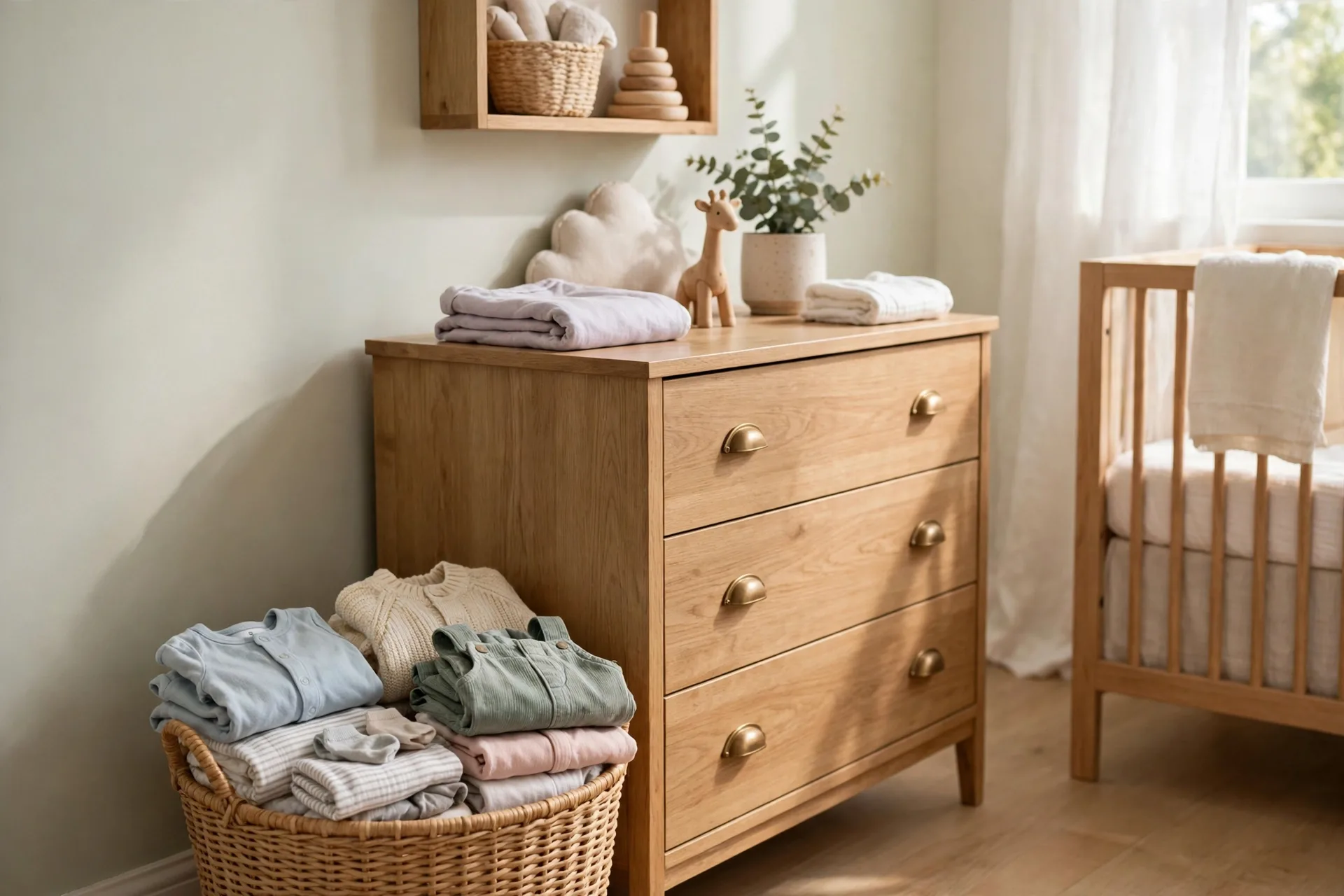
Outgrown clothes leave the nursery in drips and drabs, one too-small sleeper at a time, and without a basket they pile up on the dresser. A small basket inside the nursery catches them all: too small, stained past saving, or ready to hand down. When it fills, the whole basket goes to storage or the donation bag in one trip, and the nursery stays honest about what actually fits. Label it if you like, or let it be the obvious basket. The point is the clothes leave the room instead of colonizing it, and the next size up is always one basket away, not buried in a drawer.
32. Choose a rug you can wash
The nursery rug will meet milk, diaper leaks, spit-up, and at least one mystery stain per month. Buy the rug you can throw in the washing machine, not the rug you have to love from a distance. A washable rug in a soft neutral goes under the crib or beside the chair, and it comes out of the wash looking like itself again. Check the care label before you fall in love, and keep a spare if the budget allows, so the floor is never bare while one rug dries. Pretty matters here, but washable matters more.
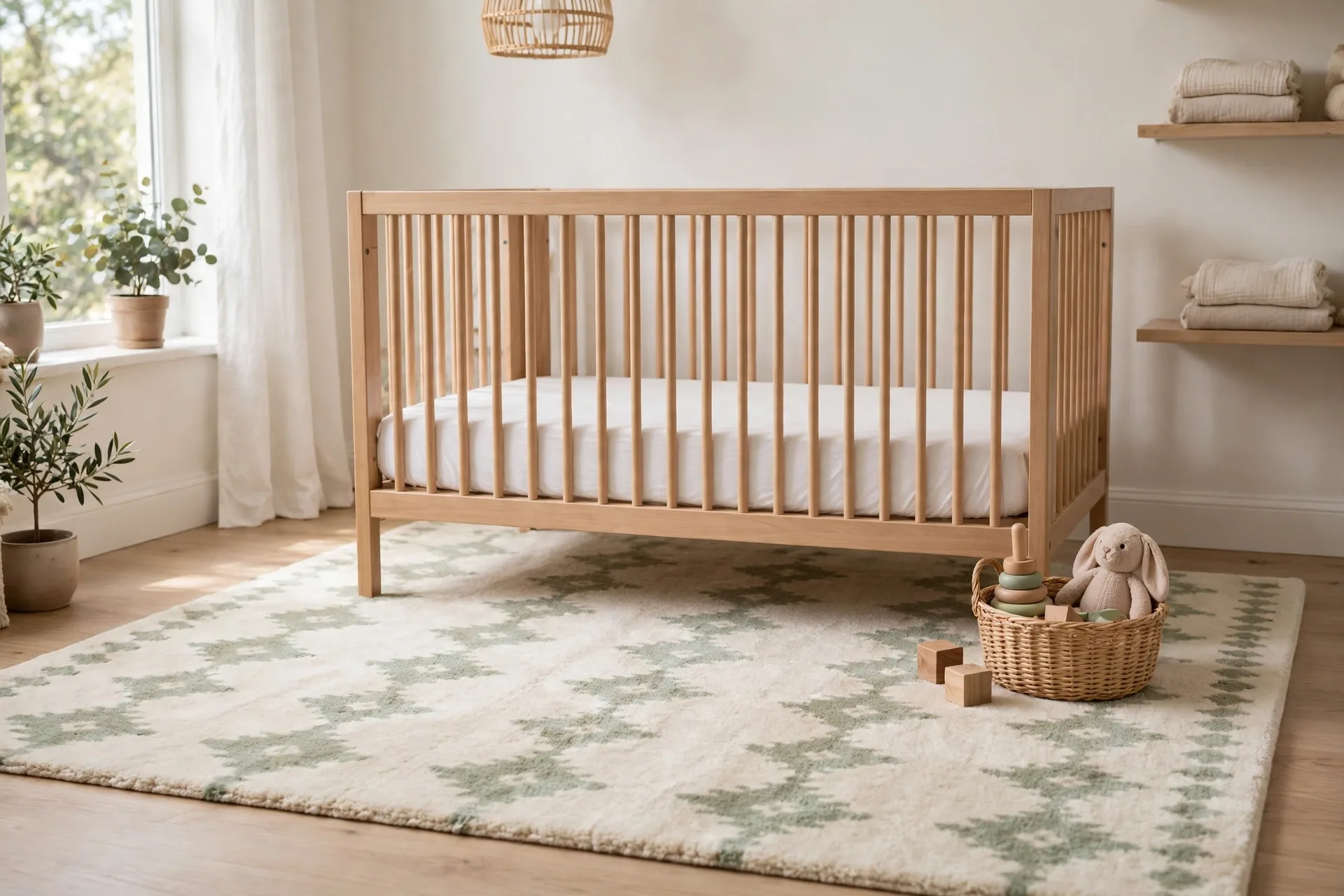
33. Put a dimmer on the overhead light
The overhead light has two settings in most nurseries: interrogation bright and off. A dimmer gives you the middle, and the middle is where 3am lives. Dimmed low, the overhead lights the changing pad and the path without waking the baby fully, and without waking you fully either. It is a fifteen-minute job if the switch is standard, and it is the cheapest lighting upgrade in the whole room. If your landlord says no to wiring, a plug-in dimmer lamp does the same job from the side table. Either way, the room gets a low setting, and low is the setting you will use most.
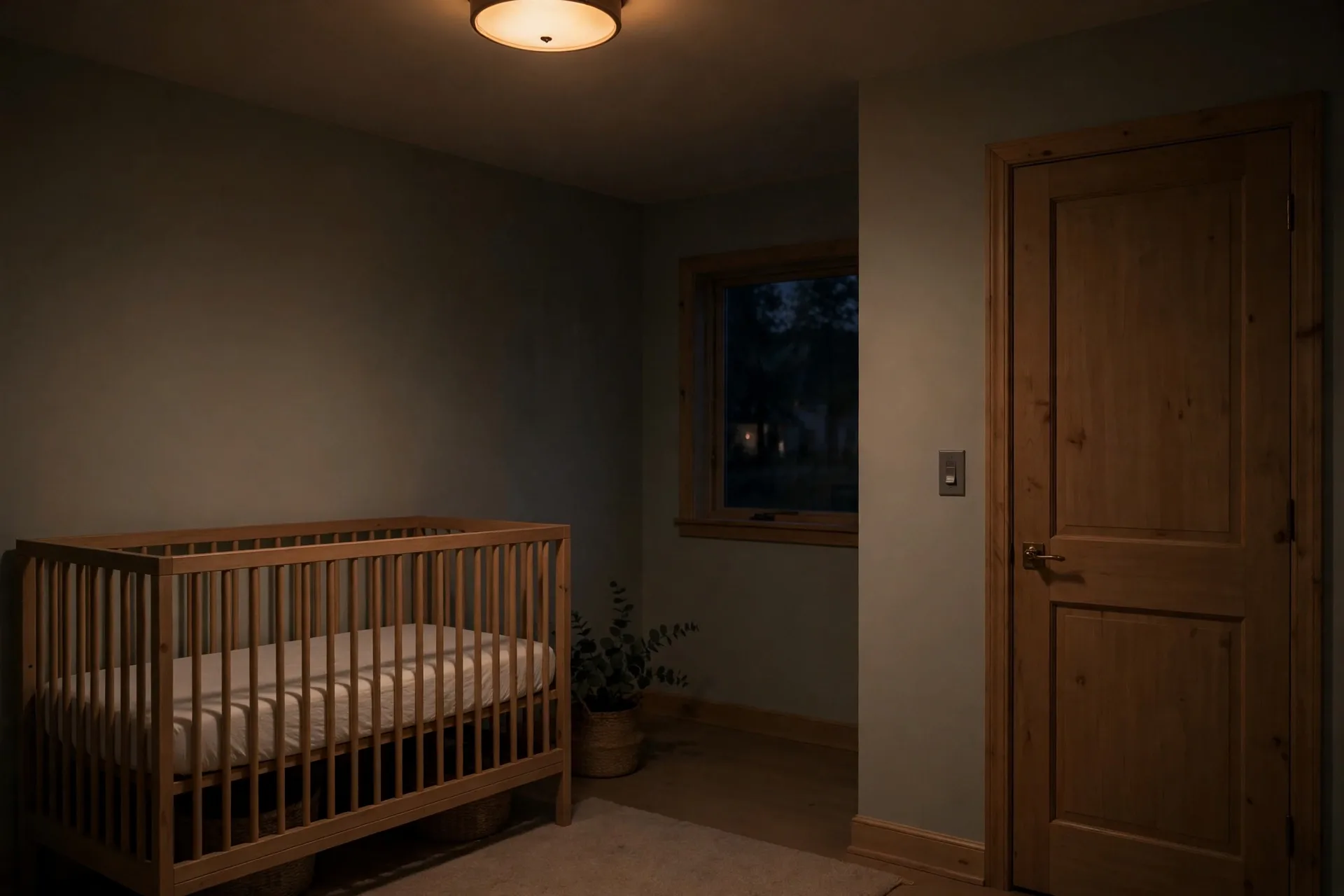
34. Store diapers by size in the top drawer only
Diapers live in one drawer, the top one, sorted by size with the current size in front. The rule sounds fussy until the night you grab the wrong size in the dark and find out mid-change. One drawer, one job, nothing else in it. The next size waits behind the current one, and the outgrown size leaves the drawer the day the baby sizes up. It is the smallest system in this guide and the one you will thank yourself for most, because a change that goes right the first time is a baby back asleep five minutes sooner.
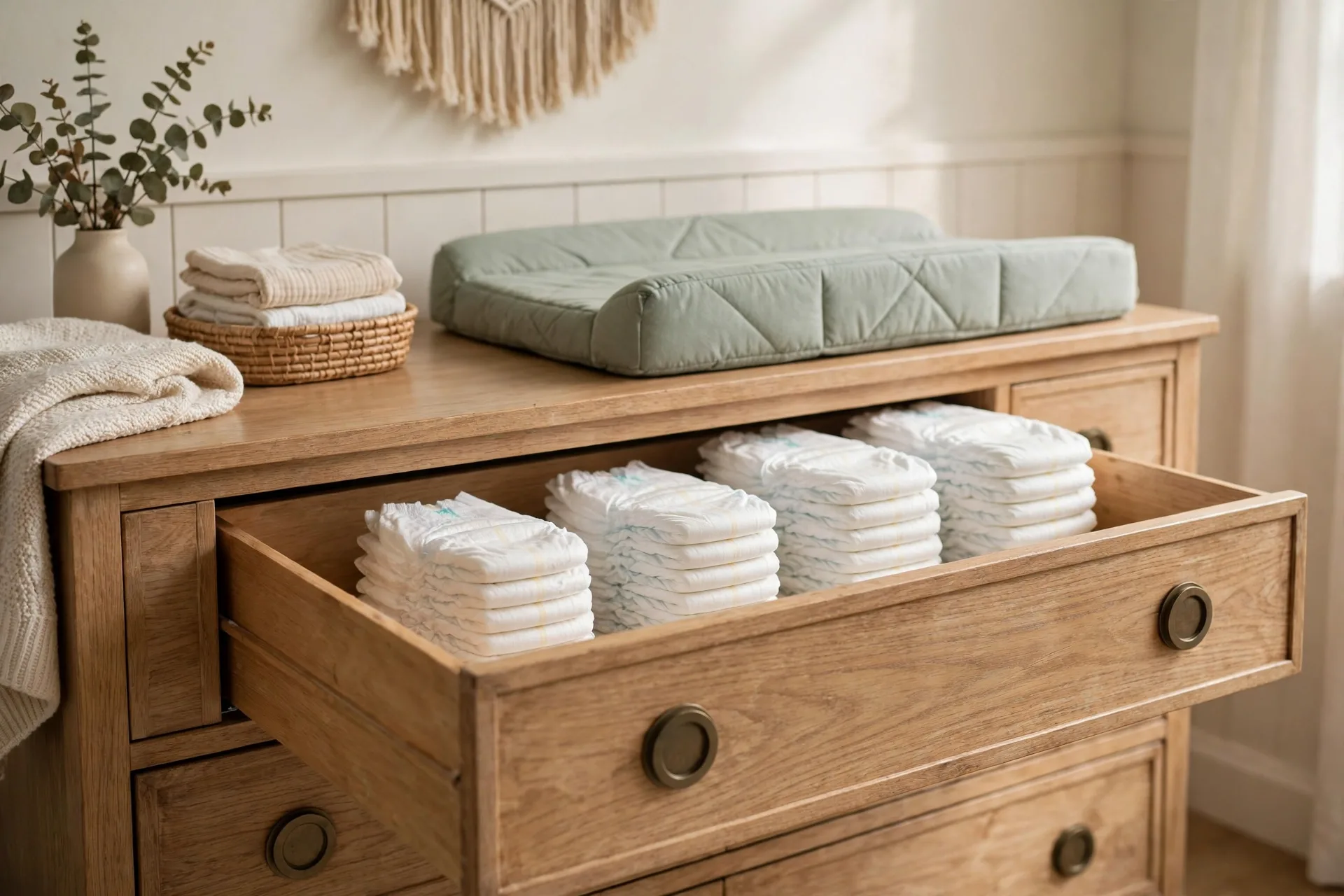
35. Add a ceiling fan on low to keep the air moving
A ceiling fan on its lowest setting keeps the nursery air moving without chilling the room, and moving air is kinder than still air on a warm night. It also gives the room a soft, steady sound that pairs well with the sound machine across the room. Keep the fan on low, keep it clean, and keep the crib out from directly underneath it. If the room has no fan, a small fan placed across the room, aimed at the wall and never at the crib, does the same job. The goal is gentle circulation, not a breeze on the baby.
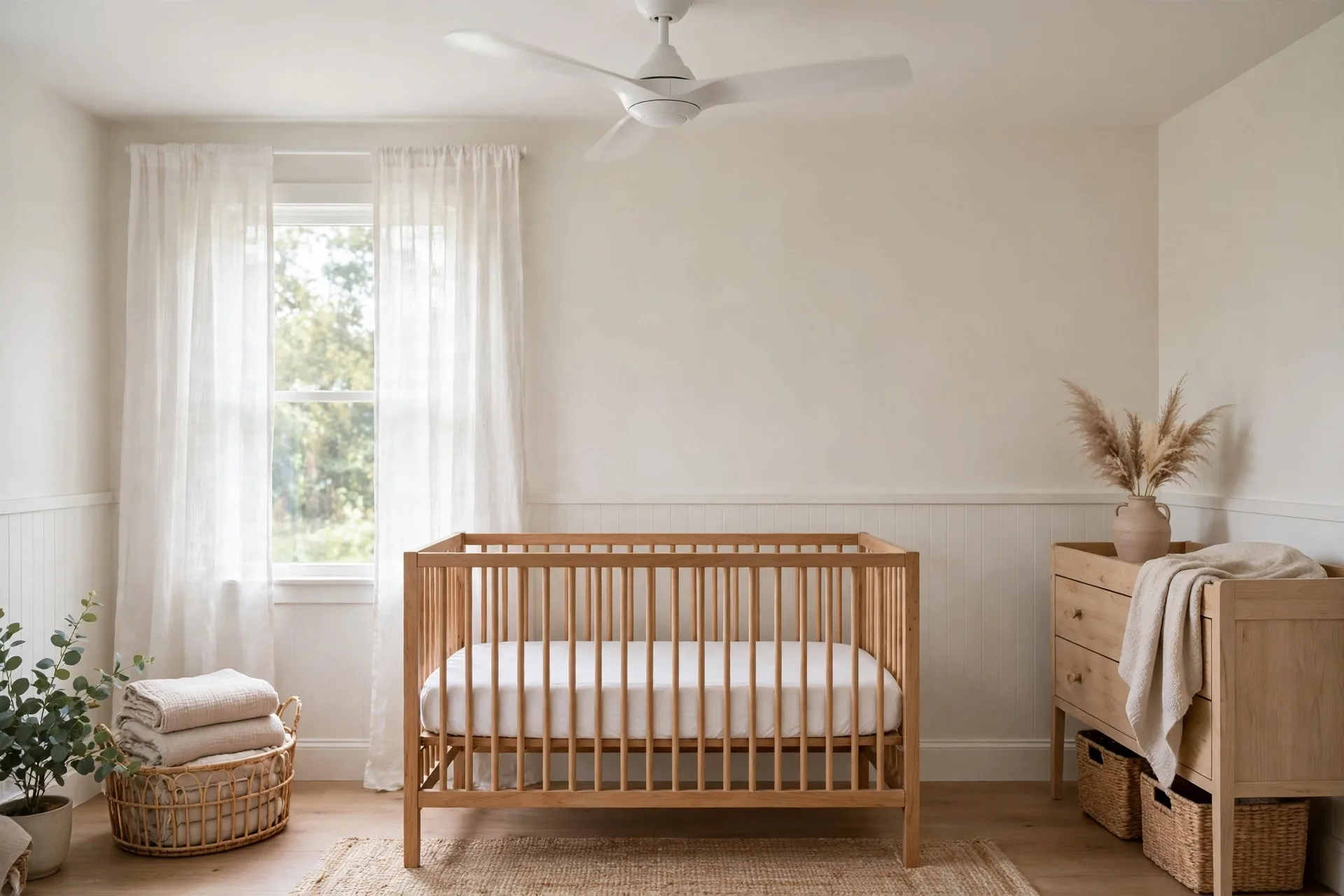
36. Keep a simple feeding and sleep log on the dresser
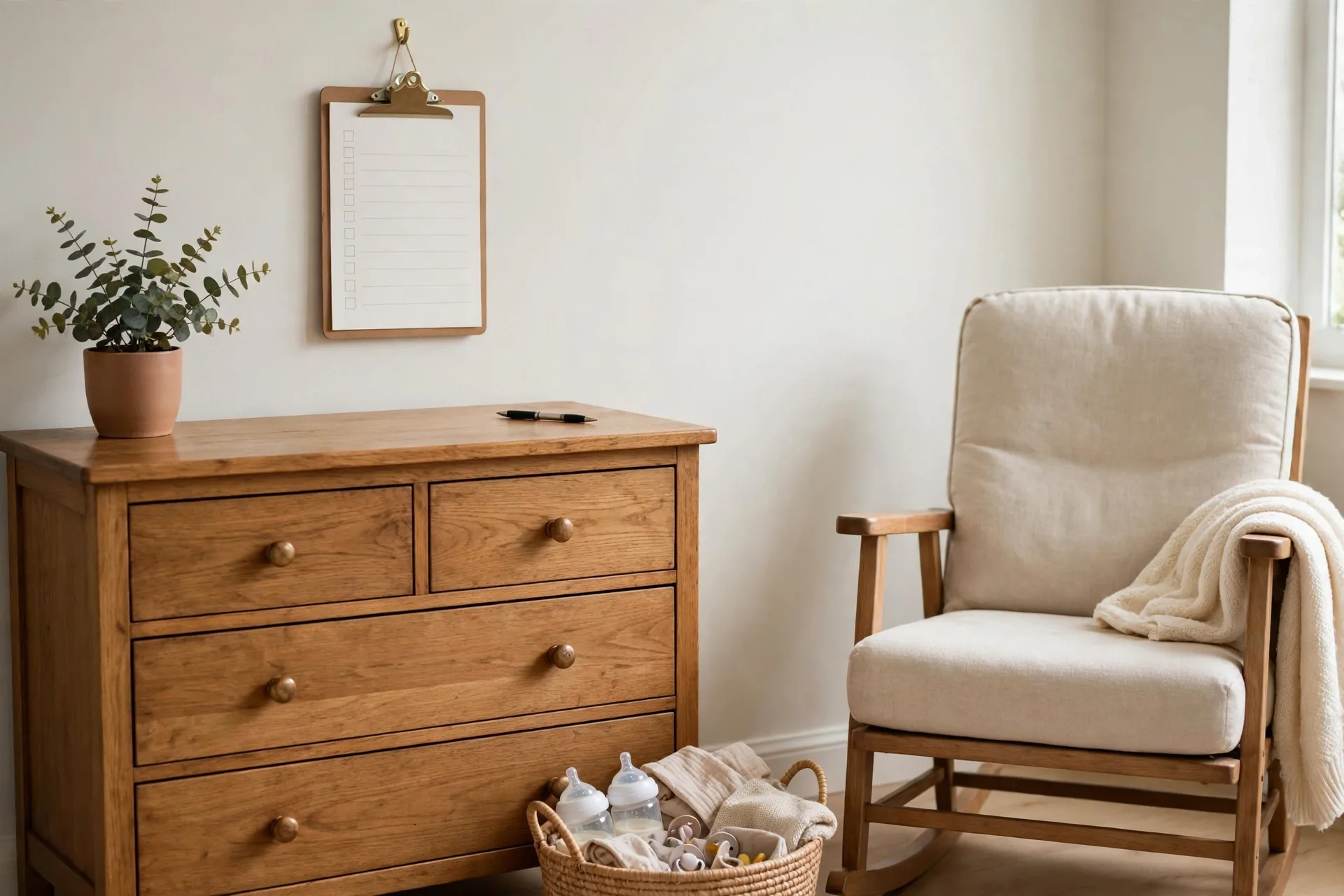
In the early weeks, nobody remembers when the last feed started, including you. A simple log on a clipboard on the dresser ends the guessing: time, side or amount, and one line for sleep. Two people can read it, the night shift can trust it, and the pediatrician gets real answers instead of tired estimates. Stop logging when it stops helping, which is usually around the time the pattern settles and you can feel it in your bones. A month of notes is plenty for most families, and the clipboard retires to the keepsake box when its job is done. Until then, the clipboard is the memory, and your memory gets to rest.
The Finishing Layer: Ten More Ideas
37. Hang blackout lining behind pretty curtains
The pretty curtains stay, and blackout lining goes behind them: the room gets the look you chose and the darkness naps actually need. Lining hangs on the same rod, costs less than new curtains, and peels off when you move. It also softens street noise a little, which is a bonus in a busy neighborhood. Measure twice, because lining that is too short leaks light at the bottom, and light at the bottom is the light that wakes a baby. Curtains for the room, lining for the dark, both doing their own job, and the baby gets the darkness that makes naps actually happen.
38. Add a footstool that doubles as storage
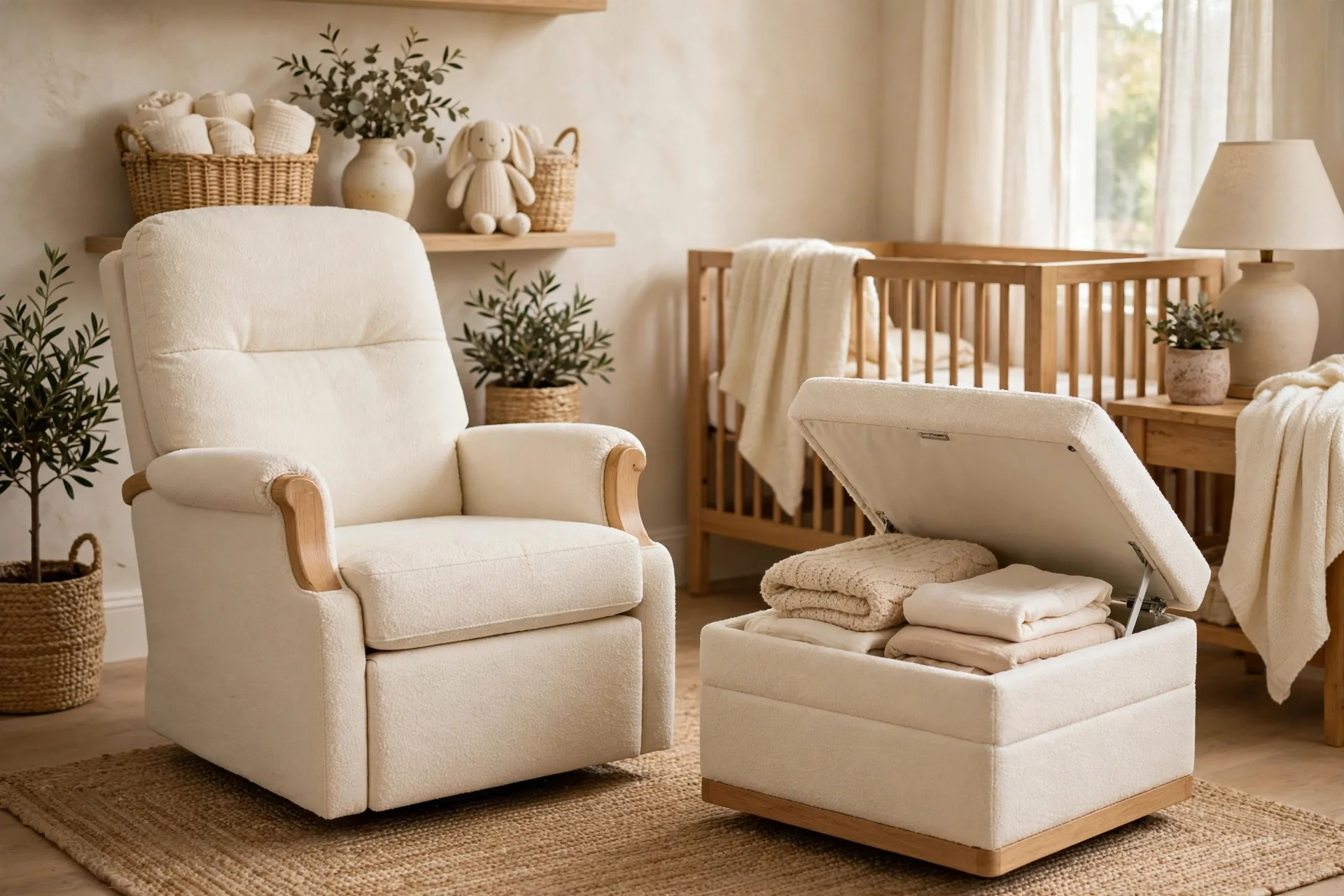
The footstool earns its floor space twice: your feet go up during feeds, and the hinged top opens to hold spare blankets, sleep sacks, and the extra burp cloths. It sits beside the chair, exactly where your feet already want it, and it swallows the clutter that used to live on the floor. Choose one that opens quietly, because a squeaky hinge at 3am is a crime, and check that it stays put when you push off it to stand. Storage you can reach without standing up is the only storage that counts at night.
39. Keep one drawer empty for the things you do not know you need yet
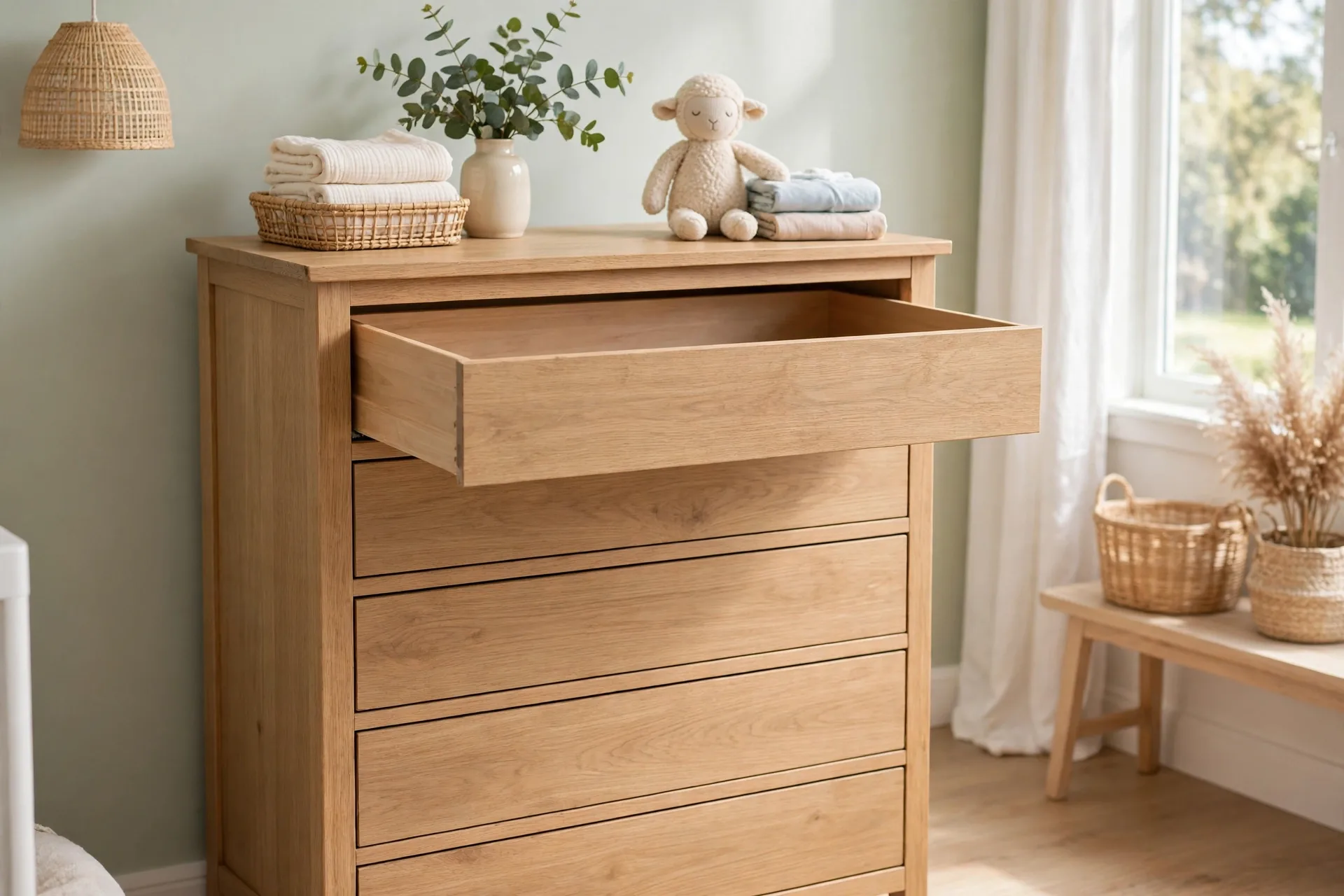
Every nursery gains things in the first months: the cream the pediatrician recommends, the thermometer you buy at midnight, the spare pacifiers, the nasal aspirator. Leave one drawer empty on purpose, so those things have a home the day they arrive instead of a pile on the dresser. An empty drawer is not wasted space. It is the room admitting it does not know everything yet, which is the honest position. Fill it slowly, one useful thing at a time, and never feel guilty about the space it takes. An empty drawer is the room keeping its options open, and options are the one thing a new baby never stops creating.
40. Put art at the changing pad for the baby to study
The baby spends serious time on the changing pad, staring at whatever is in front of them. Give them something worth staring at: a few high-contrast black and white prints hung low on the wall beside the pad, at baby height. Bold shapes and strong patterns are the first things newborn eyes can actually see, and a changing pad with art turns a chore into a show. Keep the frames light, secure, and well out of reach of grabbing hands, and change the prints every few months as the baby’s eyes grow into color. The changing pad is the baby’s favorite gallery, and the art should grow as fast as the audience does.
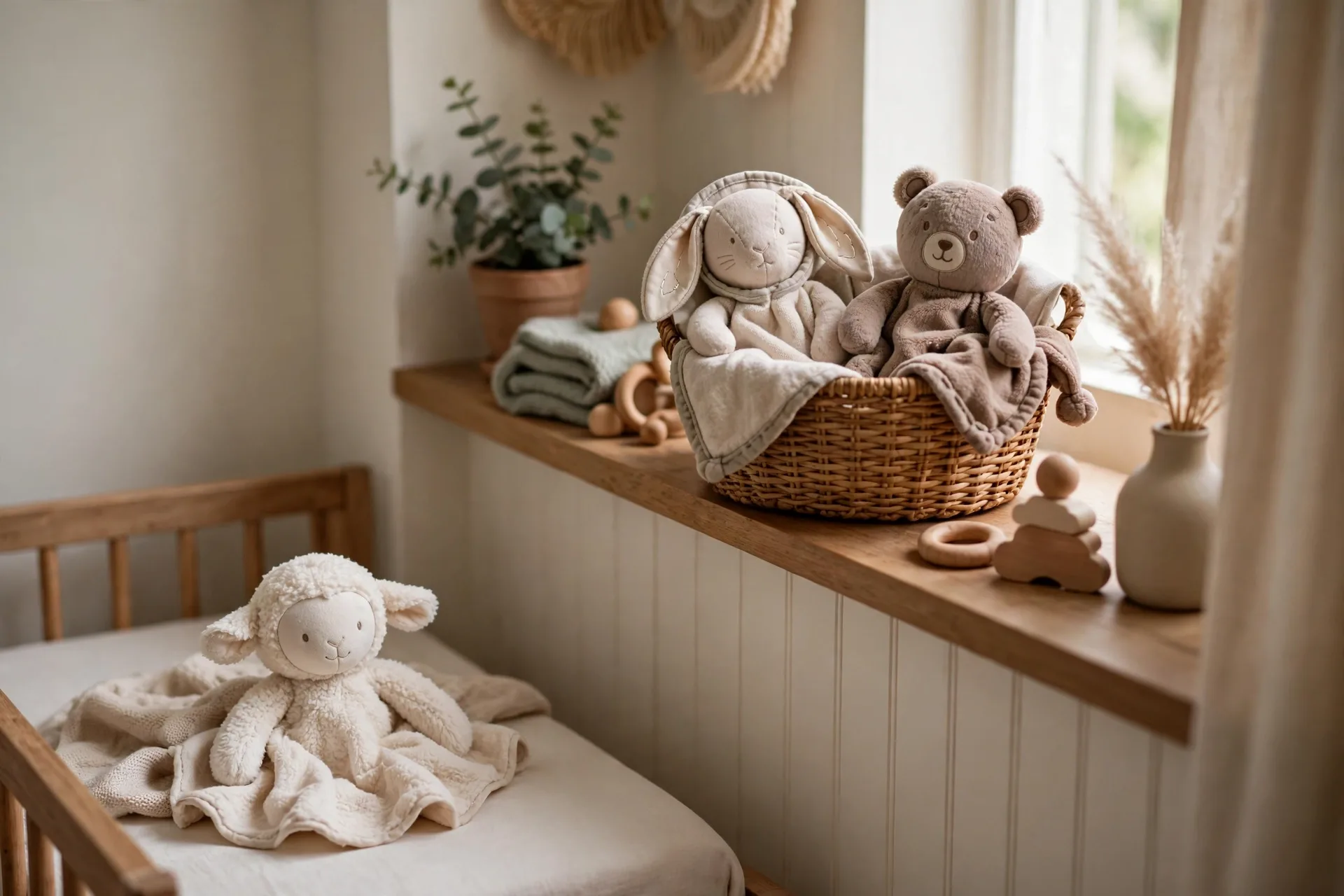
41. Use a small basket for the lovey rotation
One lovey in use, one in the wash, one in the basket: the rotation keeps a spare ready for the day the favorite goes missing or gets soaked. The basket lives on the shelf, and the baby learns that the basket is where comfort lives. When the lovey needs washing, the spare steps in without a crisis, and nobody has to explain anything to a tired baby at midnight. Buy the duplicates early, before the favorite becomes irreplaceable, and rotate them from the start so all three smell the same and feel the same. A lovey that has a twin is a lovey that can survive the washing machine without a household crisis.
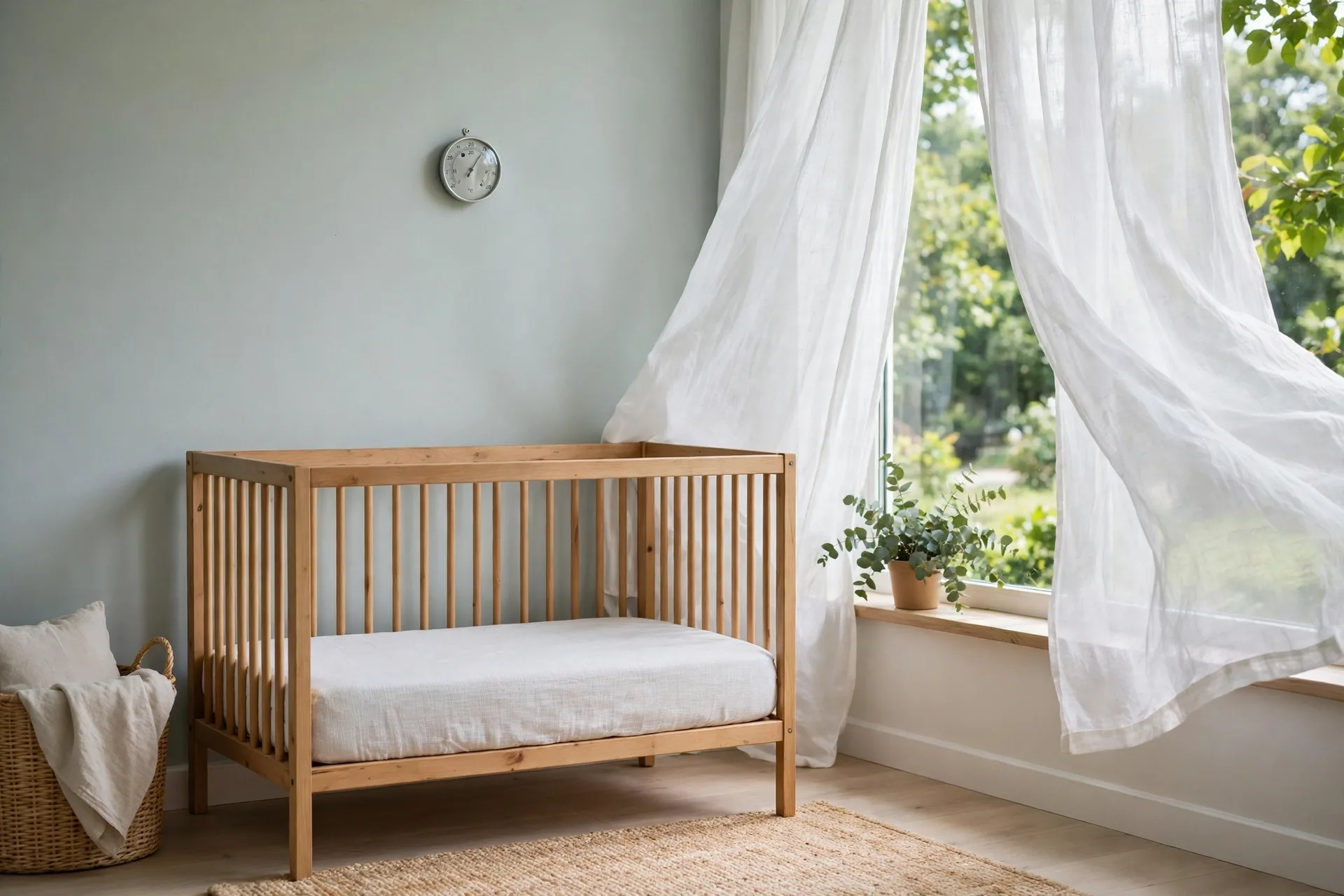
42. Keep the room cool and steady
A cool room sleeps better than a warm one, and a steady temperature beats a room that swings. Aim for the cool side of comfortable, dress the baby in one light layer more than you would wear, and skip the heavy blankets entirely, since the crib stays bare. A small thermometer on the wall tells you the truth when the room feels warmer than it is. In summer, the fan and the blackout curtains do the work. In winter, the room stays cool and the sleep sack does the warming. The baby sleeps in the air, not in the bedding.
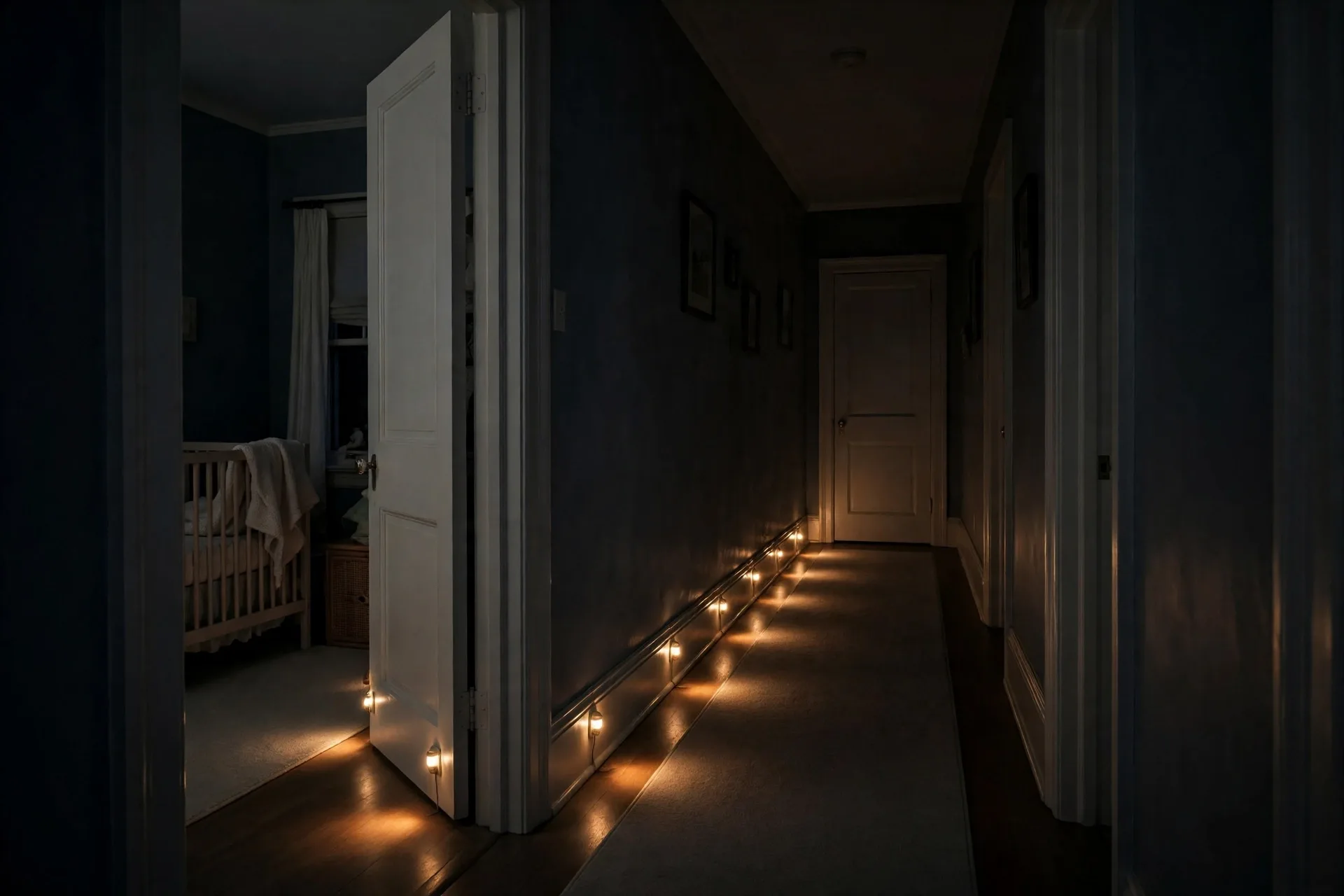
43. Add a night-light path to the door
One night light in the nursery is not enough when the hallway is pitch black. A small plug-in light in the hallway, or a second low light near the door, turns the trip from your bed to the crib into a lit path instead of a stumble. Keep them warm and dim, and keep them low, so the light stays on the floor and out of the baby’s eyes. The path matters most in the first months, when you are walking it half asleep, and it costs less than a takeout dinner. Light the floor, not the room, and everyone stays sleepy.
44. Store keepsakes in a labeled box from day one
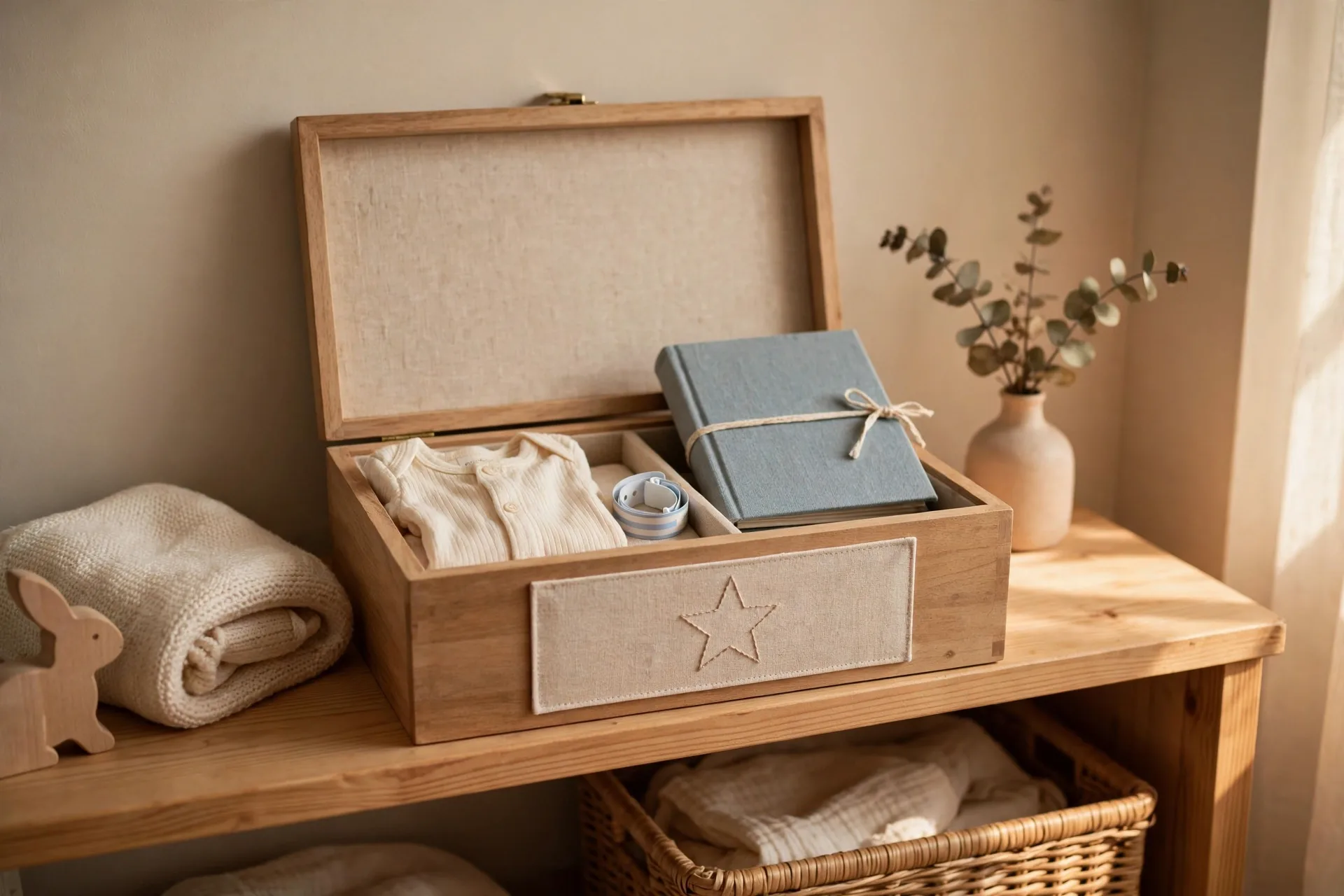
The first outfit, the hospital bracelet, the first photo, the card from grandma: they arrive fast and they scatter faster. One labeled box on the shelf, started on day one, catches them all before they become a drawer of mysteries. Add to it when things arrive, not when you remember, and write the date on anything that needs one. In a year, the box is the story of the first year. In ten years, it is the box your child opens. Start it now, while everything is still in one place, because the first year moves faster than anyone warns you, and the small things are the first to disappear.
45. Leave one wall free for the toddler bed later
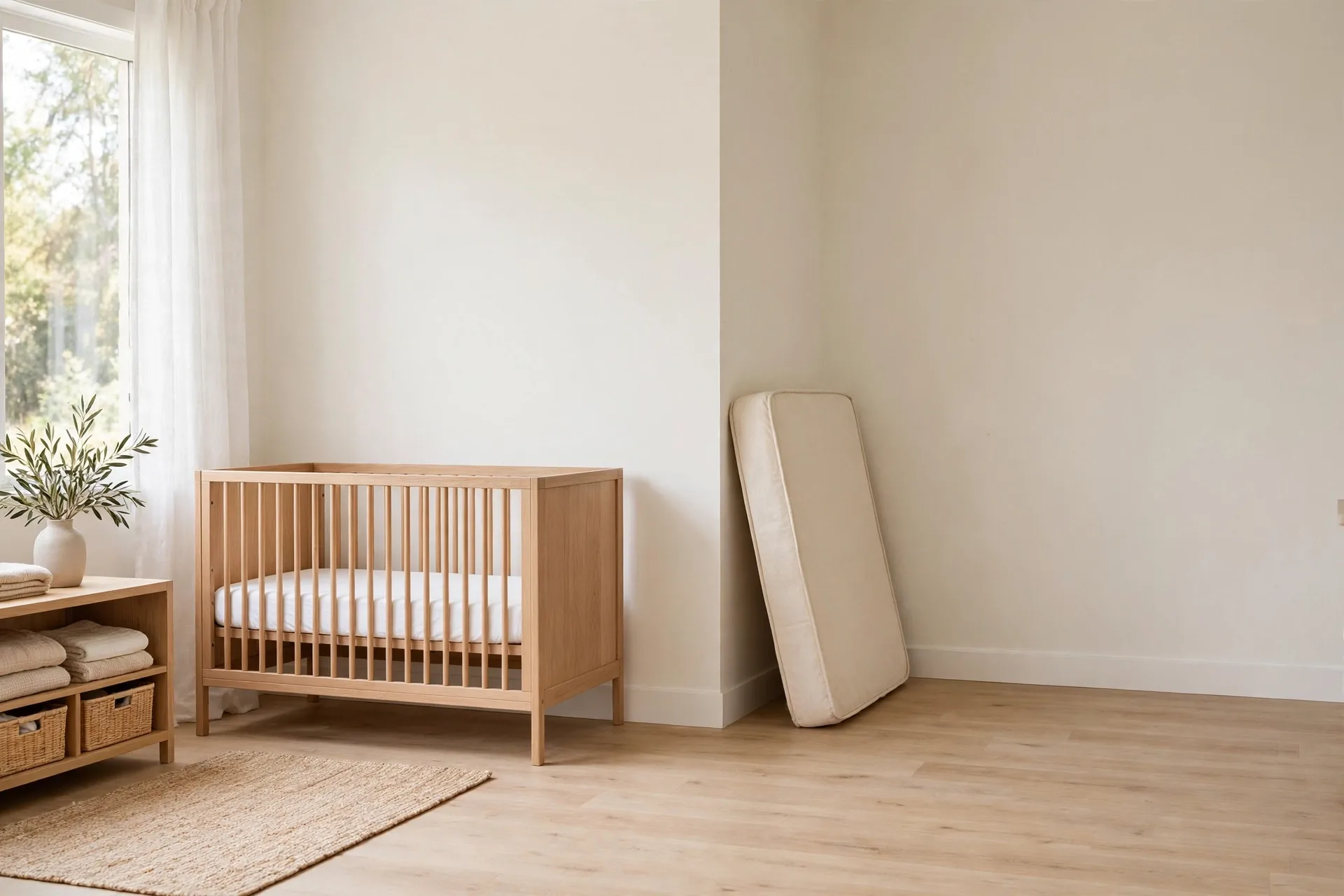
The crib will not be the last bed in this room. Leave one wall free now, no shelves, no art, no furniture against it, so the toddler bed or floor bed has a home when the day comes. The empty wall looks strange for a while, and then one day it is exactly where the big-kid bed goes, and you will be glad nothing is in the way. Planning the next bed now costs nothing and saves a full furniture shuffle later. The room grows with the baby, and the free wall is the proof you planned for it.
46. Do a monthly safety sweep as the baby grows
The room that was safe for a newborn is not the room that is safe for a crawler, and the room that was safe for a crawler is not the room that is safe for a climber. Once a month, walk the room on your knees at baby height and look for what changed: the cord that slipped down, the drawer that became a ladder, the shelf the baby can now reach, the anchor that needs tightening. Fifteen minutes, once a month, and the room stays ahead of the baby instead of behind. Safety is not a setup, it is a habit, and the monthly sweep is the habit.
The Safety Pass
Run this pass when the room looks finished, and again when your baby starts rolling and pulling up. It takes fifteen minutes.
- Anchor every dresser, bookcase, and shelving unit to the wall with anti-tip straps.
- Keep the crib away from windows, and every blind or curtain cord completely out of reach — cordless where you can.
- Nothing hangs over the crib: no shelves, frames, or mobiles within reach of standing hands.
- The crib stays bare: firm mattress, fitted sheet, no bumpers, pillows, loose blankets, or soft toys.
- Cords of every kind — monitor, lamp, sound machine — run out of reach of the crib.
- Small and heavy decor lives high or elsewhere; if a toddler can grab it, move it now.
Quick Picks: Match the Idea to Your Situation
| Your situation | Start here |
|---|---|
| Tiny room or no spare room | Ideas 22 and 23 — the closet nook and the bedroom corner |
| Baby will sleep in your room first | Idea 6, then build the sleep zone in stages |
| Not finding out the sex | Idea 16 — the neutral base that grows |
| Tight budget | Ideas 24 and 25 — the minimalist edit and secondhand rules |
| Expecting twins | Idea 26, plus the twins guide in the index below |
| The room feels too warm at night | Idea 42 — the cool, steady room |
| Baby is getting mobile | Idea 46 — the monthly safety sweep |
Every Nursery Idea on MamaKinder, by Color, Style and Situation
When you are ready to go deeper on any direction, these are the full guides. Start with the two planning pieces, then pick your color or your style.
Start here:
By color
By style & theme
Shop This Post
| Shop This Post | |
|---|---|
|
Yogasleep Dohm Classic White Noise Machine The fan-based sound machine from Idea 4 |
|
The Night Before Christmas: The Classic Edition The first-library anchor from Idea 10 |
Nursery Questions, Answered
When should I start setting up the nursery?
In stages. The changing station and feeding chair earn their keep from the first week, so have those working by your due date if you can. The sleep zone can phase in over the first months. Big jobs — painting, anchoring, assembling the crib — finish a few weeks early: fumes clear, and nobody assembles furniture well at 39 weeks.
Does my baby need their own room right away?
No. Most babies sleep in their parents’ room for the first months, in a bassinet or crib of their own — a perfectly good, very common start. A nursery that phases in (idea 6, or the bedroom corner in idea 23) loses nothing. A baby needs a safe, bare sleep surface and a fed, held life; the dedicated room can arrive on your schedule.
What does a nursery actually need to cost?
Far less than the registry suggests. The non-negotiables are a safe crib with a new mattress, a place to change, and a chair your back approves of — everything else is layering. Secondhand furniture (with idea 25’s safety checks), a one-wall feature, and the minimalist edit keep the total modest. Spend on the mattress and the chair; save on almost everything else.
What is the best nursery color?
The one that keeps the room calm at 3am and does not need repainting at age three. Soft neutrals — warm white, beige, gentle gray, sage — flex with every theme and textile change. Color belongs in the changeable layer: curtains, rug, art, the fitted sheet. If one saturated color owns your heart, give it the feature wall (idea 17), where a repaint is one wall, not four.
How do I make a nursery in a rental?
Everything renter-friendly is already in this guide: removable decals and peel-and-stick wallpaper for the feature wall, furniture that earns its place instead of built-ins, art on removable strips. For anchoring, talk to your landlord — most agree to two small screw holes per piece for a child-safety fix, and patch kits erase them at move-out. A closet nook (idea 22) needs no permission at all.
The Room That Works at 3am
A good nursery is not a theme; it is four zones that work in the dark, a crib that stays bare, furniture that cannot tip, and one wall that makes you smile. Build it in that order and every pretty decision gets easier, because it is decorating a room that already functions. Pick your zones this week, run the safety pass before the baby comes home, and let the rest arrive in layers.
And when the room is ready and you are down to the best decision of all, our baby names guide is waiting — hundreds of names, meanings, and the shortlist method we used for both of ours.
More new-baby guides on MamaKinder: Baby Names