Thanksgiving Worksheets PDF: Free Learning Fun for Kids
The November before my daughter turned four, I searched “thanksgiving worksheets pdf,” hit print on the first promising bundle, and handed my two-year-old a word search meant for a second grader. She looked at the grid, looked at me, and quietly ate the corner of the page.
The problem was not the worksheet. The problem was the match. Thanksgiving worksheets come in wildly different difficulty levels, from scribble-friendly turkey pages to crossword puzzles that would stump some adults, and the internet hands them to you in one undifferentiated pile. So here is my fix: 12 Thanksgiving worksheets, grouped by skill, each described in full. What is on the page, which ages it suits, what it teaches, and how to use it at your kitchen table.
One honest note before we start: this is a guide, not a download page. No mystery PDF buttons, just clear descriptions so you can picture each page and pick the ones that match your kids. Every page works with supplies you already own: crayons, a pencil, kid-safe scissors, and a grown-up nearby.
Heads up: this post contains affiliate links. If you buy through them, MamaKinder may earn a small commission at no extra cost to you. It helps keep these guides free.
How To Use This Guide
Each numbered worksheet follows the same format: what is on the page, ages, what it teaches, and how to use it (little-kid adaptation included).
Quick Picks: which worksheet, right now?
| You need… | Start with | Why it works |
|---|---|---|
| Something for a 2-year-old who scribbles | Page 12: Thanksgiving Coloring Pages | Huge shapes, impossible to mess up |
| Counting practice that feels like a game | Page 2: I-Spy Count and Color | Search first, count second, compare at the end |
| A page that buys you 30 quiet minutes | Page 9: Dot-to-Dot Turkey | Number sequencing with a reveal at the end |
| A challenge for an older kid | Page 8: Word Scramble and Crossword | Real vocabulary, genuinely tricky |
| Something that carries the holiday’s meaning | Page 11: “I Am Thankful” Writing Pages | Gratitude on the page, display-worthy after |
Counting and Math Pages (Worksheets 1 to 4)
These four build number sense the way holidays do best: with things worth counting. Turkeys, pies, acorns, and pilgrim hats beat flashcards every time.
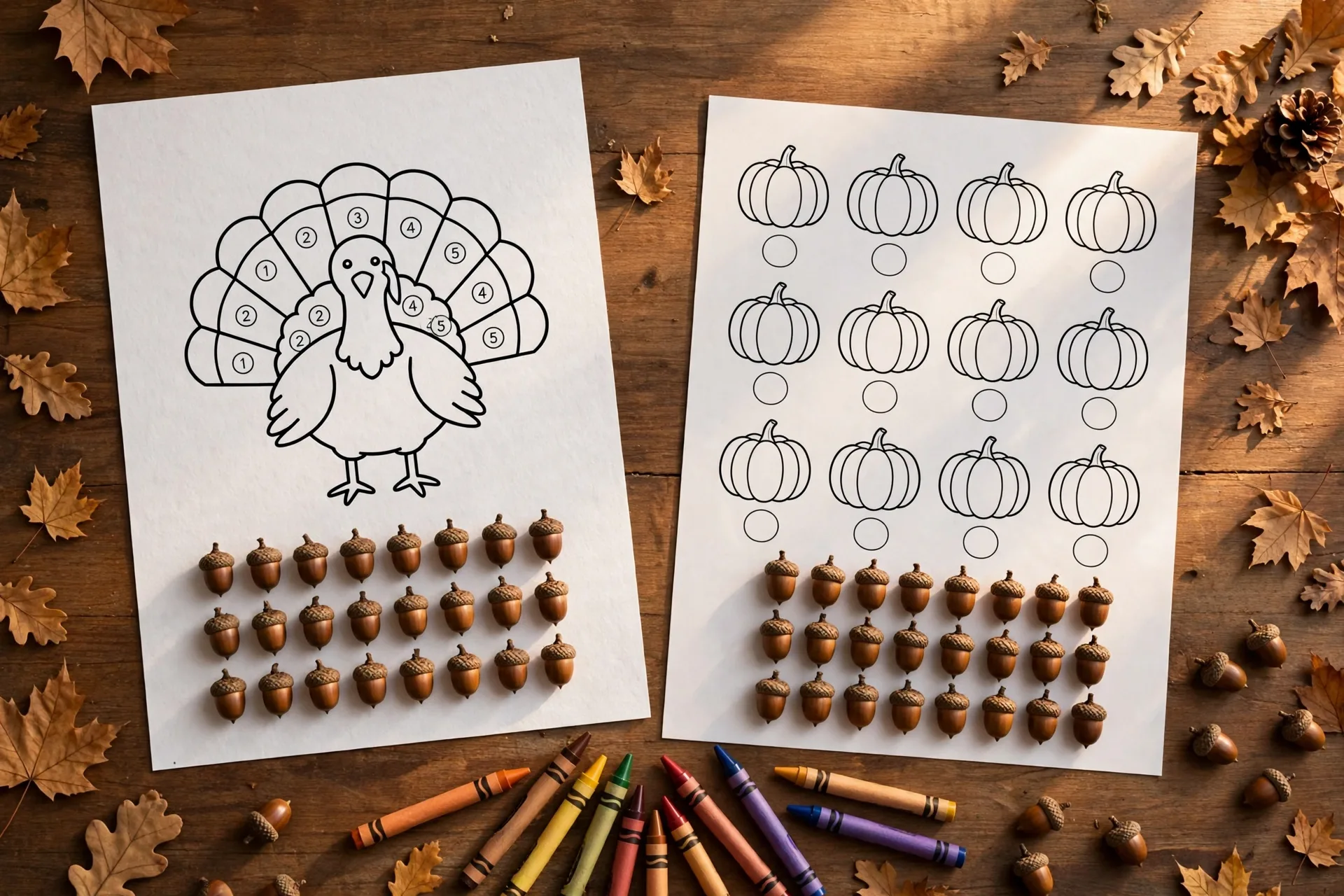
1. Turkey Counting and Number Recognition. What is on the page: a big turkey with numbered circles on its tail feathers (1 through 20), plus a counting strip of pumpkins where kids count and circle the correct number. Ages: 2 to 5. What it teaches: number recognition and one-to-one counting. How to use it: say a number, let your child find that numeral on the turkey tail, and cover it with a sticker or a dab of washable marker. Finding a numeral is a different skill than reciting numbers, so give it time. If 1 to 20 is too much at once, start with 1 to 5. Toddlers can simply point to the pumpkins while you count aloud together.
2. I-Spy Count and Color. What is on the page: a scatter of Thanksgiving objects above a line (turkeys, pies, acorns, leaves, pilgrim hats) and matching answer pictures below it, each with a blank for the total. Ages: 3 to 7. What it teaches: counting, observation, comparing quantities. How to use it: start with one object type and scan the page together, left to right, row by row, pointing and counting slowly. For little kids, finding and naming the objects is enough. For kids ready for more, ask which object appears most often. Systematic scanning prevents double-counting, which is half the lesson.
3. Color by Number Turkey. What is on the page: a turkey drawing divided into numbered sections with a color key (1 = brown, 2 = orange, 3 = red, and so on). Ages: 4 to 8. What it teaches: number recognition through art. How to use it: match each number to its color, fill in the section, and watch the turkey appear. This is the page that buys you the longest quiet stretch, because it is a puzzle and a picture at the same time. Markers give the boldest result; crayons are calmer for the under-five crowd.
4. Comparing Quantities: Which Side Has More? What is on the page: pairs of picture groups, pies on one side and turkey legs on the other, with a blank for the answer. Ages: 5 to 8. What it teaches: more than, less than, equal to. How to use it: count each side first, write the totals underneath (that step matters, it connects the pictures to numerals), then decide which side is bigger. If the symbols are new, say the comparison aloud first (“five is greater than three”) and add the written symbol after. Equal groups are the sneaky-hard part, so celebrate the equals signs.
Reading and Writing Pages (Worksheets 5 to 8)
These four sneak literacy practice into the holiday week. The trick is the vocabulary: harvest, thankful, cornucopia, gratitude. Words worth knowing, wrapped in November.
5. Acorn Alphabet: Letter Recognition. What is on the page: rows of acorn shapes with dotted letters, running A through Z. Ages: 3 to 6. What it teaches: letter recognition and alphabet order. How to use it: read the instruction together, find A, and continue through the alphabet at a pace that suits your child. Keep a printed alphabet nearby if the sequence is unfamiliar; a reference is a tool, not a crutch. The best first target is the first letter of your child’s own name. Kids who are not writing yet can simply point while you say the letter names aloud.
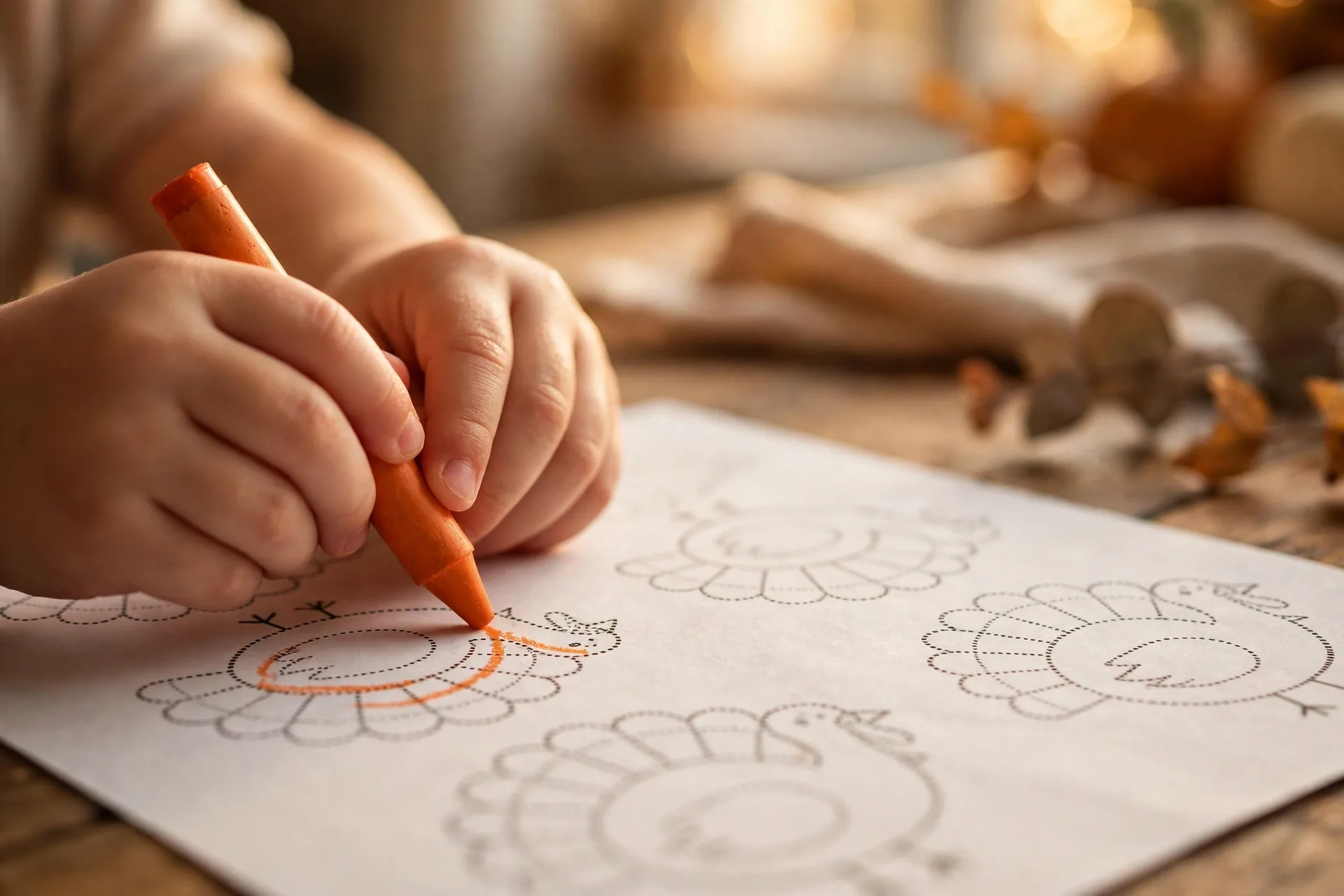
6. Thanksgiving Tracing Words. What is on the page: holiday words in dotted lines for tracing (turkey, pumpkin, thanks, family, harvest, pie), each beside a simple picture of the word. Ages: 4 to 7. What it teaches: handwriting and vocabulary. How to use it: trace the dotted letters slowly, saying the word as you go. Short, thick crayons or triangular pencils are the easiest grip for small hands. Two or three words per sitting is plenty. Say each word’s letter names as you trace, so the spelling sticks alongside the handwriting.
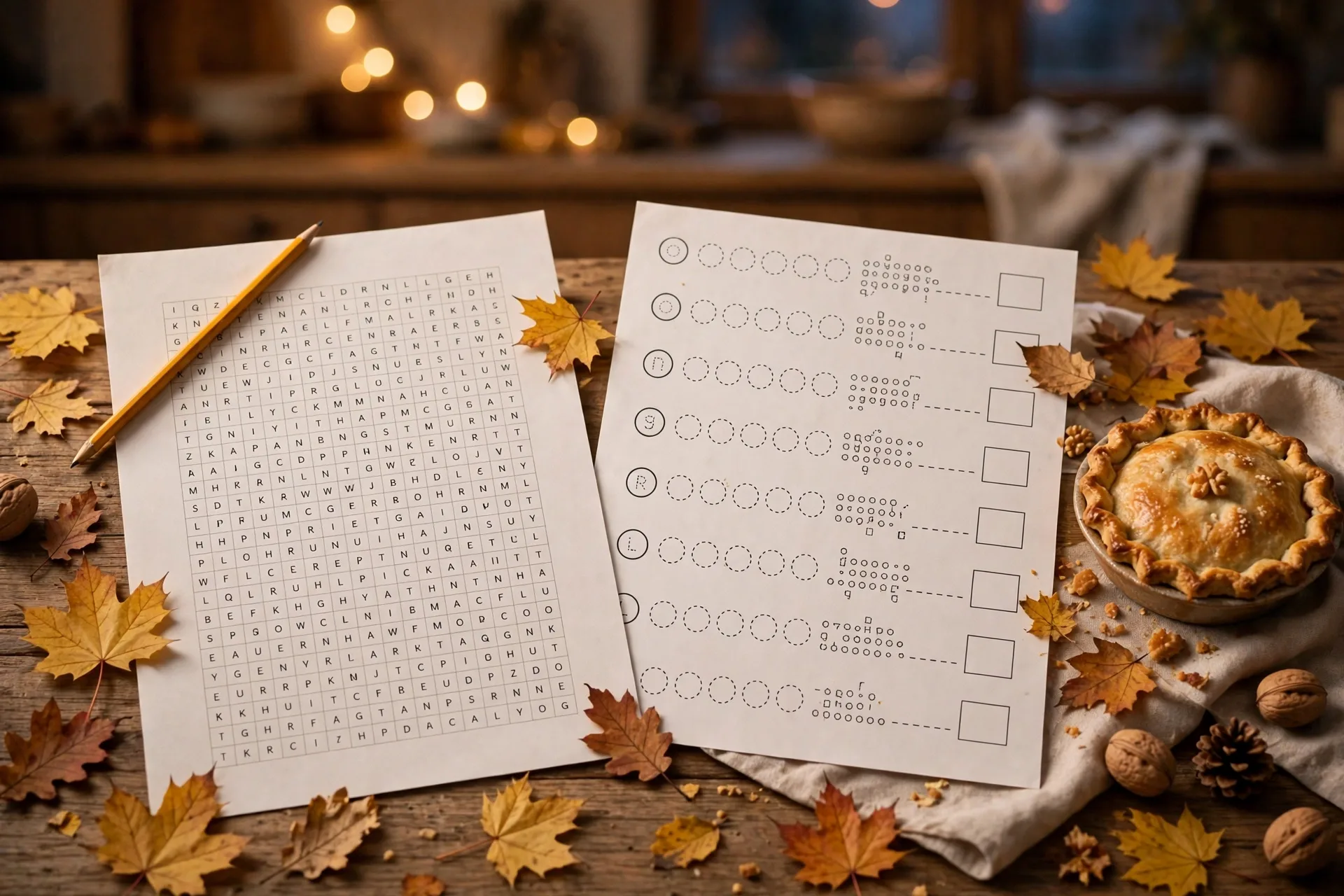
7. Thanksgiving Word Search. What is on the page: a word grid with Thanksgiving vocabulary, in three levels: easy (10 words), medium (14 words), and hard (18 words). Ages: 6 to 10, by level. What it teaches: vocabulary and spelling. How to use it: talk through the word list before searching begins, so the words mean something before they are hunted. Five minutes on the meanings first (harvest is gathering crops when they are ripe; cornucopia is a horn-shaped basket overflowing with fruit) turns a puzzle into a vocabulary lesson.
8. Word Scramble and Crossword. What is on the page: a Thanksgiving word scramble (unscramble festive words like “pumpkin” and “gratitude”) plus a crossword with simple picture clues. Ages: 8 to 10. What it teaches: spelling, problem solving. How to use it: let the scramble be the warm-up and the crossword the main event. Keep the word bank visible; the fun is in the solving, not in memorizing. These two are the right pick for the big kid who is “too old for coloring pages” but still wants in.
Puzzles, Gratitude, and Creative Pages (Worksheets 9 to 12)
The last four are the reason Thanksgiving worksheets are better than generic ones. A maze that ends at a dinner table. A page that asks what you are thankful for. The holiday is baked into the activity.
9. Dot-to-Dot Turkey. What is on the page: numbered dots, 1 through 30, that connect to reveal a turkey. Ages: 4 to 7. What it teaches: number sequencing and fine-motor control. How to use it: connect the dots in order, then color the revealed turkey. The reveal is the reward, so resist the urge to say what it will be. For younger kids, call out every fifth number as a checkpoint (“great, you found 10!”).
10. Maze: Turkey’s Path to the Feast. What is on the page: a maze that starts at a turkey and winds to a Thanksgiving dinner table, with a couple of dead ends for drama. Ages: 5 to 9. What it teaches: planning and fine-motor control. How to use it: trace the path with a finger first, then draw it with a crayon. Finger-first separates the planning from the drawing for younger kids. Time it for a competitive sibling pair, or do it twice and try to beat the first run.
11. “I Am Thankful” Writing Pages. What is on the page: two designs: one with fall leaves, pumpkins, and acorns framing a blank writing space, and one with a turkey and a big slice of pumpkin pie for drawing what you are thankful for. Ages: 4 to 10. What it teaches: gratitude and self-expression. How to use it: write or draw one thing you are thankful for per leaf, or fill the pie slice with a picture. Younger kids draw; older kids write a sentence or two. Display them afterward: tape them to the fridge, or set them at each seat on Thanksgiving Day as conversation starters.
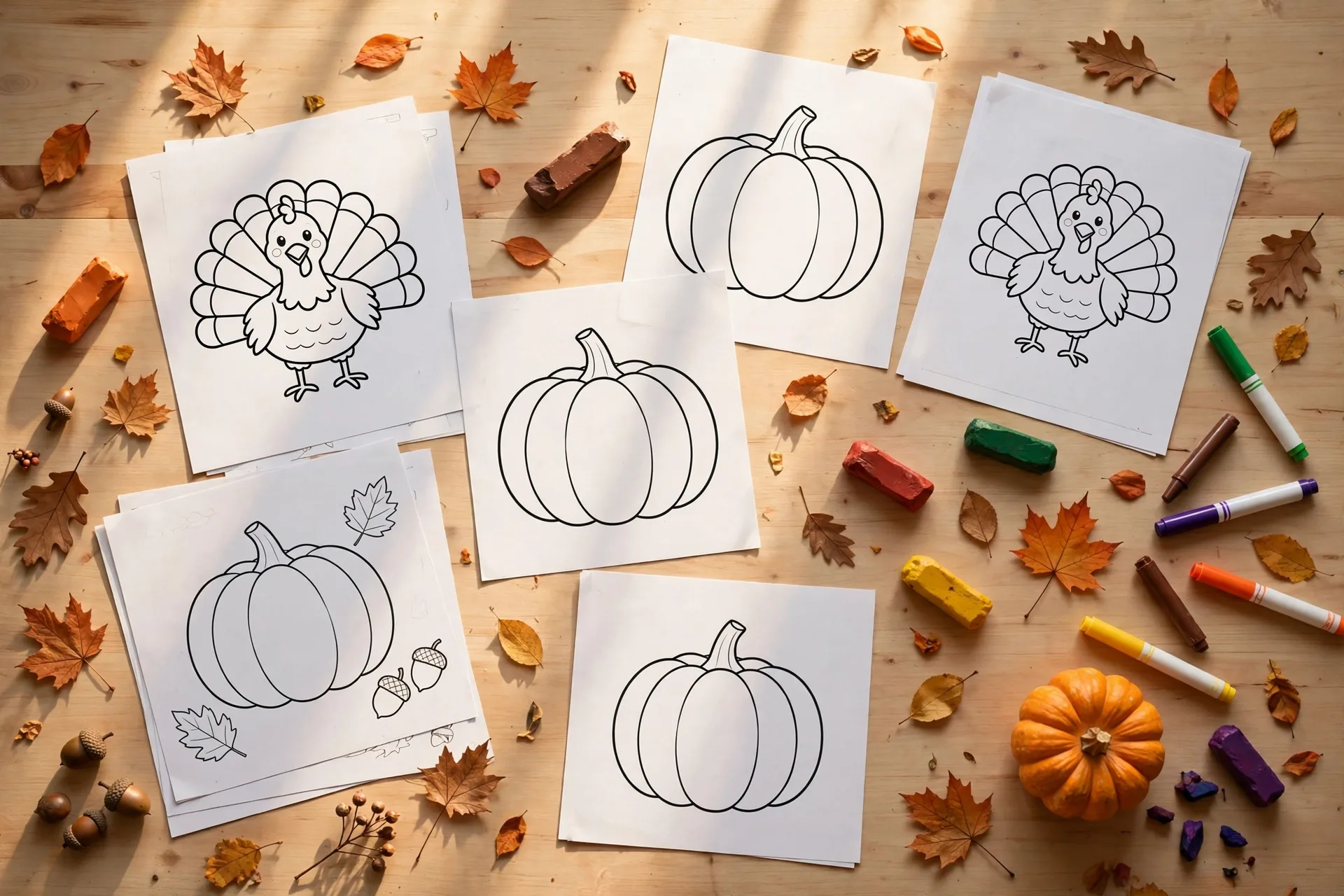
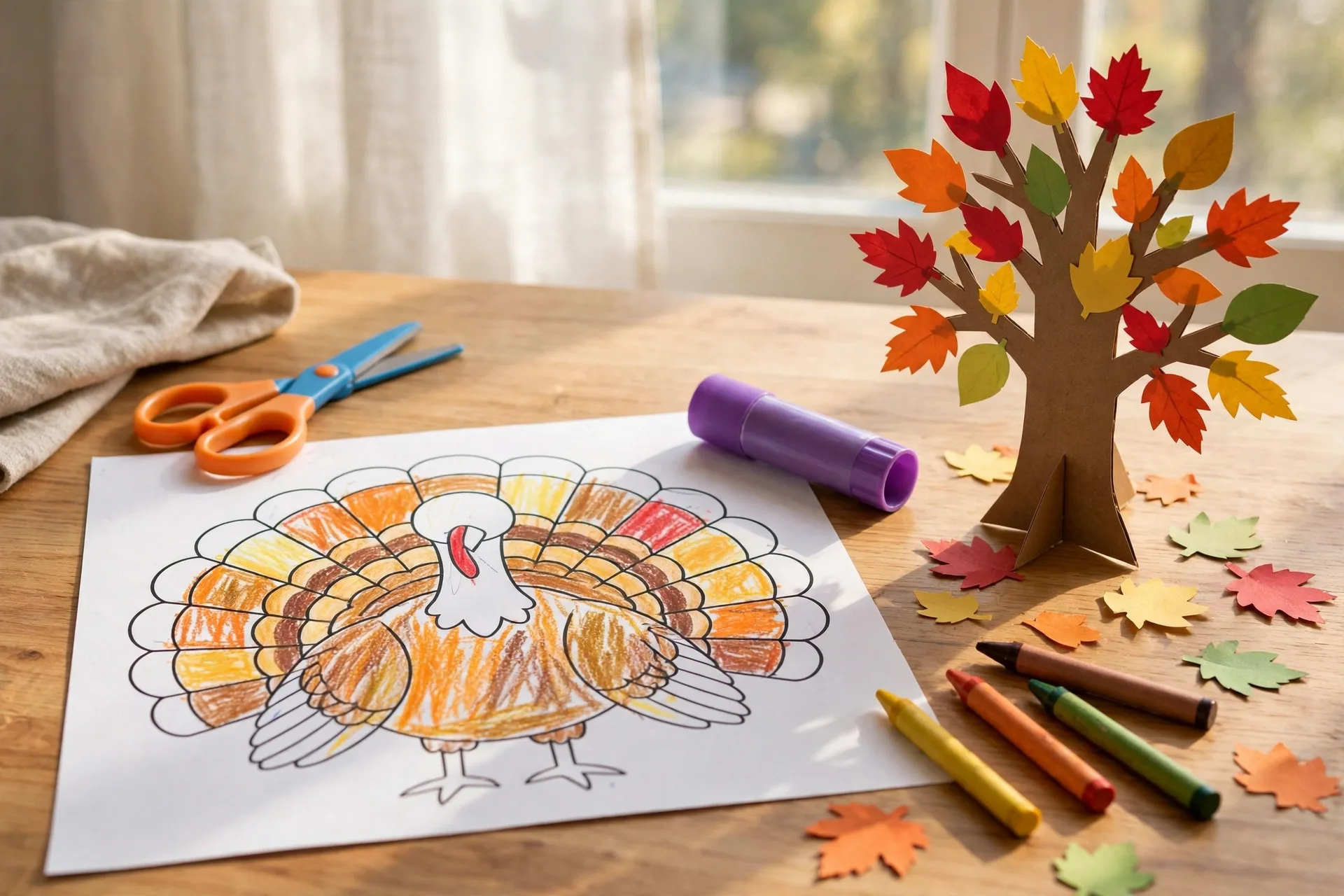
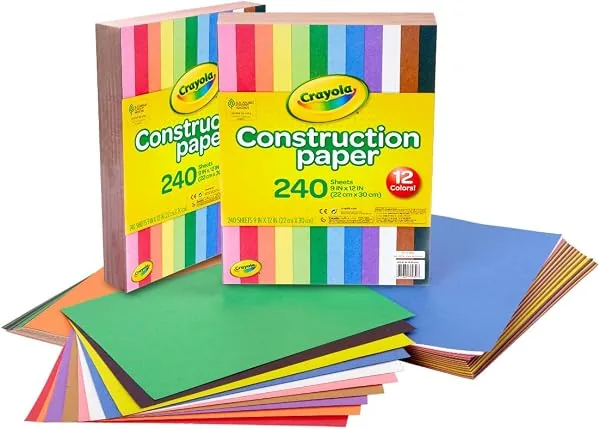
12. Thanksgiving Coloring Pages. What is on the page: big, simple turkey, pumpkin, and cornucopia outlines with thick lines and wide open spaces. Ages: 2 to 6. What it teaches: color exploration and the joy of a calm page. How to use it: this is the wind-down worksheet, for the toddler who cannot do the word search and the kid who has finished everything else. Back the printed page with construction paper to keep marker bleed off the table, and let the coloring be open-ended. A real leaf hunt beforehand (go find the colors outside, then match them on the page) turns this into an afternoon.
The Three-Pages-Tonight Rule
If the holiday week has already started and you need something now, print three: one counting page, one coloring page, and one thankful page. The counting page practices a skill, the coloring page buys you quiet time, and the thankful page carries the meaning of the holiday. Everything else on this list is bonus.
Printing Guide: Good Pages, Cheap Ink
Paper. Regular copy paper is right for every puzzle and writing page on this list. Reach for cardstock only for the coloring pages, which take marker and crayon abuse better on thicker stock.
Grayscale vs. color. Word searches, scrambles, crosswords, and mazes print beautifully in grayscale. Save the color ink for the color-by-number key and the coloring pages, where the colors actually matter. When you print grayscale, say so in the print dialog.
Fit to page. The single most common worksheet problem is a clipped edge. Open the print preview, check that the whole page fits, and choose the fit-to-page setting before you hit print. If the preview shows a sliver of margin cut off, that is your sign.
One adult owns the printer. Printing is a grown-up job: the printer gets hot, paper trays pinch little fingers, and ink cartridges are not toys. Kids can press “print” only with a grown-up standing right there.
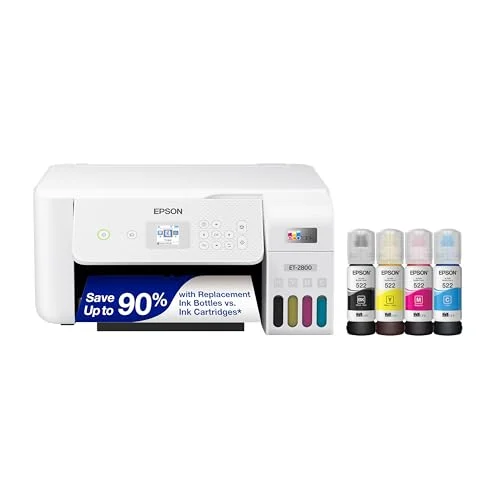
The upgrade that changes the ink math. If your house prints a lot (worksheets this week, coloring pages next week), a refillable ink-tank printer like the Epson EcoTank ET-2800 Printer removes cartridges from the equation entirely. Just the listing facts: refillable tanks, up to 4,500 black and 7,500 color pages from one ink set, and Epson says up to 2 years of ink comes in the box.
Epson EcoTank ET-2800 Printer
The one upgrade that changes the math on a print-heavy week: a refillable ink-tank printer, so no cartridges at all. Epson rates a single ink set at up to 4,500 black and 7,500 color pages, and says up to 2 years of ink comes in the box. A whole season of worksheets for pennies of ink per page.
One Week of Worksheets
You do not need all twelve at once. Spread them across the week before Thanksgiving and the holiday feels like a season instead of a day.
Monday: Counting pages (1 and 2). Start with numbers; they are the easiest on-ramp.
Tuesday: Literacy pages (5 and 6). Alphabet and tracing while the week is still calm.
Wednesday: Puzzles (7 and 9). Word search plus dot-to-dot: one quiet, one revealing.
Thursday: The meaning day (11 and 12). Thankful pages in the morning, coloring pages while dinner cooks.
Friday: Leftovers for the kids’ table (3, 4, 8, 10). Whatever did not get used during the week becomes Thanksgiving Day ammunition.
The Thanksgiving Day Kid-Table Plan
Set the kids’ table with four pages per child: a coloring page, a maze, a word search at their level, and a thankful page. Add a cup of crayons per two kids (sharing is the point of the kids’ table), and one rule: finished pages go in the middle of the table for everyone to admire. You will get forty-five minutes of happy noise, which is exactly what the adults need to get dinner on the table.
Troubleshooting the Worksheets
A page prints with a clipped edge. Check the print preview and choose fit-to-page before you print the stack.
The page is too hard. Cover half of it with scrap paper and do one section at a time, or drop to the easier version. Smaller tasks keep the focus on the skill instead of on finishing.
The page is too easy. Add a challenge layer: time the maze, do the word search with the word list covered, or have the child explain the answer aloud first. Explaining is its own skill.
Ink costs are the real problem. Print puzzles in grayscale, print only what you will use this week, and run the refillable-tank math for the long haul.
Shop This Post
Everything used in this guide, in one place:
| Product | Used For | Price |
|---|---|---|
| Epson EcoTank ET-2800 Printer |
Printing the whole worksheet week on cheap ink | Check Price |
 Crayola Construction Paper, 480 Sheets |
Backing coloring pages to stop marker bleed | Check Price |
Frequently Asked Questions
What ages are Thanksgiving worksheets for?
This set covers ages 2 through 10. Coloring and pointing pages suit toddlers, counting and letter recognition suit preschoolers, color by number and tracing suit kindergarten through second grade, and word searches, scrambles, and crosswords suit older elementary kids. Let readiness guide the pick, not the age number alone.
How many pages should I print?
Start with three: one counting page, one coloring page, one thankful page. Add more through the week only if your kids ask for them. A stack of twelve unused pages is just recycling with extra steps.
Can I print these in black and white?
Yes for the puzzles, mazes, word searches, and writing pages. Print the color-by-number key and the coloring pages in color, since the color is the point of those two.
What paper should I use?
Regular copy paper for everything except the coloring pages, which deserve cardstock if you have it. Marker bleed on thin paper ruins a good coloring page.
Can toddlers actually do worksheets?
Toddlers can point, name, scribble, and color alongside a grown-up, and that counts. The expectation is participation, not completion.
Can teachers use these in the classroom?
A small selection works beautifully: I-Spy and letter recognition for centers, the word search for early finishers. Print one copy first to check fit-to-page, then run the stack.
Print Three Tonight
That is the whole playbook: pick three pages tonight, print the puzzles in grayscale, spread the rest across the week, and let the thankful page carry the meaning. Twelve worksheets, zero store runs, one very happy kitchen table.
Our house ended last November with the two-year-old’s coloring page taped to the fridge and the four-year-old’s thankful page (“pie”) sitting at her seat. Yours will have its own version. Happy Thanksgiving, mama.
More Thanksgiving guides on MamaKinder
Thanksgiving Ideas for FamiliesThanksgiving Coloring Pages Free PDFThanksgiving Handprint CraftsThanksgiving Painted Rock IdeasFree Coloring Pages for Kids