Thanksgiving Jeopardy Game: 31 Questions for the Whole Table
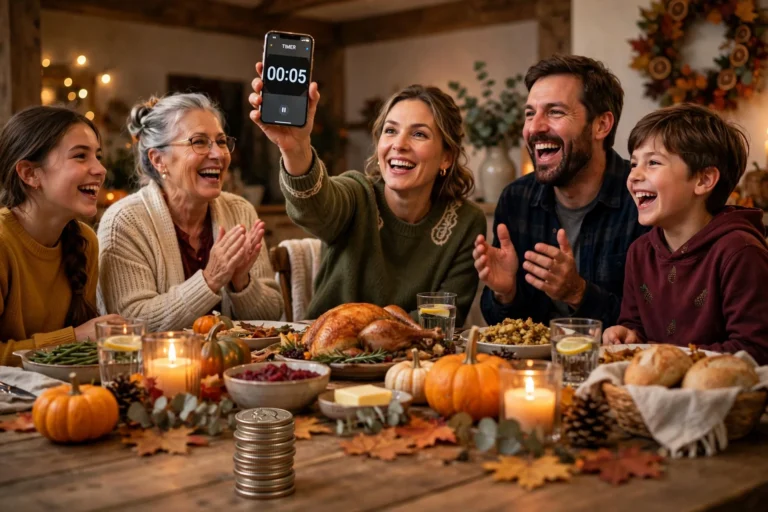
Last Thanksgiving, in that stretch between the pie and the third cup of coffee, my husband’s uncle turned to the room and said, “So. Now what?” Fourteen people, zero plans, and that particular full-and-sleepy silence that makes hosts panic. My four-year-old saved the evening. She stood on a chair, pointed at my phone like a game show host, and announced, “It is time for the guessing game.” An hour later my mother-in-law was undefeated and the uncle was demanding a rematch. That is the Thanksgiving Jeopardy Game, and this year you can host it with nine full rounds and 31 ready-to-play questions that work at a real holiday table.
The setup is simpler than the name sounds. Build a little board with categories and question cards, teams take turns picking a category and a point value, and they answer in the form of a question. Kids can play. Grown-ups can play. The two-year-old in the high chair can play by yelling whatever his brother whispers to him (my own two-year-old’s actual strategy last year). Below are the 9 rounds, in play order: the build, the main board, the kid-friendly rounds, and the big-finisher rounds. A full run takes about 45 minutes, or 20 if dessert is already melting.
Heads up: this post contains affiliate links. If you buy through them, MamaKinder may earn a small commission at no extra cost to you. It helps keep these guides free.
Why Jeopardy Works at Thanksgiving
Trivia games live or die on one thing: whether everyone at the table can play at once. Jeopardy passes that test because teams answer together, not one by one.
The drama is built in. Daily Doubles and Final Jeopardy give the night a beginning, a middle, and an end. You do not have to be a charismatic host. The game structure does the entertaining.
It fits the real mix at the table. Ages four to eighty-four, the cousins who see each other twice a year, Grandma who knows everything. The four-year-old contributes real answers from the kids’ questions while the grown-ups sweat the 500-pointers. Nobody is benched.
Zero screen time, zero cost to start. The board is paper and tape, the buzzers are optional and free (more on that below), and the whole game happens at the table, in the conversation, while the dishwasher runs.
Build the Board (20 Minutes, Day Before or Morning Of)
Two options, both work.
Print the question cards. Type each round’s questions into a document, print, and cut them into cards. An Epson EcoTank ET-2800 printer handles a stack like this without a cartridge panic: Epson’s refillable ink tank system is rated at up to 4,500 black and 7,500 color pages from one ink set, with up to 2 years of ink in the box.
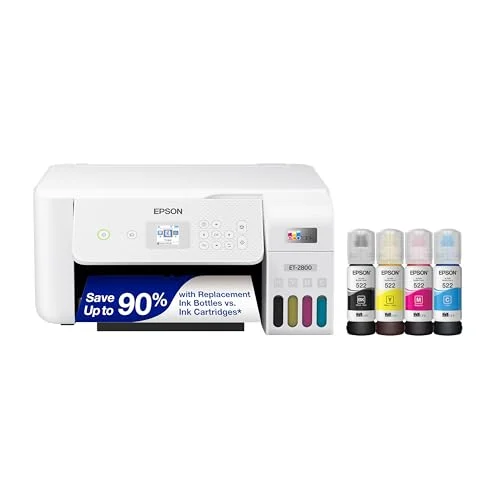
Epson EcoTank ET-2800 Printer
The printer behind the question cards matters more than any single setting. The EcoTank ET-2800 swaps cartridges for refillable ink tanks, and Epson rates one ink set at up to 4,500 black and 7,500 color pages, with up to 2 years of ink in the box. A whole stack of question cards costs pennies instead of a cartridge panic.
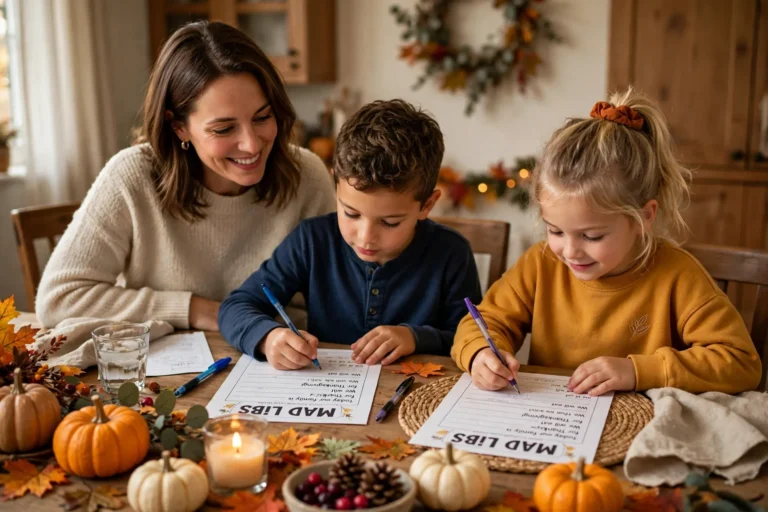
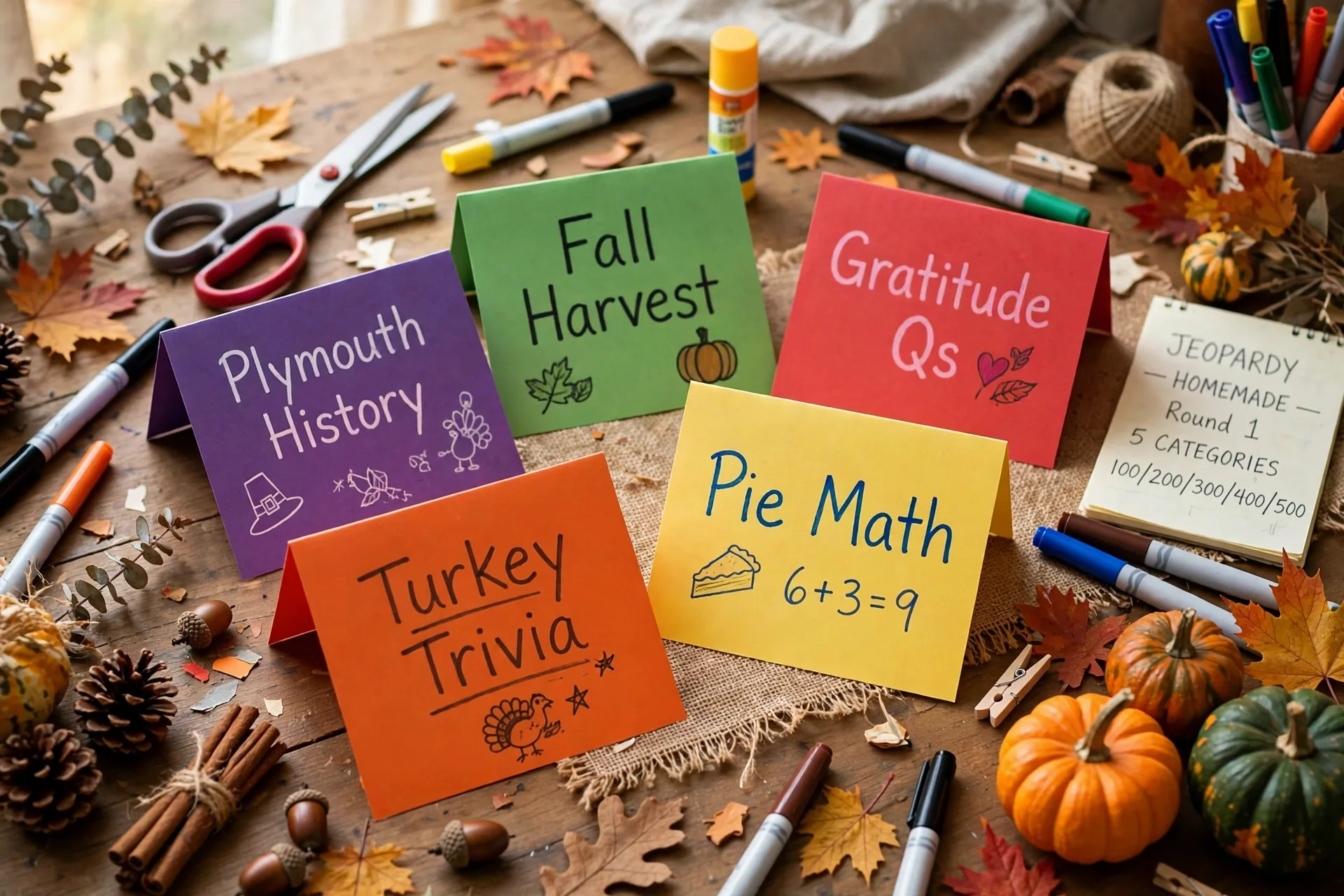
Or handwrite on index cards. The route we took last year, and the kids loved seeing the cards appear in Mom’s handwriting. Write the category on a folded card, the question on the back of a card, the answer in tiny letters in the corner.
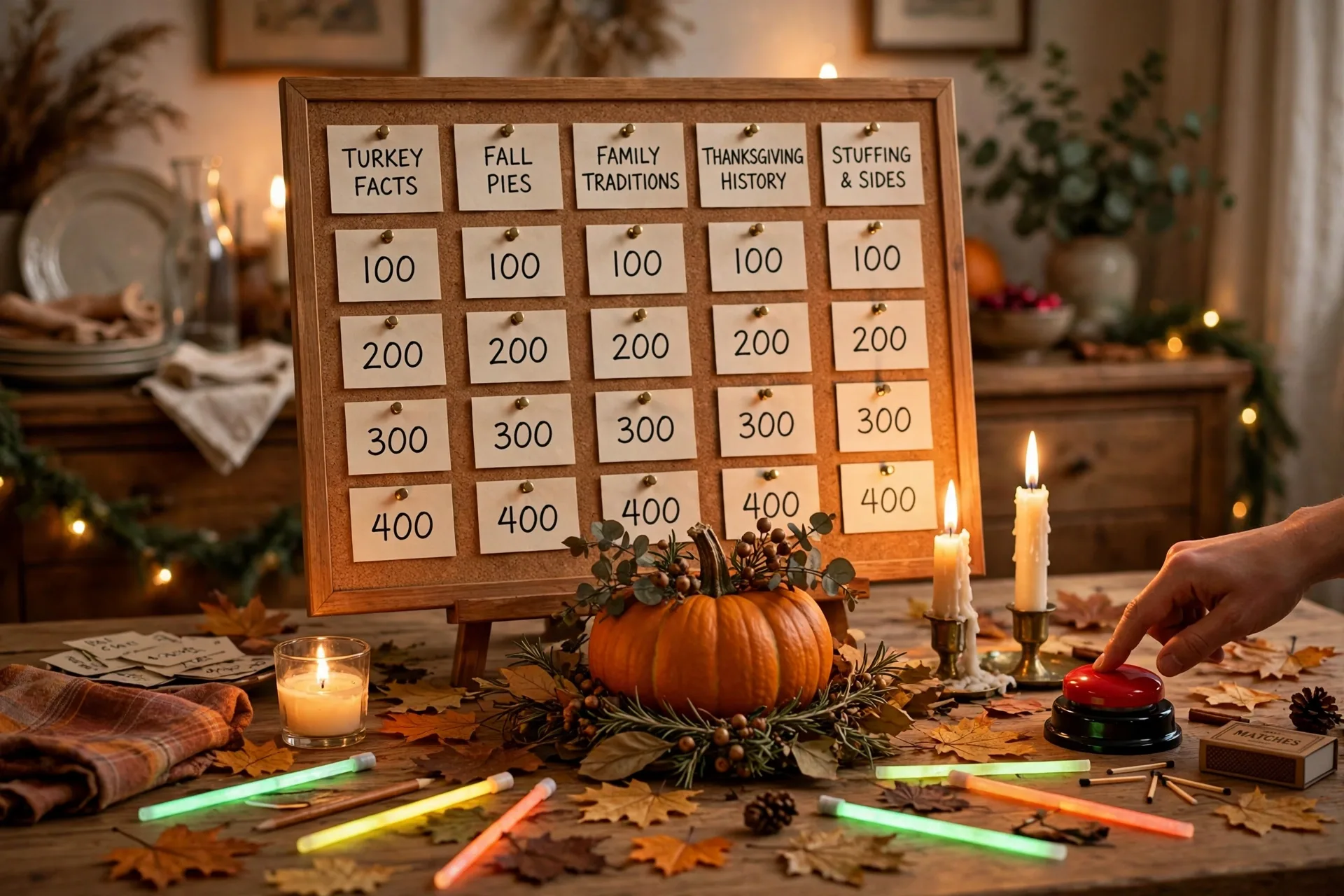
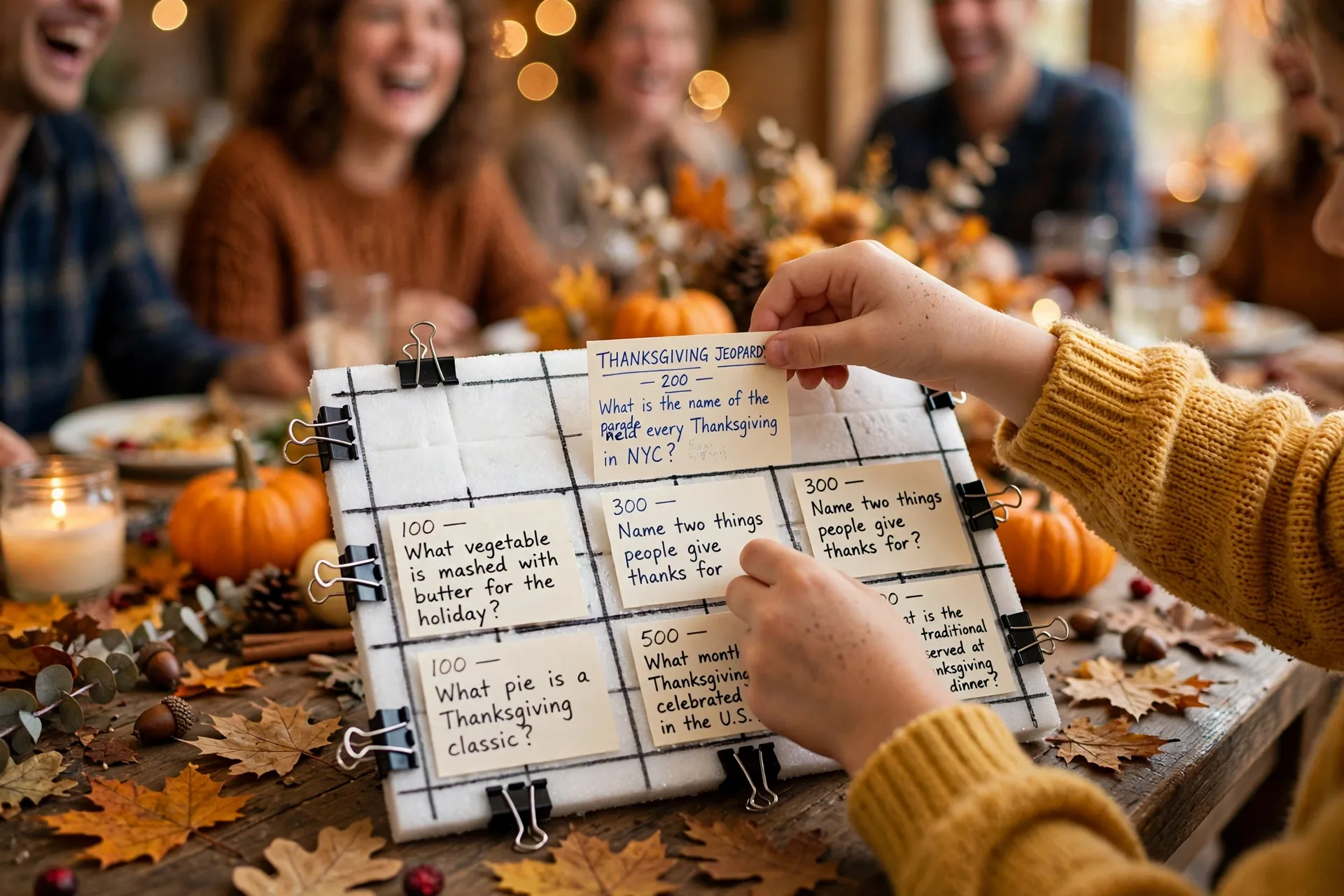
Lay the categories across the top of a table, a foam board, or a cookie sheet with magnets, with point values (100 to 500) on cards beneath each. When a team picks “Turkey Trivia for 300,” you read the card and remove it from the board. A grown-up runs the board when little kids are playing, reading questions aloud and tracking points on a scrap of paper.
The 9 Rounds
Every question below is original, written for this game. Thirty-one questions in all, counted across the nine rounds, so the board never runs dry before dessert.
Round 1: The Classic Board (everyone, ages 6 and up)
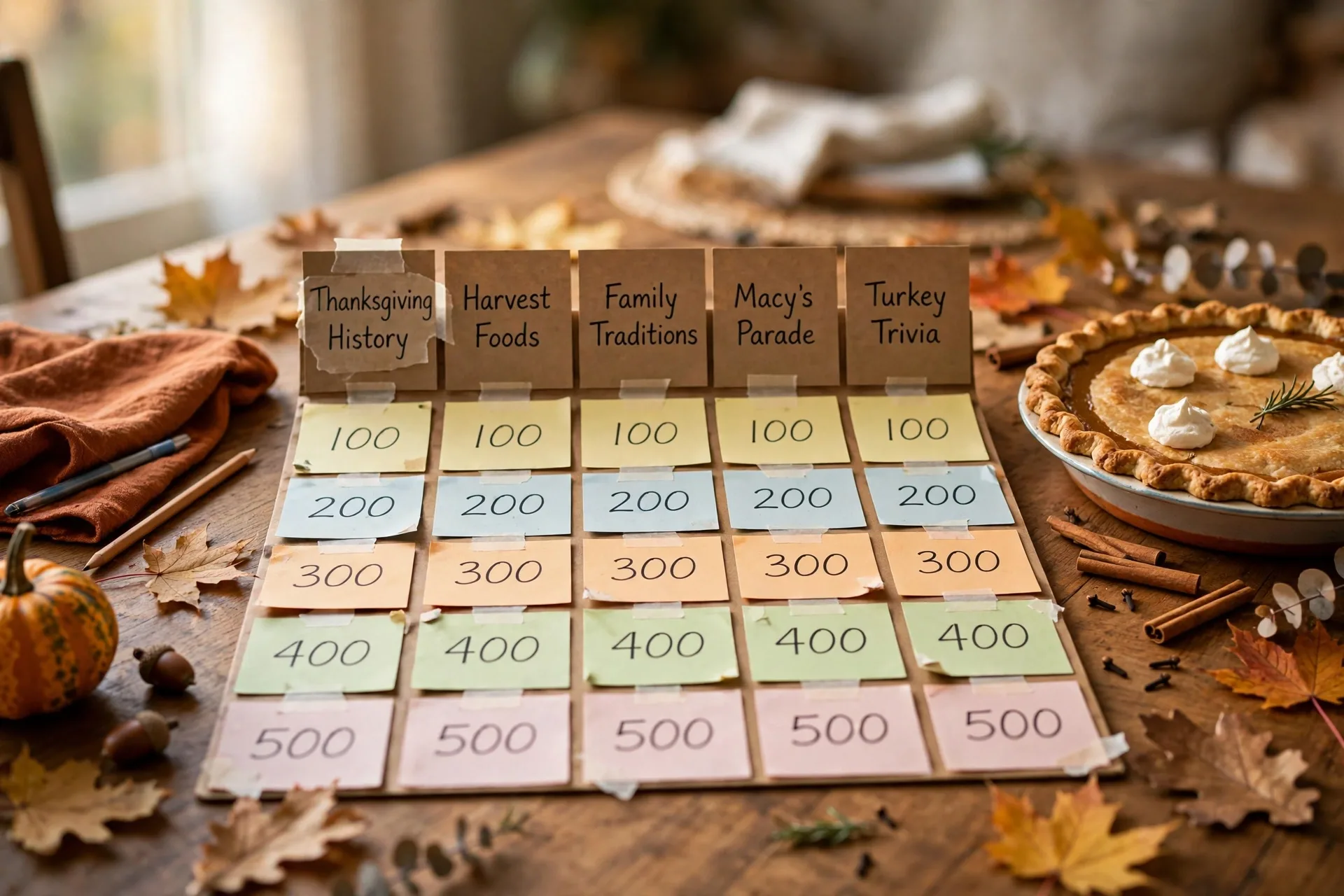
The core Jeopardy round: teams pick a category and a value, and answers must be phrased as a question (“What is the Mayflower?”). Teams play in turn order, so everyone gets questions and nobody is eliminated early.
Sample questions from the board:
100 · Food: The red sauce that comes jellied or whole-berry. (What is cranberry sauce?)
100 · Parade: The last float of the famous parade carries this holiday guest. (Who is Santa Claus?)
200 · History: The ship that brought the Pilgrims to America in 1620. (What is the Mayflower?)
200 · Parade: The giant balloon cat that starred in the first big parade in 1927. (What is Felix the Cat?)
300 · History: This president made Thanksgiving a national holiday. (Who is Abraham Lincoln?)
400 · Food: The bread-based side dish baked with herbs and celery. (What is stuffing or dressing?)
400 · History: The Native people who shared the 1621 harvest feast with the Pilgrims. (Who are the Wampanoag?)
500 · Wordplay: A baby turkey covered in fluffy down. (What is a poult?)
One house rule to decide before you start: with grown-ups, require the question form, since it is the whole flavor of Jeopardy. With kids under ten, drop it and just take answers.
Round 2: Make Your Own Category Cards (ages 4 and up)
Half craft, half game. Give each team folded construction paper and a marker, and they invent one category for the board, with five questions and secret answers on the back. The 480-sheet pack in assorted colors covers a whole holiday season of games. A grown-up handles the scissors, and the host reads the teams’ questions aloud so nobody hides a riddle nobody else can answer. House rule: every team-made question must be answerable by someone else at the table.
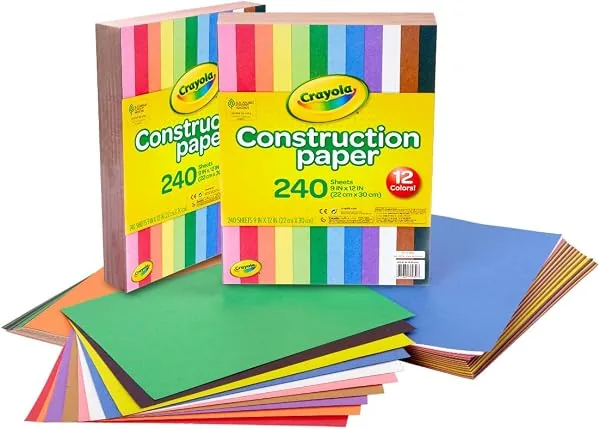
Crayola Construction Paper — 480 Sheets
The paper behind the DIY category cards: a big 480-sheet pack in assorted colors, so teams can cut, fold, and handwrite a whole season of game boards. A grown-up handles the scissors.
Round 3: The Kids Board (ages 4 to 7)
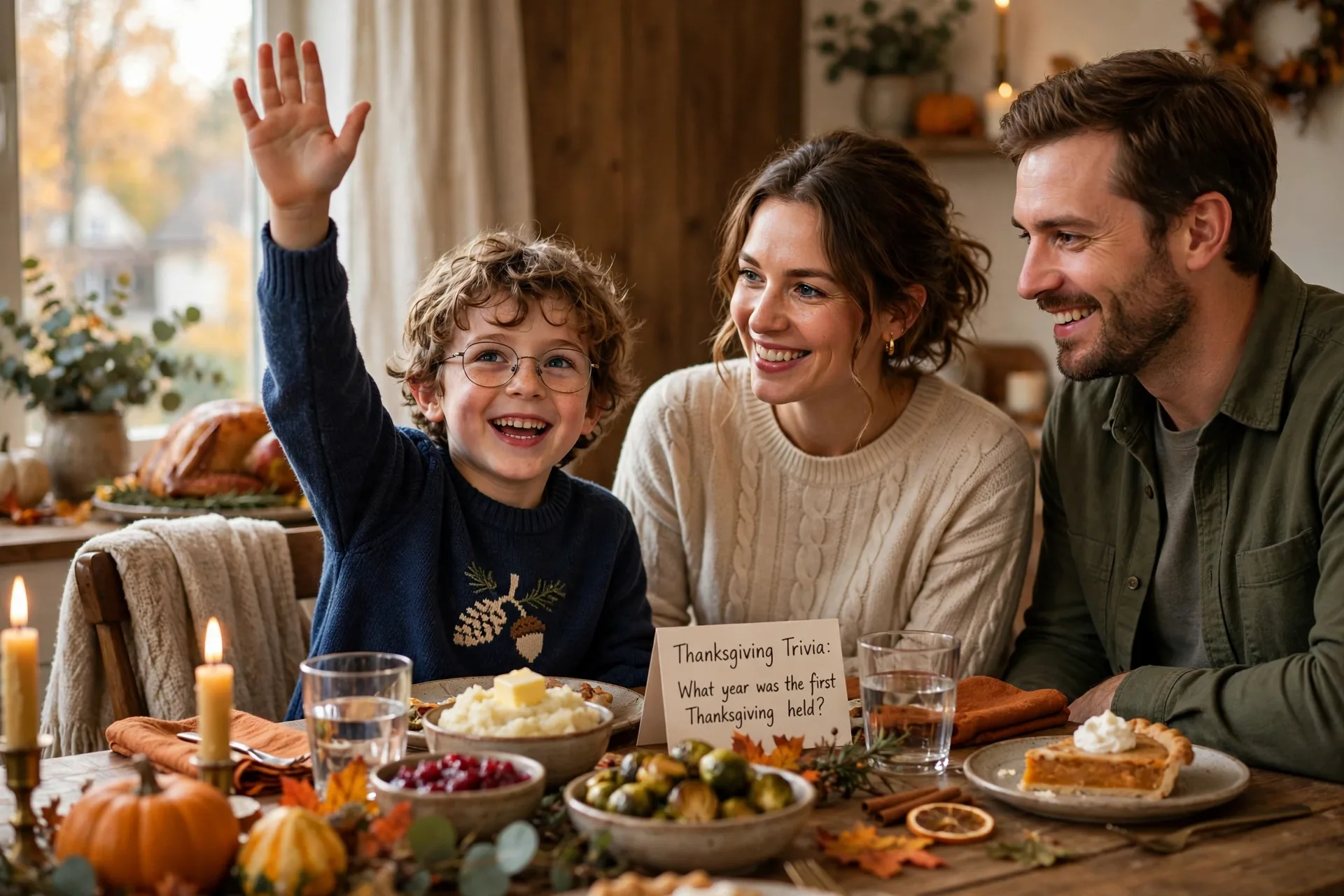
The whole board goes easy and the host reads every question aloud. No timers, no point loss, and “pass” is always allowed with zero judgment.
The Kids Board questions:
100: The big bird on the table. (What is a turkey?)
200: The orange vegetable Grandma bakes with marshmallows. (What is a sweet potato?)
300: The season when leaves turn red and gold. (What is fall or autumn?)
400: The round bread rolls in the basket. (What are dinner rolls?)
500: The dessert made from the orange gourd. (What is pumpkin pie?)
Let the youngest player answer first every time. If a little one freezes, the host smiles and passes the question to the table. Laugh with the answers, never at a frozen kid.
Round 4: Family History Round (everyone)
The round people talk about for years. Before dinner, the host collects three to five family facts on slips of paper, and each becomes a Jeopardy question in your family’s own categories: “Grandma’s Life,” “The Kitchen,” “Holiday Legends.”
Write-your-own examples (swap in your real facts):
100: Grandma’s first job as a teenager. (What is a grocery checker?)
300: The year Mom and Dad got married. (What is the year on your calendar?)
500: The weirdest thing ever found in the turkey. (What is whatever really happened that year?)
Keep it loving. The target is the shared story, never a person. Skip anything that would embarrass a grandparent or start a real argument.
Round 5: The Gratitude Round (everyone, best right before dessert)
Five questions about giving thanks, answered by the whole table at once. Everyone who answers gets the points, because gratitude is not a competition and this round says so out loud.
100: Name one thing you are thankful for this year. (Anything goes, “pie” included.)
200: Name one person at this table you are glad showed up. (Look them in the eye when you answer.)
300: Name one Thanksgiving tradition your family always keeps. (Open ended, perfect for stories.)
400: Name one thing somebody at this table did for you this year. (Specific beats general.)
500: Name one hope you have for next Thanksgiving. (Silly hopes count double in our house.)
Keep it silly if your family prefers: “My dog” and “the good rolls” are perfectly good answers.
Round 6: The Speed Round (ages 8 and up)
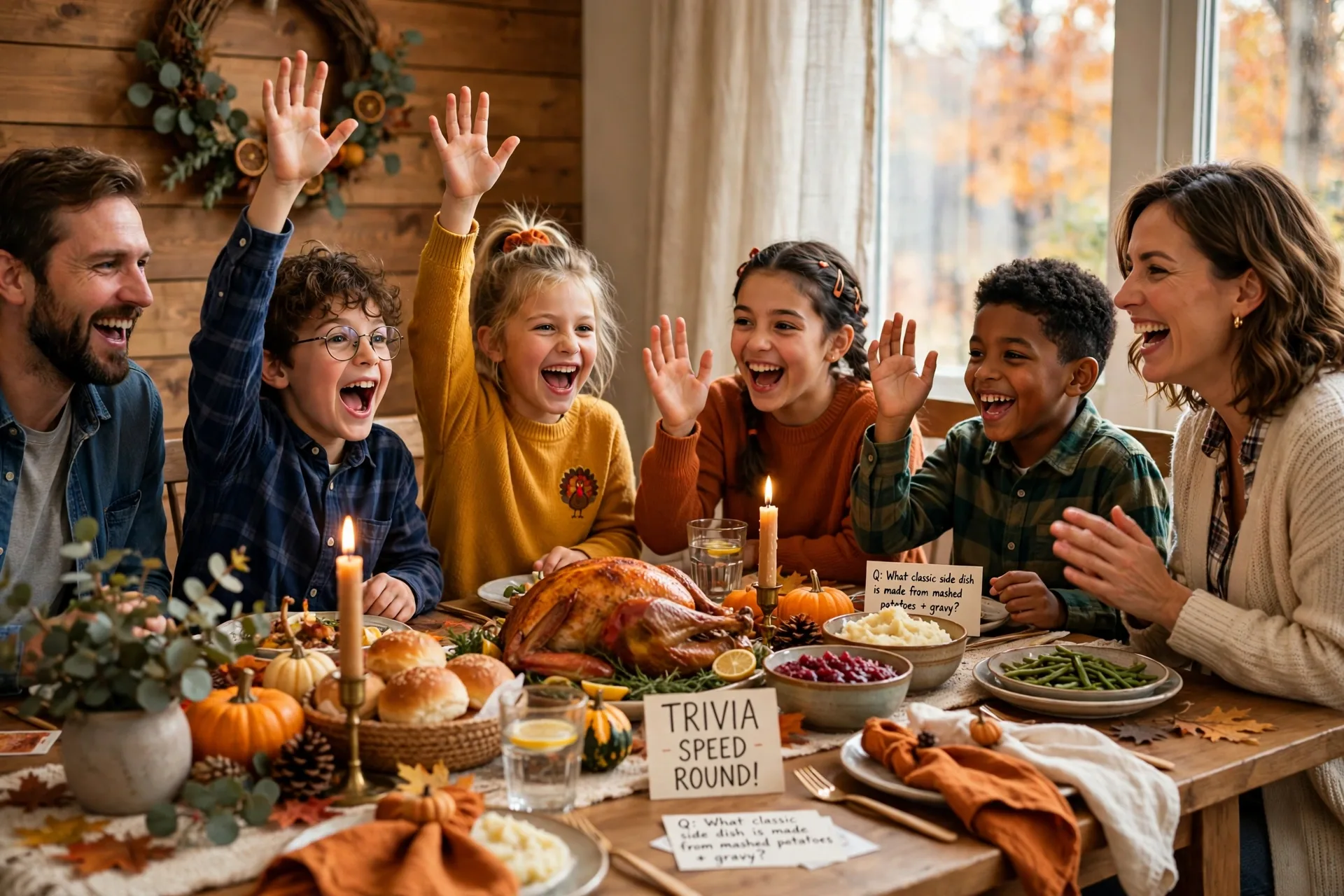
One minute, one team at a time, as many 100-point questions as they can answer. The host fires short questions and the team shouts answers. No buzzers, no turns, no auditing. The point is noise and laughter.
Speed questions (use these or any of the Round 1 100s):
The bird on the table. The orange vegetable. The red sauce. The season of falling leaves. The holiday after Thanksgiving with the big sales. The ship from 1620. The last float guest. The dessert from the orange gourd. The three-day gathering year. The month Thanksgiving falls in.
Round 7: The Picture Round (everyone)
The host shows pictures and teams identify them. Least preparation, biggest reactions. Hold up a photo on a phone, teams shout the answer in question form. Each picture is worth 300 points, flat.
Picture ideas (find these before the game): a photo of your own Thanksgiving table from last year, a cranberry bog, a parade balloon from the news, a wild turkey, a cornucopia, and a photo of Grandma as a teenager (the single best picture-round question ever asked at our table). If little kids are playing, give them the first guess on every picture. They are faster at visual answers than adults, and watching a four-year-old nail “Grandma, obviously” is the night’s best moment.
Round 8: Daily Double Rules (ages 10 and up, or all-ages with host help)
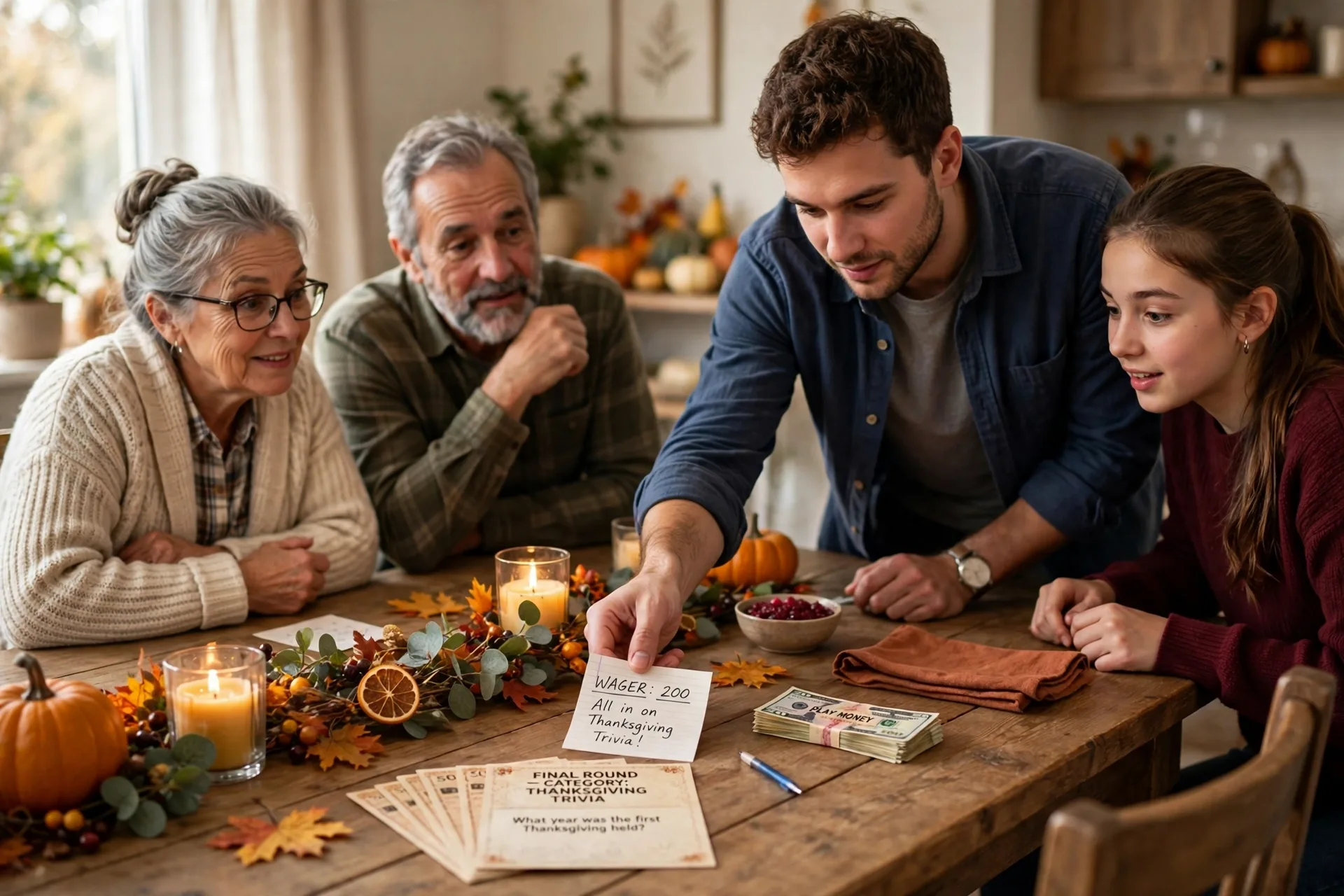
Two questions on the board are secretly marked Daily Doubles before the game. When a team picks one, the team answers alone, wagers any amount from 100 up to everything they have, gains the wager if right, loses it if wrong. Keep the wagers small and friendly at a family table. The point is the gasp when someone bets it all on “Parade 500,” not actual heartbreak. If the teams are uneven, the trailing team gets both Daily Doubles, announced before the game so it feels like a rule, not pity.
Round 9: Final Jeopardy (everyone)
One question, the finale:
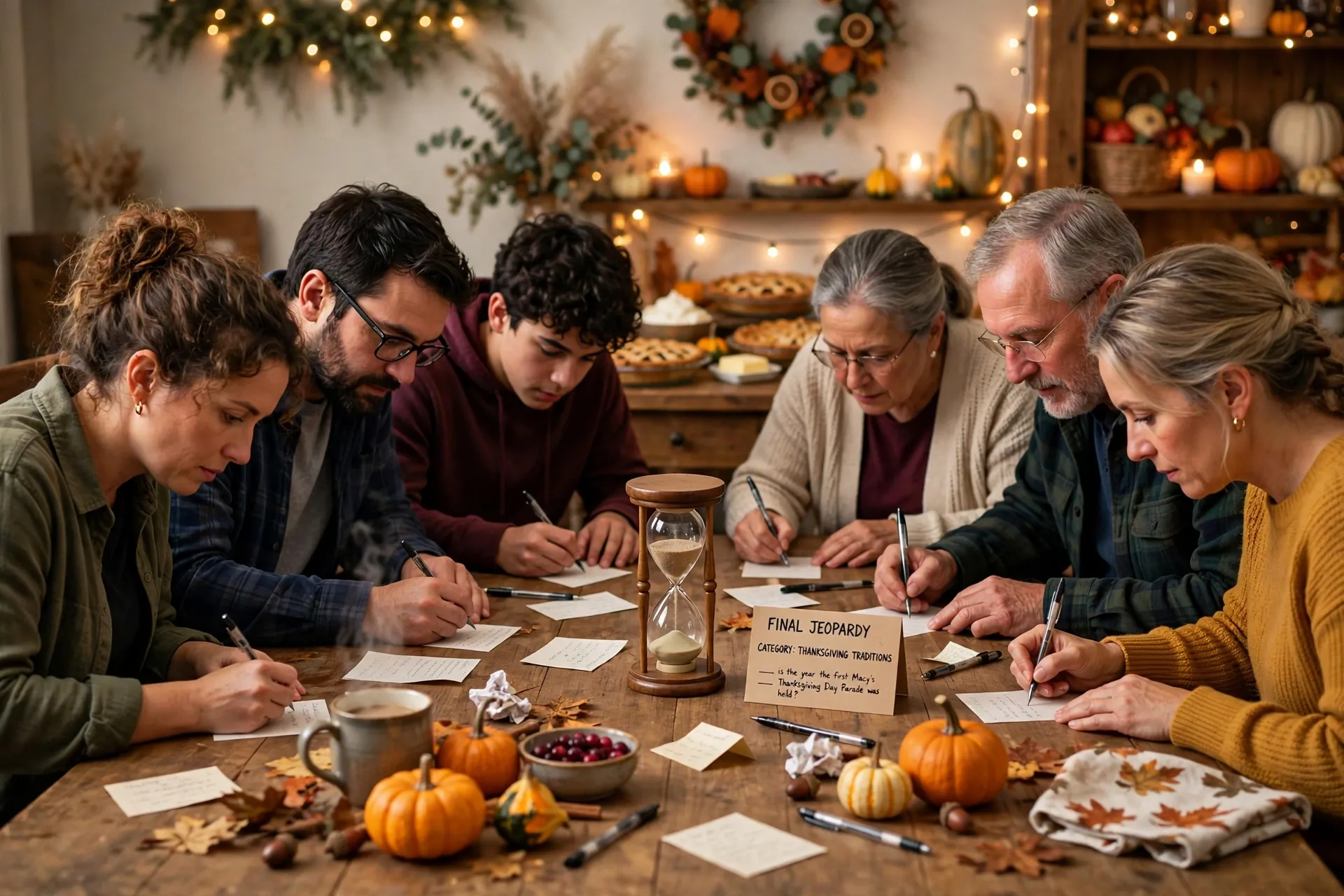
- The host reads ONLY the category. Everyone gets one minute to write down their wager on a slip of paper.
- The host reads the question. Teams have one minute to write their answer.
- The host reads the answers one team at a time. Right answers gain the wager, wrong ones lose it.
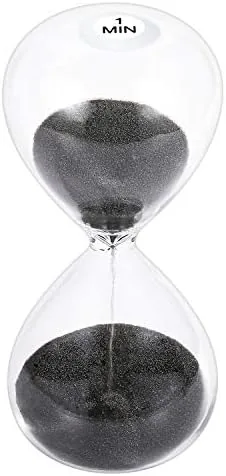
The one-minute timer matters, and the classic sand timer is perfect for it. A 1-minute hourglass sand timer runs a full minute, so it is exactly right for the Final Jeopardy writing round, not for timing single quick answers. It is glass, so the host holds it and the kids watch the sand fall.
Sand Timer — 1 Minute Hourglass
The drama pick for the Final Jeopardy writing round: flip it and the whole table watches the sand fall. This one runs a full minute, so it times the Final Jeopardy writing, not single quick answers. It is glass, so the host holds it.
Final Jeopardy sample question: Category: “Thanksgiving History.” The question: This harvest gathering in 1621 lasted three days, and Edward Winslow wrote about it in a letter. (What is the first Thanksgiving?)
The Round List (Copy and Print)
- Round 1: The Classic Board (categories, values, answers in question form)
- Round 2: Make Your Own Category Cards (teams invent a category)
- Round 3: The Kids Board (ages 4 to 7, no timers, no point loss)
- Round 4: Family History Round (your family’s own facts)
- Round 5: The Gratitude Round (everyone answers, everyone scores)
- Round 6: The Speed Round (one minute, as many as you can get)
- Round 7: The Picture Round (identify the photos, 300 points each)
- Round 8: Daily Doubles (secret, wager, answer alone)
- Round 9: Final Jeopardy (wager, write, one minute on the sand timer)
Hosting It Like a Game Show
Go teams for big tables. Ten or more people, split into two to four teams of three or four players so everyone answers. Shy players contribute from the huddle instead of the spotlight.
Appoint a host, not a player. One adult reads the questions, runs the board, and makes the final call on weird answers. The host does not play. This is the single biggest upgrade you can make, because a neutral judge ends every argument in three seconds.
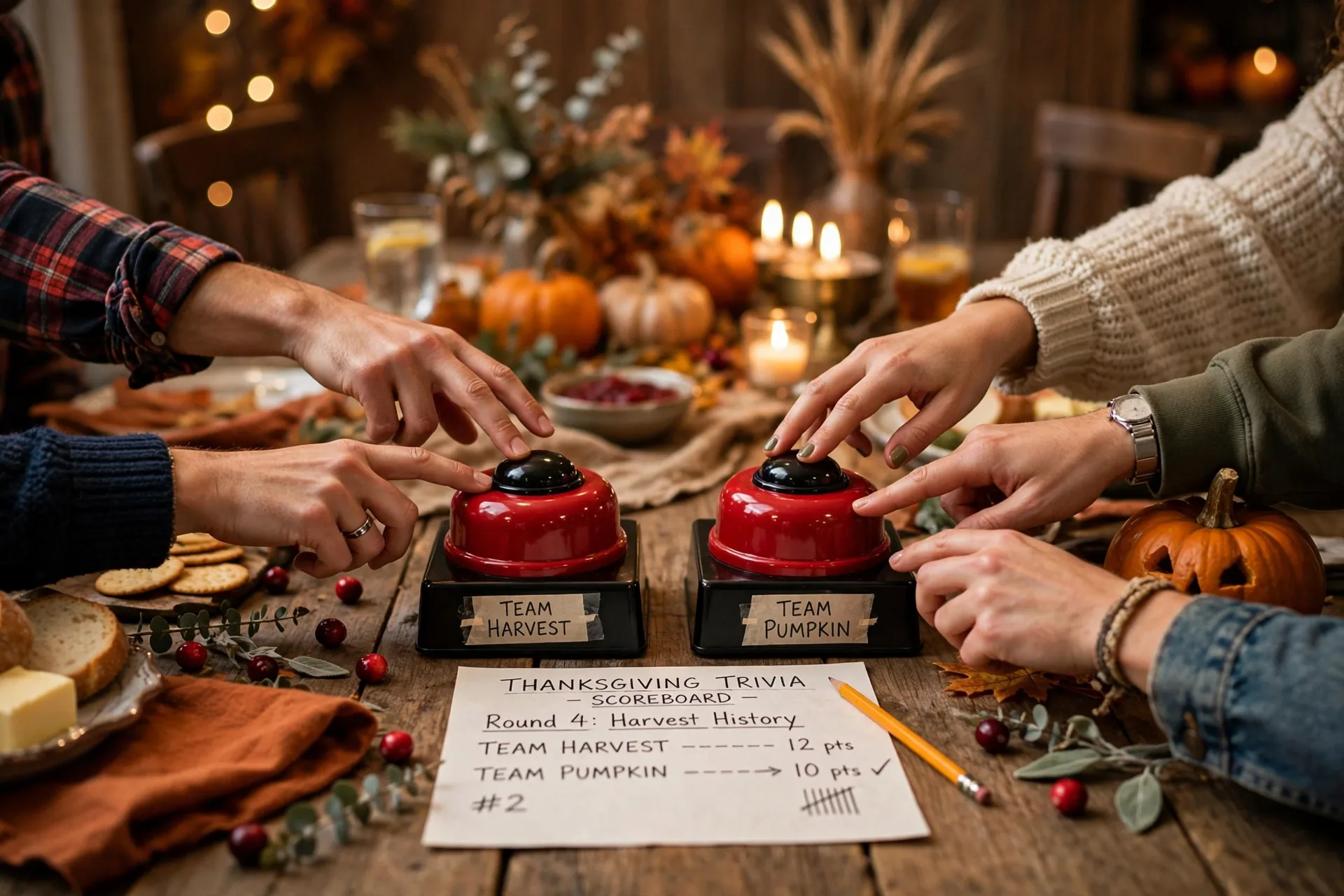
Buzzers are optional, and the free ones work. First team to stand, slap the table, or shout their team name all work. Only buy buzzers if your family plays trivia games all year, and even then rotate who holds the buzzer every few questions so one kid does not monopolize it.
Keep prizes cheap and instant. Glow-stick bracelets for the winning team of each round. They double as party favors, and the walk to the car after dark becomes a glow-stick parade. Hand the prize over the second the round ends. Crack the glow sticks before the game starts, and keep little ones supervised. The inside liquid is not for chewing.

Glow Sticks — 100 Pack
The winner prize that doubles as a party favor. Hand out glow-stick bracelets at the end of each round, and the 100-pack covers the whole table. A grown-up cracks and activates the sticks; little hands don’t do the bending.
Tie-breaker, decided before the game. Ties happen. Before the first question, announce it: one sudden-death 500-point question, first team to buzz in.
Where it fits in the day. The build goes in the morning. The game itself fits the dead hour between arrival and dinner, the turkey-resting window, or the post-dessert slump. Nine rounds run about 45 minutes; skip rounds 6 and 7 and you are at 30; run only rounds 1, 3, and 9 and you have a tight 20-minute game.
A Quick Word on Keeping It Kind
This game is trivia chaos, and keeping it kind is the host’s job:
- A grown-up runs the game when little kids are playing. Not a suggestion. The host reads the questions, tracks the points, and keeps the energy warm. Little kids freeze under pressure sometimes, and an adult host knows when to quietly move on.
- No mocking wrong answers. The joke is the game, never the person who got it wrong. The first time someone is teased for a wrong answer, the game stops being fun for the whole table.
- Match the rounds to the ages. The Kids Board is easy on purpose. Keep point loss for wrong answers out of any round kids play. If the ages are mixed, stick with rounds 1 through 5 and let the older players enjoy the handicap.
- No food shaming. Somebody at that table cooked the dish being named, or brought it, or is proud of it. The joke is the trivia, never the food. If an answer lands wrong, the host laughs it off and moves on fast.
Shop This Post
Everything used in this guide, in one place:
| Product | Used For | Price |
|---|---|---|
| Epson EcoTank ET-2800 Printer |
Printing the question-card sets at home | Check Price |
| Crayola Construction Paper — 480 Sheets |
Make-your-own category cards for Round 2 | Check Price |
| Sand Timer — 1 Minute Hourglass |
Timing the Final Jeopardy writing round | Check Price |
| Glow Sticks — 100 Pack |
Instant round-winner prizes that double as favors | Check Price |
Frequently Asked Questions
Do we have to answer in the form of a question?
With grown-ups, yes, it is the whole flavor of Jeopardy and the table will demand it. With kids under ten, drop it and just take answers. Announce the rule before round 1 and stick with it for the night.
How many of the 9 rounds should we play with little kids?
Rounds 1 (100s only), 3 (the Kids Board), 4, and 5 are the kid-friendly core. That is a solid 20-minute game. Save Daily Doubles and Final Jeopardy for when they are older, or let little ones answer teamed up with a grown-up.
Can we skip Final Jeopardy?
Absolutely. If the table is fading or dessert just landed, the game ends whenever you say it does. The team with the most points wins. Final Jeopardy is a great finale, not a requirement.
How long does the full game take?
About 45 minutes for all nine rounds with laughing and arguing included. Trim to 30 minutes by skipping the Speed Round and the Picture Round, or to 20 minutes with just rounds 1, 3, and 9.
Deal the Cards and Go
That is the whole game: build the board in the morning, deal the first category after the plates are cleared, and let the table do the rest.
Our table ended last year with my mother-in-law crowned champion and the uncle who asked “So. Now what?” already planning his Daily Double strategy for this year. Happy Thanksgiving, mama.
More Thanksgiving guides on MamaKinder