How Many Cans of Formula Per Month? A Simple Budget Guide

The first time I stood in the formula aisle with my daughter, I did the math in my head and got it wrong. I bought two cans, and we were back at the store four days later. By my second baby, I had a system: one can size, one simple formula, and a running count on the fridge.
Everything here uses one standard can size so the numbers stay comparable: a 12.5 ounce can of powder, which makes about 90 fluid ounces of prepared formula. If you buy a different size, the conversion table below redoes the math for you. Our Breastfeeding Essentials guide covers the kit that goes with feeding. Every baby is different, and your pediatrician's guidance wins over any table.
Heads up: this post contains affiliate links. If you buy through them, MamaKinder may earn a small commission.

The Short Answer
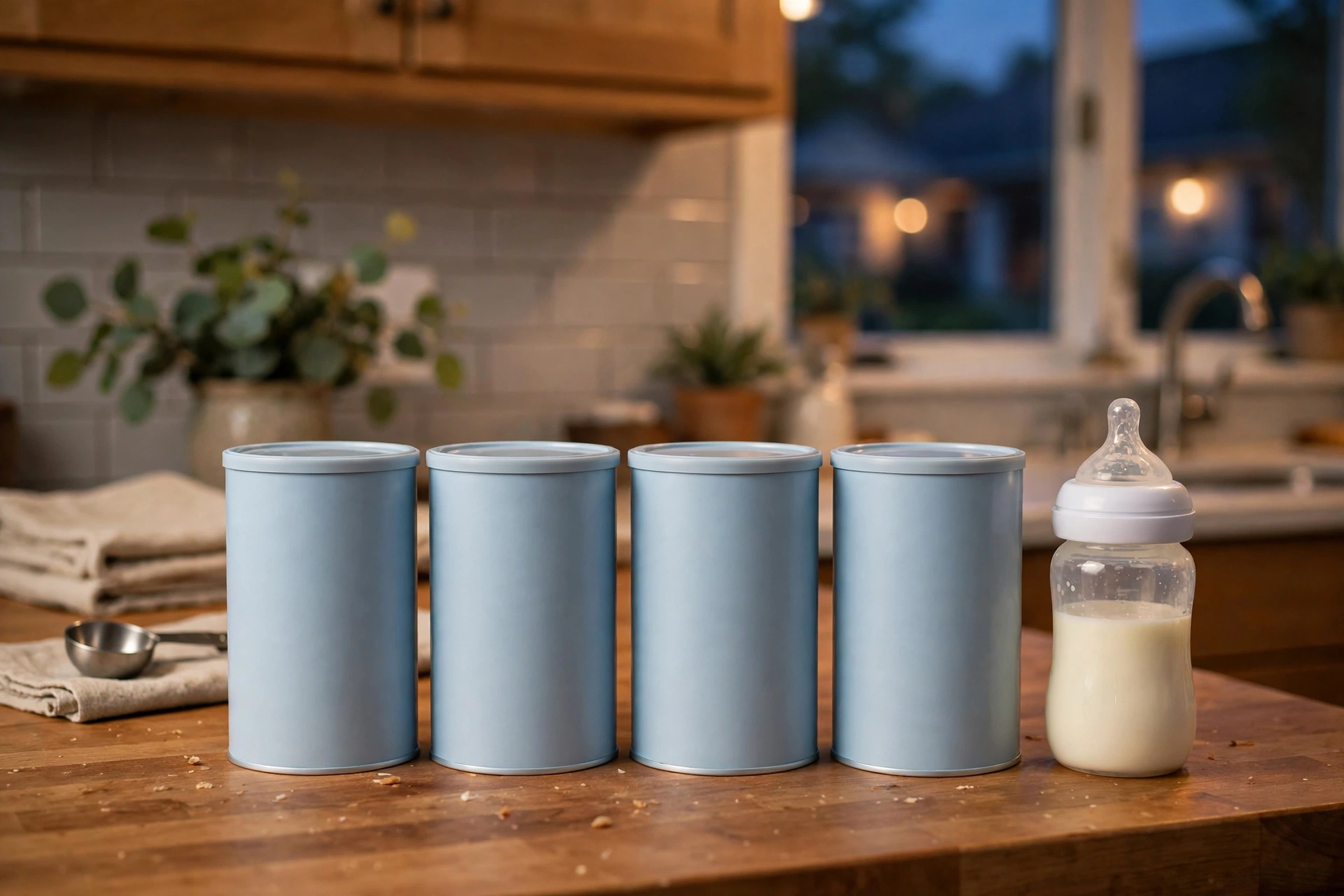
For an exclusively formula-fed baby using standard 12.5 ounce cans, plan on 5 to 8 cans in the first month, rising to 9 to 11 a month at the peak around 4 to 6 months, then falling to 7 to 9 a month by the first birthday as solid food takes over. Across the whole first year that is roughly 90 to 115 standard cans.
Read the table as a planning range, not a prescription. A baby at either end is fine if growth is on track. The rest of this guide shows where these numbers come from, so you can work out your own baby's number.
| Baby's age | Daily formula | Cans per month (12.5 oz cans) |
|---|---|---|
| 0-1 month | 16-24 oz | 5-8 |
| 1-2 months | 20-28 oz | 7-9 |
| 2-4 months | 24-32 oz | 8-11 |
| 4-6 months | 28-32 oz | 9-11 |
| 6-9 months | 20-30 oz | 7-10 |
| 9-12 months | 20-28 oz | 7-9 |
How the Math Works
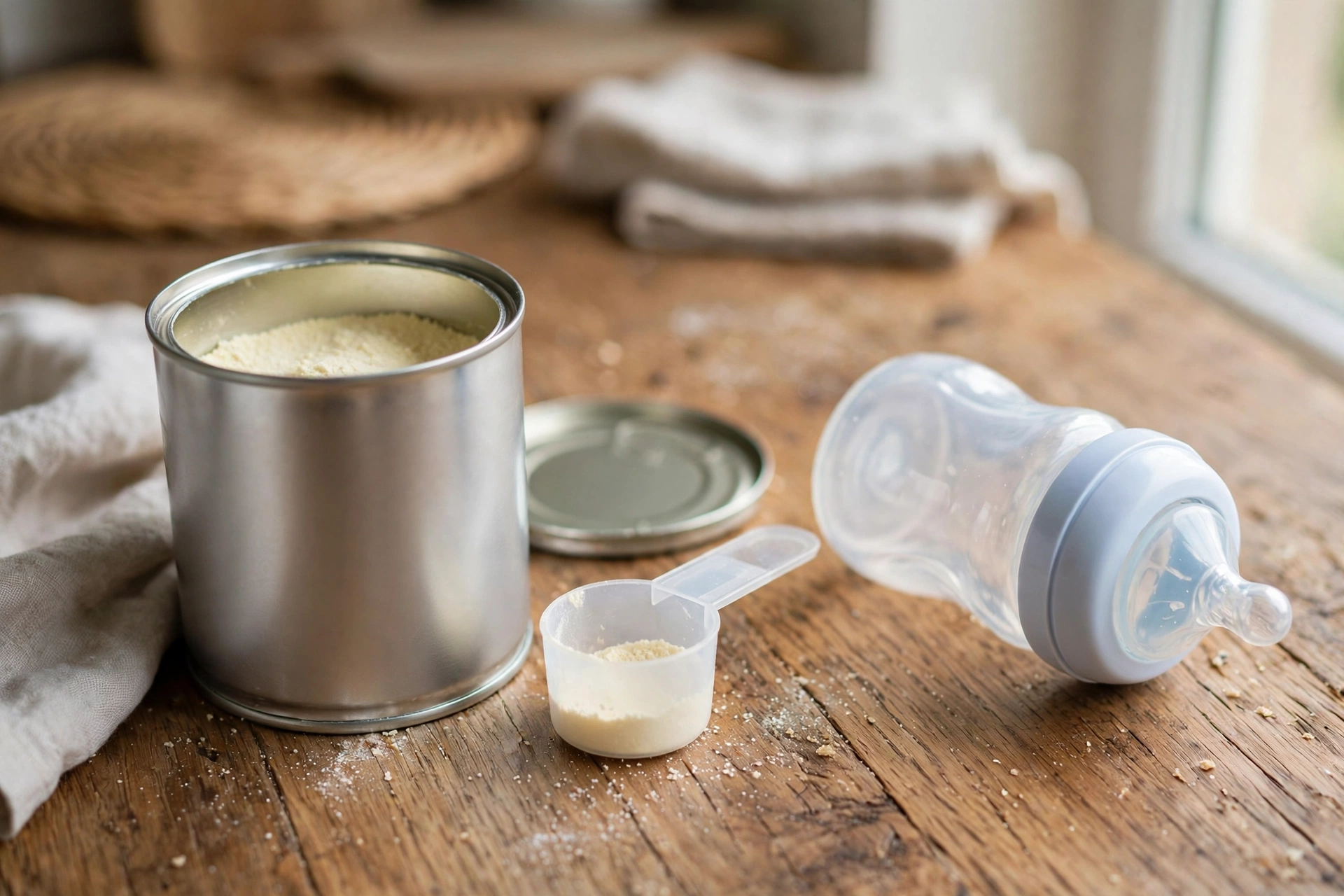
Formula math has three moving parts: how much your baby drinks in a day, how much one can makes, and how many days are in the month. The daily amount comes from the American Academy of Pediatrics: about 2.5 ounces of prepared formula per pound of body weight per day, with a ceiling of about 32 ounces a day for most healthy term babies.
One standard can holds 12.5 ounces of powder and makes about 90 fluid ounces of prepared formula, though the exact yield runs 80 to 90 ounces by brand, so check your can. The scoop is the unit that matters at 3 a.m.: one level, unpacked scoop to 2 fluid ounces of water, about 42 scoops per can. Never pack the scoop, and never add an extra one.
| Container | Powder | Prepared formula | Standard cans it equals |
|---|---|---|---|
| 12.5 oz can | 12.5 oz | about 90 fl oz | 1 |
| 22 oz tub | 22 oz | about 140 fl oz | about 1.5 |
| 30 oz refill | 30 oz | about 200 fl oz | about 2.2 |
These tables use 30 days. February is shorter and a 31-day month longer, which is why every number here is a range. Buy to the top of the range.
Cans Per Month by Age

Here is the full table, with the working shown. Daily ounces are the typical ranges for each age; monthly ounces are daily ounces times 30; cans are monthly ounces divided by 90, the yield of one standard can. Where a range crosses a whole can, I rounded up.
| Baby's age | Daily formula | Monthly formula | Cans per month |
|---|---|---|---|
| 0-1 month | 16-24 oz | 480-720 oz | 5-8 |
| 1-2 months | 20-28 oz | 600-840 oz | 7-9 |
| 2-4 months | 24-32 oz | 720-960 oz | 8-11 |
| 4-6 months | 28-32 oz | 840-960 oz | 9-11 |
| 6-9 months | 20-30 oz | 600-900 oz | 7-10 |
| 9-12 months | 20-28 oz | 600-840 oz | 7-9 |
The first month is the cheapest, because a newborn's stomach is tiny and feeds are small. The count climbs fast, and the peak lands at 4 to 6 months, when most babies drink close to 32 ounces a day. After 6 months the count falls again, because solid food starts to carry part of the day. Our guide to feeding solids at 6 months walks through that schedule.
Two traps hide in other guides. The first is the can-size switch: a guide that says 2 to 3 cans a month for a newborn is usually counting big tubs, or it divided by the wrong yield. The second is the first-week trap: a baby drinks very little in the first few days, and a guide that averages the whole first month from that week will undercount the last two weeks.
Your Baby's Number in 3 Steps
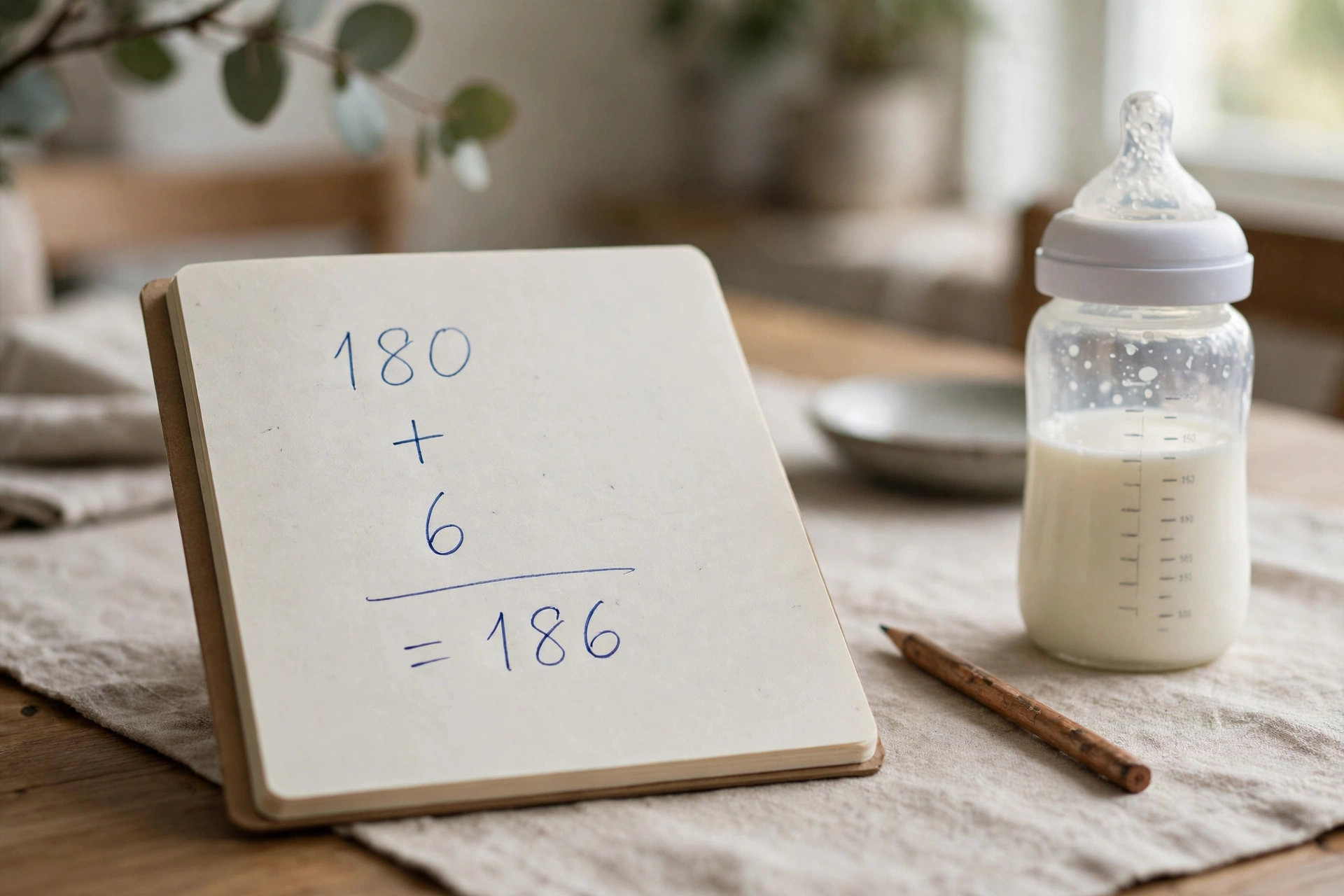
The table is an average. Your baby's number takes thirty seconds. Step one: take your baby's weight in pounds, from the last checkup, and multiply by 2.5. That is the daily ounces. Step two: multiply by 30. That is the monthly ounces. Step three: divide by 90, the yield of one standard can. Round up, and that is your cans per month.
A 12-pound baby: 12 times 2.5 is 30 ounces a day, times 30 days is 900 ounces a month, divided by 90 is 10 cans. A 9-pound baby: 9 times 2.5 is 22.5, call it 23 ounces a day, times 30 is 690 ounces, divided by 90 is 7.7, so 8 cans.
Keep the working on the fridge, and redo it after every checkup. Babies outgrow their number every few weeks in the first six months.
Free Printable: Formula Budget Tracker
The free Formula Budget Tracker is a one-page printable with the 3-step math at the top and a row for each month. Print it, stick it on the fridge, and log what you used.
What a Month of Formula Costs

Prices vary by store, region, and brand, so treat these as typical US shelf prices in October 2026, not a quote: store-brand powder about $17 to $22 a standard can, national brands about $28 to $38, and premium or organic formulas about $38 to $50.
| Baby's age | Cans per month | Store brand | National brand | Premium / organic |
|---|---|---|---|---|
| 0-1 month | 5-8 | $85-$176 | $140-$304 | $190-$400 |
| 1-2 months | 7-9 | $119-$198 | $196-$342 | $266-$450 |
| 2-4 months | 8-11 | $136-$242 | $224-$418 | $304-$550 |
| 4-6 months | 9-11 | $153-$242 | $252-$418 | $342-$550 |
| 6-9 months | 7-10 | $119-$220 | $196-$380 | $266-$500 |
| 9-12 months | 7-9 | $119-$198 | $196-$342 | $266-$450 |
At the peak months, a national-brand family spends roughly $250 to $420 a month, and the first year adds up to roughly $2,700 to $4,000 on national brands, $1,600 to $2,300 on store brands, and $3,700 to $5,500 on premium formulas. Small per-can savings multiply across a hundred cans.
Why Your Number Might Be Different

Five things move the count. Combination feeding is the biggest: if you breastfeed for some feeds and use formula for the rest, your can count falls in proportion; our breastfeeding tips for new moms guide covers that rhythm. Waste is next: every ounce poured and not drunk is a can spent faster. Growth spurts push intake up for a few days, then it settles. Solids pull the count down after 6 months. And the can itself matters: a 22-ounce tub is about one and a half standard cans.
The table is a starting point. If your baby consistently drinks far more or far less than the range for their age, that is a pediatrician conversation, not a shopping decision.
Money-Saving Moves That Actually Work
These eight moves actually move the monthly total, ordered from the biggest saving to the smallest. They stack: do the first three and the rest is gravy.
Buy Powder, Not Ready-to-Feed

Powder is the cheapest form: roughly 50 cents to a dollar per prepared ounce, against a dollar fifty to two dollars fifty for ready-to-feed bottles. The trade is your time, about two minutes a bottle, and the saving across a hundred cans runs into four figures.
Try the Store Brand

Store-brand formulas meet the same FDA nutrition standards as national brands, and they typically cost 30 to 40 percent less per can. Buy one can first, watch for a week, and only then buy in bulk. If your baby needs time to settle, our guide on adjusting to a formula change walks through it.
Buy the Big Tub

A 22-ounce tub holds about one and a half standard cans, and a 30-ounce refill about two and a fifth, and both usually cost less per prepared ounce. The catch is the one-month rule: once opened, use it within a month.
Pre-Measure for Outings

Spills and guessed scoops are the quietest waste in formula feeding. Pre-measure the powder for each bottle before you leave the house, so a bottle on the go takes seconds. The Munchkin Formula Dispenser holds three pre-measured feeds.
Munchkin Formula Dispenser, BPA Free, 3 9oz Sections, Blue
Three divisions hold pre-measured formula for up to 9 oz bottles, with a flexible seal that keeps powder in each section. BPA free.
Mix Only What They Drink

A bottle your baby does not finish is money down the drain: prepared formula left out must be thrown away after an hour, and a started bottle cannot go back in the fridge. Start with a smaller bottle, and make a top-up if they are still hungry.
Rewards and Samples

Most formula makers run a loyalty program with coupons, and your pediatrician's office usually has sample cans. A dollar off per can across a hundred cans is a hundred dollars.
Stock Up on Sale

Formula goes on sale often, and warehouse stores run 15 to 25 percent below grocery prices. The guardrail is the expiration date: unopened cans keep 12 to 18 months, so buy only what you will use before the date on the bottom.
Let a Machine Measure

At 3 a.m., a level scoop is harder than it sounds. The Baby Brezza Formula Pro Advanced mixes a warm bottle in seconds, 2 to 10 ounces in 1-ounce increments. It is the priciest item in this guide, and it pays for itself only if you use it every day.
Baby Brezza Formula Pro Advanced
A formula dispenser that automatically mixes a warm bottle in seconds, 2 to 10 ounces in 1-ounce increments, 3 temperature settings, works with virtually all formula and bottle brands.
WIC and Help Paying for Formula

If money is tight, WIC is the first place to look. WIC gives formula to families who qualify, usually at or below 185 percent of the federal poverty guidelines, and you may qualify automatically if anyone in your household uses SNAP, Medicaid, or TANF. For a fully formula-fed baby, the federal maximum is about 9 cans a month from birth to 3 months, about 10 cans from 4 to 5 months, and about 7 cans from 6 to 11 months. Your state WIC office loads the exact amount onto an eWIC card, and unused benefits do not roll over.
Apply through your state WIC agency, online or by phone, and bring proof of identity, address, and income, plus your baby's birth certificate. Food banks, diaper banks, and your pediatrician's office are the other places to ask.
How to Mix and Store Formula Safely

Mix It Exactly

Always follow the directions on your can: one level, unpacked scoop to 2 fluid ounces of water. Never dilute formula to stretch a can, and never add an extra scoop to make it richer. Diluting starves a baby of calories and can dangerously lower blood sodium. Never stretch a can by thinning it.
Warm It Gently

Warm a bottle in a bowl of warm water or a bottle warmer, never in the microwave, which leaves hot spots that can scald. Test a few drops on the inside of your wrist: it should feel lukewarm, not hot. The Philips Avent Premium Fast Bottle Warmer warms a 5-ounce bottle in as few as 3 minutes.

Philips Avent Premium Fast Bottle Warmer, with Smart Temperature Control, Water Bath Technology, Automatic Shut-Off, Model SCF358
Warms a 5-ounce bottle in as few as 3 minutes with smart temperature control, keeps milk warmed for up to 60 minutes, then automatically shuts off. Works with most bottles and baby food jars.
Feed Slowly

Hold the bottle nearly horizontal, let your baby pause every ounce or two, and watch for fullness cues like turning away or slowing down. The Dr. Brown's Natural Flow Anti-Colic Bottles come with a Level 1 slow flow nipple and an anti-colic vent.

Dr. Brown's Natural Flow Anti-Colic Options+ Wide-Neck Baby Bottles 5 oz/150 mL, with Level 1 Slow Flow Nipple, 4 Pack, 0m+
Wide-neck anti-colic bottles with a Level 1 slow flow nipple, 4 pack of 5 oz bottles. The internal vent system is designed to reduce colic, spit-up, burping, and gas; BPA-free and dishwasher safe.
Wash and Dry

Wash bottles, nipples, rings, and caps after every feed in hot soapy water, and let them air-dry on a clean rack, not a dish towel. The Boon Lawn Countertop Baby Bottle Drying Rack holds bottles and small parts upright while water drains into the removable tray. A Dr. Brown's bottle brush reaches the corners a sponge cannot. For a deeper clean, the Medela Quick Clean Micro-Steam Bags, 12 Count disinfect bottles and pump parts in about 3 minutes using only water and a microwave.

Boon Lawn Countertop Baby Bottle Drying Rack
Flexible grass blades hold bottles, cups, and feeding supplies upright while water drains into the removable tray. 13.5 by 11 inches, made without BPA or PVC.

Dr. Brown's Reusable Sponge Baby Bottle Cleaning Brush with Suction Cup Stand, Scrubber and Nipple Cleaner, BPA-Free, Blue, 1-Pack
Reusable sponge brush with a suction cup stand, a built-in nipple cleaner, and a scrubber. BPA free.

Medela Quick Clean Micro-Steam Bags, 12 Count
Microwave steam bags that disinfect bottles and breast pump parts in about 3 minutes using only water and a microwave. Each bag is reusable up to 20 times and eliminates 99.9 percent of most common bacteria and germs; made without BPA.
Mind the Storage Rules

Keep unopened cans cool and dry and use opened powder within one month. Prepared formula keeps 24 hours in the fridge and 2 hours at room temperature, and a bottle your baby has started must be used within an hour, then thrown away. If a can smells off, looks clumped, or is past its date, do not use it: our guide on old formula covers the signs to watch.
When to Call Your Pediatrician

Call the same day if your baby refuses feeds for more than a day, has fewer than 4 wet diapers in 24 hours after the first week, vomits forcefully after most feeds, has blood in the stool, or seems unusually sleepy or hard to wake. Call too if weight gain stalls, or if you are thinking about switching formulas.
You can also call just because the numbers worry you. A feeding question at a well-child visit costs nothing. Bring your tracker: the cans you used and the ounces your baby drank are the data that visit runs on.
Want the Full-Year Budget Planner?
This guide's free tracker covers the basics: one page, the 3-step math, and a row for each month. The Full-Year Formula Budget Planner is the bigger version we are building next: 12 monthly tracker pages, a brand comparison sheet, and a WIC benefit checklist. If you want the full planner when it is ready, keep an eye on this page.
Shop This Post
Frequently Asked Questions
How long does one can last?
A standard 12.5-ounce can makes about 90 fluid ounces, so at 24 ounces a day it lasts about 3 to 4 days, and at 32 ounces a day about 3 days. A 22-ounce tub lasts about 5 to 6 days, and a 30-ounce refill about 7 days.
Can I switch to a store brand?
Usually yes: store brands meet the same FDA nutrition standards as national brands and cost 30 to 40 percent less. Switch gradually over a few days, mixing the old and new formula, and watch for fussiness or stool changes for a week.
Does can size change the count?
The amount of formula stays the same; only the container count changes. A 22-ounce tub makes about 140 fluid ounces, roughly one and a half standard cans, and a 30-ounce refill about 200, roughly two and a fifth. Divide your table number by 1.5 for tubs or 2.2 for refills.
What if my baby drinks less?
Probably nothing is wrong, if growth is on track. Babies vary widely, and the table is an average across healthy babies. Watch the wet diapers, at least 4 to 6 a day after the first week, and steady weight gain at checkups.
A Small Ritual
My rule is simple: count once a month, buy to the top of the range, and write the date on the can when you open it. A tracker on the fridge and a dispenser in the diaper bag cover most of the month.
If you are still deciding how to feed, our Breastfeeding Essentials guide covers the nursing side of the plan, and Postpartum Essentials covers the rest of your recovery kit. Feed on cue, and let the math do the worrying.