
Husband Looks at Other Women? 12 Calm Ways to Handle It Without a Fight

You are sitting across from him at a restaurant, mid-sentence, when his eyes drift. A woman walks past, and his gaze follows her for a beat too long. You finish your sentence to a man who is no longer quite there.
That moment lands hard, and it lands in a very specific place. It is not really about the stranger. It is the small, cold question that follows: does he still see me the way he used to?
Here is the honest starting point. A single glance does not mean what fear says it means, and a pattern is not fixed by one angry conversation either. These 12 calm ways are grouped so you can start where you are: steady yourself first, then talk about it, then agree on the line together, and finally rebuild the small daily closeness that makes the looking matter less.
Heads up: this post contains affiliate links. If you buy through them, MamaKinder may earn a small commission at no extra cost to you, and it helps keep these guides free.

Quick Picks: Find Your Way Fast
| If this is where you are… | Start with |
|---|---|
| You need to steady yourself first | #1 to #3, before you say a word |
| You are ready to talk about it | #4 to #6, the conversation |
| You want a line you both agree on | #7 to #9, agree on the line together |
| You want the closeness back | #10 to #12, rebuild the us |
First, What a Look Usually Means (and What It Does Not)
Most men notice attractive people the way most of us notice a beautiful garden. It is a flicker of attention, not a decision. Noticing someone is not the same as wanting to leave with them. A glance can mean he found her attractive for three seconds and thought nothing more about it.
What it does not mean matters just as much. It does not mean he thinks she is more beautiful than you. It does not mean he is unsatisfied, or unfaithful, or quietly shopping for a replacement. Those are the stories fear tells in the seconds after the glance, and fear is a fast storyteller with very little evidence.
One more thing worth knowing: he probably does not even notice he did it. Most men look on impulse, the way you might glance at a loud noise, and the glance is gone from his mind before yours has even finished forming. That does not excuse how it felt. It just means the conversation you have later is about something he did without thinking, and those conversations go better when they start from that fact.
The line that matters is not the glance. It is what comes after. A glance is a moment. A stare that lingers while you sit right there, a comment about her body, a pattern of seeking her out: those are different things, and this guide treats them differently. The first nine ways below are for the glance and the hurt it causes. The last three, and the section after the list, are for when it is bigger than that.
Before You Say a Word
1. Pause before you decide what it meant.

Your first story about the glance is written by adrenaline, and adrenaline is a terrible author. Give yourself ten slow breaths before you decide what just happened, what it means about him, and what it means about you. A pause is not pretending it did not hurt. It is choosing to respond to the real moment instead of the worst version of it.
Try this: feel your feet on the floor, take the breaths, and let the first hot sentence pass. What is left after the heat drops is usually the truer feeling, and that is the feeling worth talking about later.
2. Write down what you actually saw.

Memory edits itself fast, especially when feelings are involved. Before the evening blurs, write down what actually happened in plain words on a private page: where you were, what he did, how long it lasted, and what you felt. Facts first, meaning second.
I keep The Five Minute Journal by my bed for exactly this kind of page: its morning prompts include a daily affirmation starting with “I am,” and the routine takes about five minutes. When you can read back the facts instead of replaying the feeling, the conversation you have later starts from something solid instead of something spinning.

Intelligent Change The Five Minute Journal
A guided daily gratitude journal with a morning affirmation prompt built in. Undated, so you can start any day, and the routine takes about five minutes.
3. Ask yourself: was it a glance, or is it a pattern?

One glance at a restaurant is one thing. A husband whose eyes follow every woman on every outing, every week, is another. Ask yourself honestly: has this happened before, and how often? Is it getting worse, or is this the first time you have noticed it in months?
The answer changes everything you do next. A one-off glance calls for one calm conversation. A pattern calls for a real agreement about boundaries, and that is what ways 7 through 9 are for. Be honest with yourself here, because the wrong diagnosis leads to the wrong conversation.
The Conversation
4. Pick a calm moment, not the moment it happened.

The worst time to talk about the looking is in the thirty seconds after it happens, with the stranger still in view and your voice already shaking. Nothing good has ever been decided in that window. Wait until the kids are down, the car is parked, and you are both fed and rested.
Say it plainly when you start: “I want to talk about something that happened today, and I want us both calm for it.” A good conversation needs a good room, and choosing the room is half the work.
5. Say what you felt, not what he did wrong.

“You always stare at other women” starts a fight. “I felt small when your eyes followed her across the restaurant” starts a conversation. The first sentence is a charge against his character. The second is a fact about your feelings, and feelings are hard to argue with because they are yours.
Keep it to one moment and one feeling: “When this happened, I felt this.” Then stop talking and let him answer. The goal of this sentence is not to win. It is to be heard, and you cannot be heard over an accusation.
6. Ask what he heard, then really listen.

After you have said your piece, ask him what he heard you say, and then listen to the answer without correcting it. You might be surprised. He may have heard “you think I am a bad husband” when you said “I felt small.” That gap is where most fights actually live.
Listening does not mean agreeing. It means finding out whether the two of you are even talking about the same moment. If he felt attacked, you can soften the words without dropping the point. If he heard you clearly, you can move on to the line you both want to draw.
Agree on the Line Together
7. Name the line out loud, together.

Most couples have a line about looking, and most couples have never said it out loud. That is how the same hurt keeps happening: he thinks a quick glance is nothing, and you think it is everything, and neither of you knows the other one’s line.
Sit down and name it together, in plain words: a glance is human, a lingering stare is not okay, comments about another woman’s body are not okay, seeking her out is not okay. Write it down if it helps. A line you both agreed on is a line you can both hold.
8. Agree on what respect looks like in public.

The hurt of the looking is sharpest in public, because it happens in front of other people and it feels like being made small in front of an audience. So agree on the public part specifically: when you are out together, his attention stays with the person he came with.
This is not a rule about his eyes never wandering. It is an agreement about respect: he can notice the world, and he does not make a show of it while you sit beside him. Most husbands, asked this way, say yes without a fight, because it is a fair ask.
9. Make a plan for the next time it happens.

Agreements fail without a plan for the moment they get tested. Decide together, now, what happens next time: you will say one calm sentence, like “That hurt, and I need your eyes back here,” and he will do one thing, like turn back to you and stay there.
A plan takes the panic out of the next glance. You are not starting from zero and inventing a response while upset. You are following a script you both wrote on a good day, and scripts are what carry couples through the hard moments.
Rebuild the Us
10. Bring back one small daily ritual.

Looking elsewhere often grows in the space where closeness used to live. You do not fix that with one big talk. You fix it with one small thing, done every day: ten minutes on the porch after the kids are down, coffee together before the day starts, a walk around the block after dinner.
Pick one ritual and protect it like an appointment. It does not have to be romantic or impressive. It has to be regular. Small daily closeness is what makes a husband’s attention come home on its own, and it is the quietest repair on this list.
11. Read one book together, slowly.

Some conversations are easier with a book in the middle of them. And Baby Makes Three by John and Julie Gottman is written for this exact season: the Gottmans’ six-step plan for preserving intimacy after the baby arrives, with short exercises built for tired parents.
Read one short chapter a week, together, and talk about one idea from it. You are not assigning homework. You are giving the two of you a shared language for the things that are hard to say from scratch, and a shared project that is not the kids.
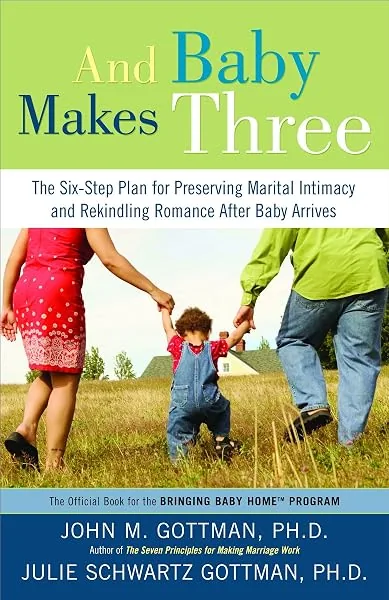
And Baby Makes Three — John & Julie Gottman
The book written for this exact season: the Gottmans’ six-step plan for preserving intimacy and rekindling romance after the baby arrives, with short exercises built for tired parents.
12. Get outside help before it becomes a wall.

If the same conversation keeps happening and nothing changes, that is not failure. That is information: the two of you need a third person in the room. A few sessions with a couples counselor is maintenance, and plenty of strong couples use it that way.
Bring the notes from way 2 and the line from way 7. A good counselor does not take sides. A counselor gives you both a room where the hard sentences can be said without the fight that usually follows them home.
When It Crosses the Line
Everything above assumes a husband who is careless, not cruel. There is a line where the looking stops being a habit to work on and becomes disrespect: staring that makes other women uncomfortable, comments about their bodies, seeking one woman out again and again, or any looking that continues after you have clearly said it hurts you.
If the looking comes with control, with shouting when you raise it, with pressure or threats, or with anything that makes you feel unsafe, that is not a communication problem. Reach out to a trusted professional, a counselor, or a local support service right away. You do not have to sort that out alone, and you do not have to wait for it to get worse before you ask for help.
Shop This Post
| Product | Used For | Price |
|---|---|---|
| The Five Minute Journal |
The private page from way 2, writing down what you actually saw | Check Price |
| And Baby Makes Three — Gottman & Gottman |
The read-together starting point from way 11 | Check Price |
 Flameless LED Tea Lights |
The small evening ritual from the closing, the click that ends the day | Check Price |
Frequently Asked Questions
Is it normal for a husband to look at other women? In the small sense, yes. A brief glance is common and usually means very little on its own. What matters is the pattern: how often it happens, how long the look lasts, and whether it stops when you say it hurts. A glance is not a verdict on your marriage. It is a small moment, and small moments are fixed with small, honest conversations, not with big decisions made in the heat of one.
Should I tell him it bothers me if it only happened once? Yes. One calm sentence, close to the moment, is kinder than silence. Waiting turns one small hurt into a story you tell yourself for months, and by then the conversation is about the silence too.
When should I worry about the looking? When it is a pattern rather than a moment: staring that lingers, comments about another woman’s body, seeking her out, or looking that continues after you have asked him to stop. Those are the signs to take seriously, and to bring to a counselor.
A Small Ritual That Is Only Yours
Before you do anything else, protect one small thing that belongs to you alone. Mine is embarrassingly small: after the kids are down, the flameless LED tea lights click on, the tea goes in the same mug, and I get ten minutes with a book before the day officially ends. There is no open flame around little hands, and the click is the sound of the day being over.
Flameless LED Tea Lights
Battery tea lights with no open flame, so the evening wind-down is safe around little hands and paperback pages. One click and the day is officially over.
You are not a bad wife for noticing, mama. You are a wife paying attention, and attention is the first act of love, even when it hurts. Notice what actually happened, say it once calmly, agree on the line together, and then rebuild the small daily closeness that makes his attention come home. Our Mom Life Tips are the companion for the you side of this season.


