
Mother-in-Law Manipulates My Husband: 21 Steady Ways to Set Boundaries and Protect Your Marriage

She calls him while you are in the next room, and by the time he hangs up, the plan you agreed on has quietly changed. She cries when she does not get her way, and suddenly he is apologizing to her for a decision the two of you made as a couple. She tells him a version of what happened that is just different enough to make you look unkind, and he believes her, because she is his mother.
If that sounds familiar, you are not imagining things, and you are not the villain of this story for noticing it. Manipulation does not always look like shouting. Sometimes it looks like tears, or guilt, or a small favor with a long string attached. The question is not whether she is a bad person. The question is what you and your husband will do, together, when the pattern keeps repeating.
These 21 steady ways are built in that order for a reason: first see what is actually happening, then talk to your husband as a team, then set boundaries you can both hold. None of them require a fight, a threat, or a test. They only ask for one honest conversation at a time, with the two of you on the same side of the table.
Heads up: this post contains affiliate links. If you buy through them, MamaKinder may earn a small commission at no extra cost to you, and it helps keep these guides free.

Quick Picks: Find Your Place Fast
| If this is where you are… | Start with |
|---|---|
| You are not sure what you are seeing yet | #1 to #7, see it clearly first |
| You are ready to talk to your husband about it | #8 to #14, talk as a team |
| You both agree and need to hold the line | #15 to #21, hold the boundary |
First, See It Clearly
1. Pause before you name it manipulation.

The word manipulation is heavy, and once you say it out loud it is hard to take back. Before you settle on it, ask one honest question: what did I actually see, and what else could it mean? She might be controlling, or she might be lonely. The pause excuses nothing. It only makes sure you answer what really happened, not the worst version of it.
2. Write down what actually happened.

Feelings blur fast. By tomorrow, “she called and he changed our plans” may have become “she always ruins everything.” Write down the plain facts on a private page, the way a kind friend would: what happened, what he did, what you needed. I keep The Five Minute Journal by my bed for exactly this: its morning prompts include a daily affirmation starting with “I am,” and the routine takes about five minutes.

Intelligent Change The Five Minute Journal
A guided daily gratitude journal with a morning affirmation prompt built in. Undated, so you can start any day, and the routine takes about five minutes.
3. Look for the pattern, not the single scene.

One difficult phone call is a bad evening. Three months of changed plans is a pattern. Ask yourself two questions. Has this been steady for weeks, or one rough weekend? Is it a change from how things used to be? A pattern is what turns a suspicion into something worth talking about.
4. Name the move, not the motive.

“She guilt-tripped him” is a verdict about what is inside her head, and he will defend her. “She cried when he said we were not coming, and then he changed our plans” is something he actually saw happen. Stick to the move: what was said, what was done, what changed after it. You do not need to prove why she did it. Show what keeps happening, and let the pattern speak for itself.
5. Notice the loyalty bind your husband is in.

He is not choosing her over you the way a judge chooses a side. He is caught between two people he loves, and every choice feels like a betrayal. When you see the bind, his silence starts to make sense: he is not ignoring you, he is frozen. A husband who feels trapped needs a way out, and the way out is a plan the two of you build together.
6. Ask what she may be afraid of losing.

Most mothers who pull at their sons are not trying to ruin a marriage. They are afraid of losing their place: the daily calls, the first say, the feeling of being needed. That fear does not excuse the pressure, and it does not mean you should give in. But when you understand her fear, you can hold a boundary without making her feel erased, and that is much easier for your husband to stand behind.
7. Notice who else the pattern touches.

Watch where the pattern lands beyond the two of you. Do the kids hear the arguments that follow her calls? Does she tell them things about you that they repeat back? Does she promise treats and trips that undo your rules? Children notice far more than adults think they do. What touches them is the clearest reason to set the boundary, and the easiest one for your husband to agree on.
Then Talk to Your Husband as a Team
8. Pick a calm moment, never right after her call.

The worst time to talk about his mother is in the ten minutes after she hangs up, when his guilt is fresh and your frustration is loudest. Wait for a calm hour, after the kids are down. Say it plainly: “I want to talk about something that matters to me, and I need ten quiet minutes.” A calm setting gives him a chance to hear you instead of just defending her.
9. Start with “I feel” instead of “your mother”.

“Your mother manipulates you” lands like an attack, and an attacked person defends his mother instead of listening. “I feel alone when our plans change after her calls” lands like a fact about your heart, and it is much harder to argue with. Keep it about you: what you felt, in one moment, in plain words. He can hear a feeling. He cannot hear a verdict about his mother.
10. Name one moment, not the whole relationship.

“Last Sunday, she called and you cancelled the dinner we had planned” is something he can picture, remember, and answer. “She always ruins everything” is a whole relationship in one sentence, and there is nothing to do with it but deny it. One moment, one example, one request. Small and specific is how big conversations actually start.
11. Ask him what he feels when she pressures him.

You have spent a long time thinking about what her calls do to you. Ask him what they do to him. Does he feel guilty when he says no? Does he feel proud when he stands his ground, or does he feel like a bad son? His answer tells you where the pressure actually lands, and it tells you what kind of help he needs. A husband who feels heard by you is far more likely to hear you back.
12. Agree on the boundary together, before you say it to her.

A boundary only works if both of you own it. Sit down together and decide, in plain words, what the line is: calls end at nine, visits need a day’s notice, parenting decisions are made by the two of you. Write it down, so there is no argument later about what was agreed. When it comes from the two of you together, it is not you versus his mother. It is the marriage speaking.
13. Let him deliver it to his own mother.

It is his mother, so the boundary lands best coming from him. When you deliver it, she hears a daughter-in-law pushing her son away. When he delivers it, she hears her son saying, “Mom, this is how our house works now.” Help him find the words, practice them together, and then step back and let him say them. His voice carries a weight yours cannot, and using it is how he stops being the middle and starts being your partner.
14. Thank the small tries out loud.

When he does try, even clumsily, say so. “Thank you for telling her we needed the weekend to ourselves. That helped more than you know.” A husband praised for a small effort will try again. A husband whose first attempt is met with “too little, too late” will stop trying. Progress is rarely a grand gesture. It is a small try, noticed and thanked, and then another small try after it.
Hold the Boundary and Protect the Marriage
15. Decide your house rules together.

Vague boundaries do not hold. Decide the specifics: visits need a day’s notice, nobody walks in without knocking, calls end by nine. Write them down where you can both see them. House rules are not a punishment. They are the ordinary way adults run a home, and once they are written down, nobody argues about them again.
16. Keep parenting decisions inside the marriage.

Grandparents get a say in the fun parts: the stories, the treats, the Sunday visits. Bedtime, food, screens, and discipline belong to the two of you. When she overrides your rule in front of the kids, it is not just annoying. It teaches them that your word can be undone by someone else. Agree on this together, and when it happens, correct it the same day, calmly, as a united front.
17. Have a plan for holidays and big days.

Holidays are where the pressure gets loudest. Decide the plan weeks ahead, together, and tell her early: which house, which hours, whose turn this year. A plan made in advance is much harder to guilt apart than a plan made on the phone the night before. When she knows the plan early, she has time to get used to it, and when the day comes, you are simply following it.
18. Do not let the kids carry the message.

When adults cannot talk to each other, children get used as messengers, and that is never fair. “Tell your mom I said…” and “Don’t tell your dad about this” both put a child in the middle of a grown-up problem. If a message needs to reach her, an adult delivers it. If she tells the kids something meant for you, answer it yourself, directly. The kids’ job is to be kids. The adults’ job is to talk to each other.
19. Read one book together, a chapter at a time.

Talking is hard when every conversation becomes the same argument. A book gives you both a third thing to talk about. Read The Seven Principles for Making Marriage Work by John Gottman and Nan Silver together, one short chapter at a time: the Gottmans’ guide to moving from gridlock to dialogue, with exercises for couples working through the issues they cannot resolve. Our Marriage Advice For New Parents guide is the companion piece for the everyday side of this season.
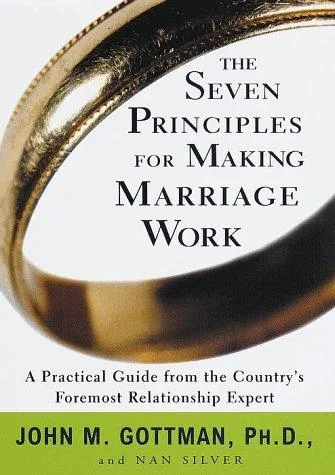
The Seven Principles for Making Marriage Work: John Gottman & Nan Silver
The Gottmans’ guide to moving from gridlock to dialogue, with questionnaires and exercises for couples working through the issues they cannot seem to resolve.
20. Build your own rituals as a couple.

A marriage that only ever reacts to his mother slowly becomes a marriage about his mother. Build something that is only yours: a Sunday walk, a Friday takeout night, ten minutes on the porch. Rituals are small, and that is the point. They are proof, repeated every week, that the two of you have a life together that does not run through anyone else.
21. Decide together what “better” looks like.

Sit down together and name it in plain words: what would better look like a month from now? Maybe it is “when she calls, we decide together before we answer.” Maybe it is “visits happen on our terms, and the kids see us agree.” Write it down, both of you, and check in after a month. A shared goal turns “your mother needs to stop” into “we are building this together.”
When to Get Outside Help
Some things are bigger than a list of steps, and knowing that is strength, not failure. If you have talked calmly, several times, over several weeks, and nothing changes, a counselor can do what a list cannot: sit in the room with both of you and teach you how to talk about the hard things without either of you shutting down. A few sessions is maintenance, and plenty of strong couples use it that way.
There is also a line that matters more than any step on this list. If she controls who you see, tracks your phone, or belittles you in front of the children, or if you ever feel unsafe in your own home, that is not a communication problem. Reach out to a trusted professional, a doctor, or a local support service right away. You deserve to feel safe, and so do your children.
Shop This Post
| Product | Used For | Price |
|---|---|---|
| The Five Minute Journal |
The private page from step 2, five quiet minutes with the facts | Check Price |
| The Seven Principles for Making Marriage Work: Gottman & Silver |
The read-together starting point from step 19 | Check Price |
 Flameless LED Tea Lights |
The small evening ritual from the closing, the click that ends the day | Check Price |
Frequently Asked Questions
What if my husband does not believe his mother manipulates him? He may never use that word, and he does not have to. What he needs to see is the pattern, not the label. Show him one moment at a time, in plain facts, and ask how he feels after her calls. Most husbands come around to the pattern long before they accept the word for it, and the boundary works the same either way.
What if she cries or says we are keeping her from the grandchildren? Tears and guilt are the hardest part, because they make a boundary feel cruel. Hold the line gently: “Mom, we love you, and the kids love you. Visits happen on the days we agree, and that is how it works for every family.” You are not keeping her from them. You are setting the terms on which visits happen, and that is what every healthy family does.
How long should I try these steps before getting outside help? Give the calm conversation and the small steps a few honest weeks, not a few days. If you have talked about it clearly more than once, tried the steps, and nothing has moved, that is the moment for a couples counselor. If you ever feel unsafe, do not wait for a timeline: reach out to a trusted professional right away.
A Small Ritual That Is Only Yours
Before you do anything else, protect one small thing that belongs to you alone. Mine is embarrassingly small: after the kids are down, the flameless LED tea lights click on, the tea goes in the same mug, and I get ten minutes with a book before the day officially ends. There is no open flame around little hands, and the click is the sound of the day being over.
Flameless LED Tea Lights
Battery tea lights with no open flame, so the evening wind-down is safe around little hands and paperback pages. One click and the day is officially over.
You are not a bad wife for noticing what is happening, mama, and you are not a bad wife for wanting your husband beside you. A marriage is two people deciding together, and nobody outside it gets a vote in how you run your home. Try the steps in order, give him a real chance to stand with you, and trust what the pattern tells you. Our Mom Life Tips are the companion for the you side of this season.