7 Clear Signs Your Toddler Is Ready to Stop Napping and What Comes Next

There is a week in every toddler house when naptime stops working. You put your toddler down at the usual time, and instead of drifting off, they sing to the wall, chat to their stuffed bunny, and come out wide awake an hour later. Then bedtime drags too, and you wonder if the nap itself is the problem.
Most toddlers drop their last nap between the ages of 3 and 5. The calendar alone never tells you when your child is ready. The signs do, and they only count when they show up together, most days, for about two weeks.
This guide covers the 7 clear signs, what to try before you drop the nap for good, and what quiet time looks like once the nap is gone. Our toddler parenting tips guide has routines that make the days around this change easier.
Heads up: this post contains affiliate links. If you buy through them, MamaKinder may earn a small commission at no extra cost to you, and it helps keep these guides free.

How to Read the Signs
A single rough afternoon means nothing. Toddlers go through nap refusal phases around 18 months and again near age 2, and almost all of them still need a nap then. Look for a pattern, not a day.
Count a sign only when it shows up most days for two weeks, and count the change only when you see two or more signs at once. One sign on its own usually means the schedule needs a small fix, like a shorter nap or an earlier bedtime, not the end of naps.
Age matters too. Children younger than 2 and a half are rarely ready to drop the nap entirely, so keep the nap and the routine steady if yours is. The signs below are written for toddlers from about 2 and a half up to 5.
The 7 Clear Signs Your Toddler Is Ready to Stop Napping
1. It Takes Forever to Fall Asleep at Naptime

Your toddler lies awake for 30 to 45 minutes or more at naptime, most days, and still comes out cheerful. This is the clearest early sign. A tired toddler falls asleep. One who no longer needs the nap lies there, calm and awake, treating the hour as rest time instead of sleep time.
Watch what happens after. If they skip the nap and still play happily until bedtime, the nap is not doing the job it used to do. If they skip it and melt down by late afternoon, they still need it, and the long settle is a schedule problem, not a readiness sign.
2. Bedtime Takes Forever Too

When the nap stays but bedtime starts taking 20 to 30 minutes or more, the nap is giving your toddler more daytime sleep than they need. They toss, ask for one more drink, one more story, one more trip to the bathroom. On days without a nap, the same child is asleep in minutes.
Watch the nights too. If nap days bring restless bedtimes or split nights, where your toddler wakes in the middle of the night ready to play, that is the same sign from the other side. Too much daytime sleep leaves too little sleep pressure for night.
A steady bedtime routine helps while the schedule changes. Keep the room dark and the sound the same every night. A white noise machine that runs all night, not on a short timer, keeps the cue steady.

3. Your Toddler Wakes Up Too Early

Your toddler starts waking well before their usual time, most mornings, bright and ready to play the moment they are up. A child who has slept enough at night does not need the extra daytime hours, so the body trims them from the morning end. Waking before 6 on nap days, when 6:30 or 7 used to be normal, is the classic version.
Check the pattern before you act. Early waking after a late bedtime or a poor night is not a readiness sign. Early waking on days when the nap was long and bedtime was on time, for two weeks running, is.
Two tools make the early mornings easier to read. An ok-to-wake clock teaches your toddler when it is time to get up, so a 5 a.m. stir does not become a 5 a.m. start. Blackout curtains keep the room dark until morning, so light is not what wakes them.

Hatch Rest 2nd Gen Sound Machine and Night Light
Time-to-Rise light, 18+ sounds, night light.

4. Naptime Turns Into Playtime

Your toddler plays, sings, or talks to their stuffed animals for the whole nap window instead of sleeping. They are not upset and not calling for you. They are happily busy in their own bed, and when you peek in, they are wide awake and unbothered.
A toddler who needs sleep will fight the nap and then crash, or fall asleep mid-play. One who plays happily for the full hour, most days, is telling you the sleep is not there to take. This sign is strongest with sign 1: awake at naptime and cheerful after it.
Do not make the room boring to force sleep. A dark room and a quiet house will not put a child to sleep who has no sleep pressure left. The play is the message.
5. Your Toddler Stays Happy All Afternoon Without a Nap

On days without a nap, your toddler stays steady and cheerful through the afternoon. They play, eat dinner, and get ready for bed without falling apart. There is no 4 p.m. crash, no tears over nothing, no sudden exhaustion.
The late afternoon is where the truth shows. A toddler who still needs the nap will look fine at 2 p.m. and unravel by 4:30. One who is ready will still be themselves at 5. Watch a full week of no-nap afternoons first. A single good day can be a fluke, and a single bad day can be a cold coming on.
If the afternoons hold, the nap has already done its job in your house. It is daytime rest your toddler no longer needs, and the evening you get back is the proof.
6. Night Sleep Stays Solid Without the Nap

On no-nap days, your toddler falls asleep quickly at bedtime and sleeps well through the night. They wake rested, and the night holds together without extra waking. This is the sign that ties the others together: the daytime sleep was not missed, because the night sleep absorbed it.
Toddlers who stop napping still need about 10 to 12 hours of sleep at night. If your child is getting that without the nap, and bedtime has moved a little earlier, the new rhythm is working. If night waking increases or mornings get earlier instead, the nap went too soon, and it is fine to bring it back.
A fresh toddler bed setup helps the new rhythm stick. A low bed your toddler can climb into alone, with bedding they picked, makes bedtime theirs.
7. Your Toddler Is Old Enough and the Schedule Has Changed

Your toddler is 3 or older, and the day itself has changed. Preschool or pre-K runs without a scheduled nap, and your child manages the full day fine. They come home tired in a normal way, not wrecked, and asleep at a reasonable bedtime.
Age on its own is never the sign. Plenty of 4-year-olds still nap, and that is completely normal. Age plus the other signs is what counts: a child who lies awake at naptime, stays happy all afternoon, and sleeps well at night is a different case from one who simply started preschool.
If the program has no nap, ask for quiet time instead of forcing sleep. A child who rests quietly for an hour gets most of the reset a nap gives.
Try These Before You Drop the Nap
Do not drop the nap cold turkey on the strength of one hard week. Shorten it first. Cutting the nap back a little at a time is easier on your toddler and on you, and it tells you quickly whether the nap is the problem.
| Step | What to do | Watch for |
|---|---|---|
| Week 1 | Cap the nap at 60 minutes | Bedtime gets easier |
| Week 2 | Cap the nap at 30 minutes | Mornings stay steady |
| Week 3 | Swap the nap for quiet time | Afternoons stay happy |
Move the nap earlier in the day if you can. An earlier nap leaves a longer wake window before bedtime, so more sleep pressure builds by night. If your toddler will not fall asleep at the earlier time either, cap it instead.
Shift bedtime earlier while you adjust. Thirty minutes earlier covers most of the tiredness the missing nap leaves behind. Keep the routine the same every night: lights low, a book, and a night light that stays on so the room never feels strange.

Expect some back and forth. Your toddler may nap one day and refuse the next, and a catch-up nap every second day is fine while the new rhythm settles. If night waking increases or the afternoons fall apart, bring the nap back and try again in a few weeks. That is not a failure.
What Quiet Time Looks Like
When the nap goes, quiet time takes its place. One calm hour in the middle of the day, in the same spot, at the same time, every day. Your toddler does not have to sleep. They rest, they play quietly, and the house gets the reset the nap used to give.
Build a small quiet-time bin and keep it only for that hour. Rotate it every few days so it stays interesting. These five fill the bin.
Sticker books are the easiest start. A puffy sticker book with reusable stickers keeps a toddler busy without noise, and the pages survive being peeled again and again.

Crayons and paper come next. Big crayons are easy to hold, and a few sheets of plain paper are enough. Keep the set small so cleanup stays quick.

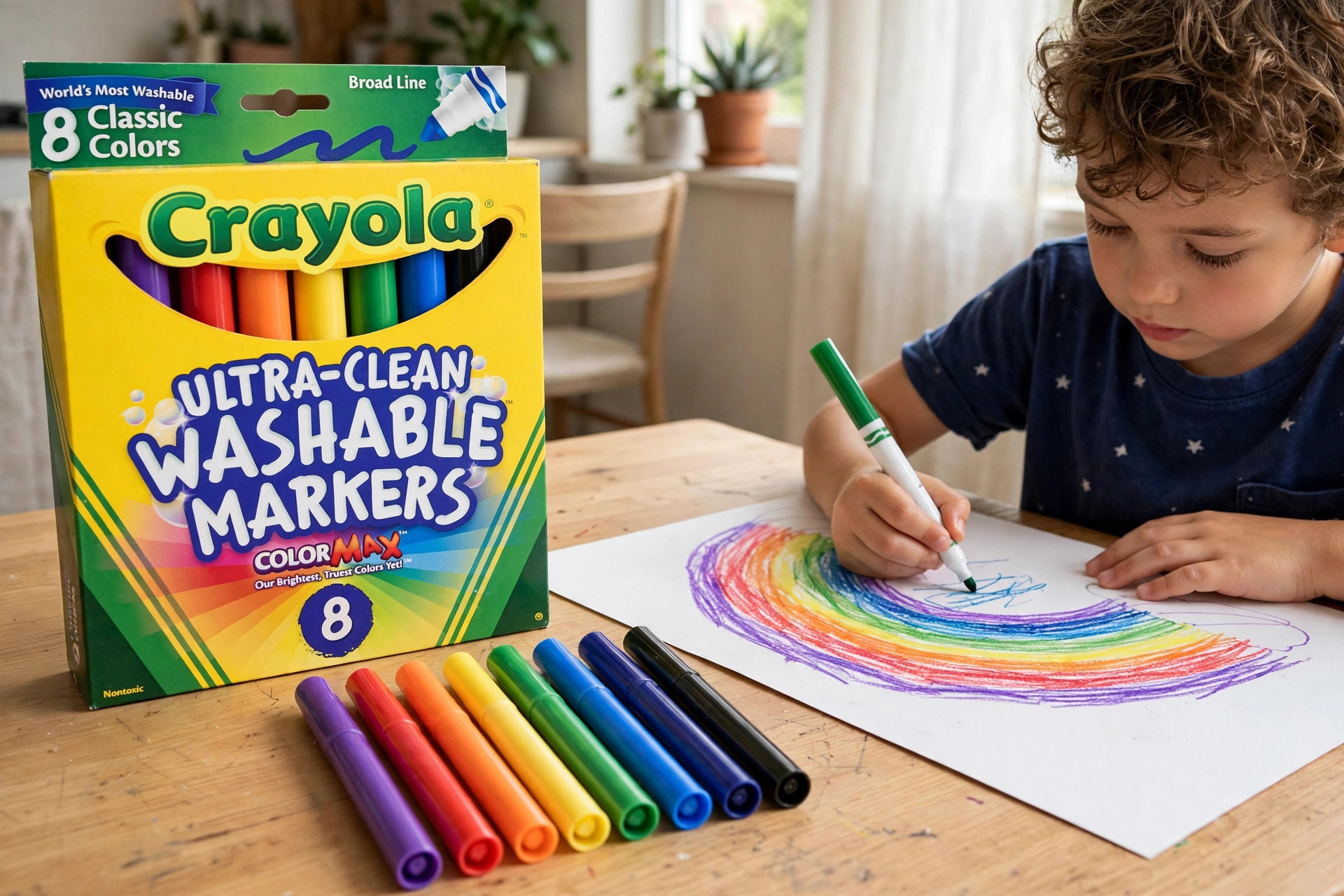
Washable markers are the mess-free upgrade. They wash off skin and most clothing, so a marker on a hand is a five-second fix, not a bath.
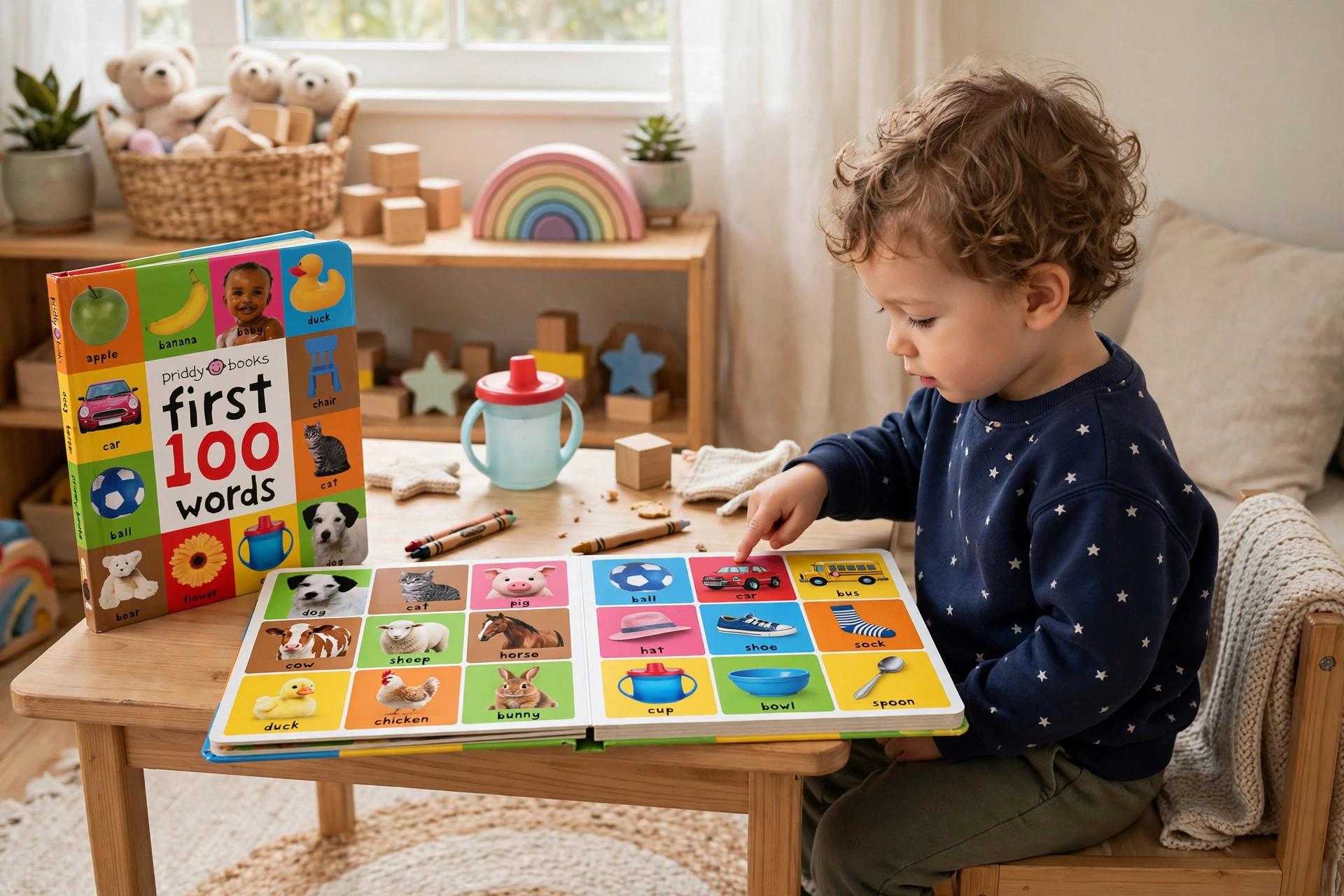
Board books close the hour. A first-words book works for the youngest quiet-timers, and a classic story works for the older ones. Two books in the bin are enough.

Keep the rule simple: quiet time is rest, not sleep, and it is not a punishment. If your toddler falls asleep during quiet time, let them sleep. The body is still asking for rest on those days.
Want More Quiet-Time Ideas?
This guide gives you five quiet-time activities to start with. We are putting together a longer quiet-time activity pack with 30 calm activities, one for every day of the month, so the bin never runs dry. There is no buy link yet.
Three Signs Your Toddler Is NOT Ready Yet
The signs above only count when the afternoons and nights hold together. These three tell you the nap still has work to do.
Your toddler falls apart by late afternoon. Tears over nothing, clumsiness, and a short fuse from 4 p.m. on are the body asking for the rest it missed. A ready toddler is tired at bedtime, not wrecked at dinner.
Your toddler falls asleep in the car every time. Car naps that used to be rare and now happen on every short drive mean the daytime sleep pressure is still real. A child who is done with naps stays awake for the ride.
Bedtime crashes hours early or nights get worse. If dropping the nap means your toddler is asleep at 5:30, or night waking and split nights increase, the nap went too soon. Bring it back, cap it at an hour, and try again in a few weeks.
One hard week is never enough to decide. Two weeks of steady afternoons and steady nights is. If you are unsure, keep the nap and quiet time side by side for another fortnight. The signs will still be there when your toddler is truly ready.
A note on safety: keep the sleep space simple, a firm mattress with a fitted sheet, and keep clocks, cords, and chargers out of your toddler’s reach. If night waking that does not settle, loud snoring, or pauses in breathing keep coming up, talk to your pediatrician before changing the schedule.
Shop This Post
Everything with a link in this guide:
| Product | Used for |
|---|---|
| Hatch Rest 2nd Gen Sound Machine | Ok-to-wake clock (Sign 3) (Check Price) |
| NICETOWN Blackout Curtains | Dark mornings (Sign 3) (Check Price) |
| Yogasleep Dohm White Noise Machine | Bedtime routine (Sign 2) (Check Price) |
| Elephant 3D Night Light | Bedtime routine (Transition) (Check Price) |
| Toddler Bedding Set | Toddler bed (Sign 6) (Check Price) |
| Melissa & Doug Puffy Sticker Books | Quiet time (Stickers) (Check Price) |
| Crayola Crayons, 24 Count | Quiet time (Drawing) (Check Price) |
| Crayola Washable Markers | Quiet time (Drawing) (Check Price) |
| First 100 Words Board Book | Quiet time (Reading) (Check Price) |
| The Very Hungry Caterpillar | Quiet time (Reading) (Check Price) |
Frequently Asked Questions
At what age do toddlers usually stop napping? Most toddlers stop napping between the ages of 3 and 5. Some 3-year-olds are genuinely ready, and some 4-year-olds still need the nap. Age alone never decides it.
How long should I watch the signs before dropping the nap? Two weeks. Count a sign only when it shows up most days, and count the change only when you see two or more signs at once. One hard week is usually a phase, a cold, or a schedule that needs a small fix.
What if my toddler skips the nap at daycare but naps at home? Follow the setting. Ask the daycare for quiet time instead of a forced nap, and keep the nap at home on weekends if they still take it. Many toddlers drop the daycare nap months before the home one.
Should I drop the nap cold turkey or shorten it first? Shorten it first. Cap the nap at 60 minutes for a week, then 30 minutes, then swap it for quiet time. A gradual drop tells you quickly whether the nap was the problem.
Start With the Signs, Not the Calendar
You do not need all 7 signs to start. Two steady signs over two weeks are enough to try capping the nap. Keep the quiet-time bin ready, move bedtime thirty minutes earlier, and let the afternoons tell you the rest.