Keeping a House Tidy With Toddlers: 11 Realistic Systems

A toddler can undo a clean living room in about four minutes. I have timed it. The blocks come out, the books come out, the snack crumbs migrate to the rug, and the clean house I had at 9 AM is a memory by 9:05. Here is the honest truth I learned with a 4-year-old and a 2-year-old under one roof: you do not keep a house tidy with toddlers by cleaning harder. You keep it tidy with systems a toddler can actually follow.
These 11 realistic systems for keeping a house tidy with toddlers survived contact with our house. Every toy has a home a small person can reach. The labels are pictures, not words. One room is allowed to be a mess, and that permission is what keeps the rest of the house calm. Start with one system, the one that matches your worst hour, and let the rest follow.
Heads up: this post contains affiliate links. If you buy through them, MamaKinder may earn a small commission at no extra cost to you, and it helps keep these guides free.

Quick Picks: Where to Start
| When this is your problem… | Start with |
|---|---|
| Toys cover every floor by lunch | System 1: toy homes |
| The toy pile keeps growing | System 2: shrink the pile |
| Your toddler cannot read labels | System 3: picture labels |
| Mess spreads to every room | System 4: one mess room |
| Cleanup turns into a standoff | System 5: their own tools |
| The house never resets | System 6: 10-minute tidy |
| Sticky spots appear everywhere | System 7: wipe as you go |
| Mornings start in a dirty kitchen | System 8: close the kitchen |
| Old toys feel new again | System 9: rotate the toys |
| Leaving the house takes forever | System 10: launch pad |
| You feel like you are failing | System 11: lower the bar |
The 11 Realistic Systems
1. Give Every Toy a Home
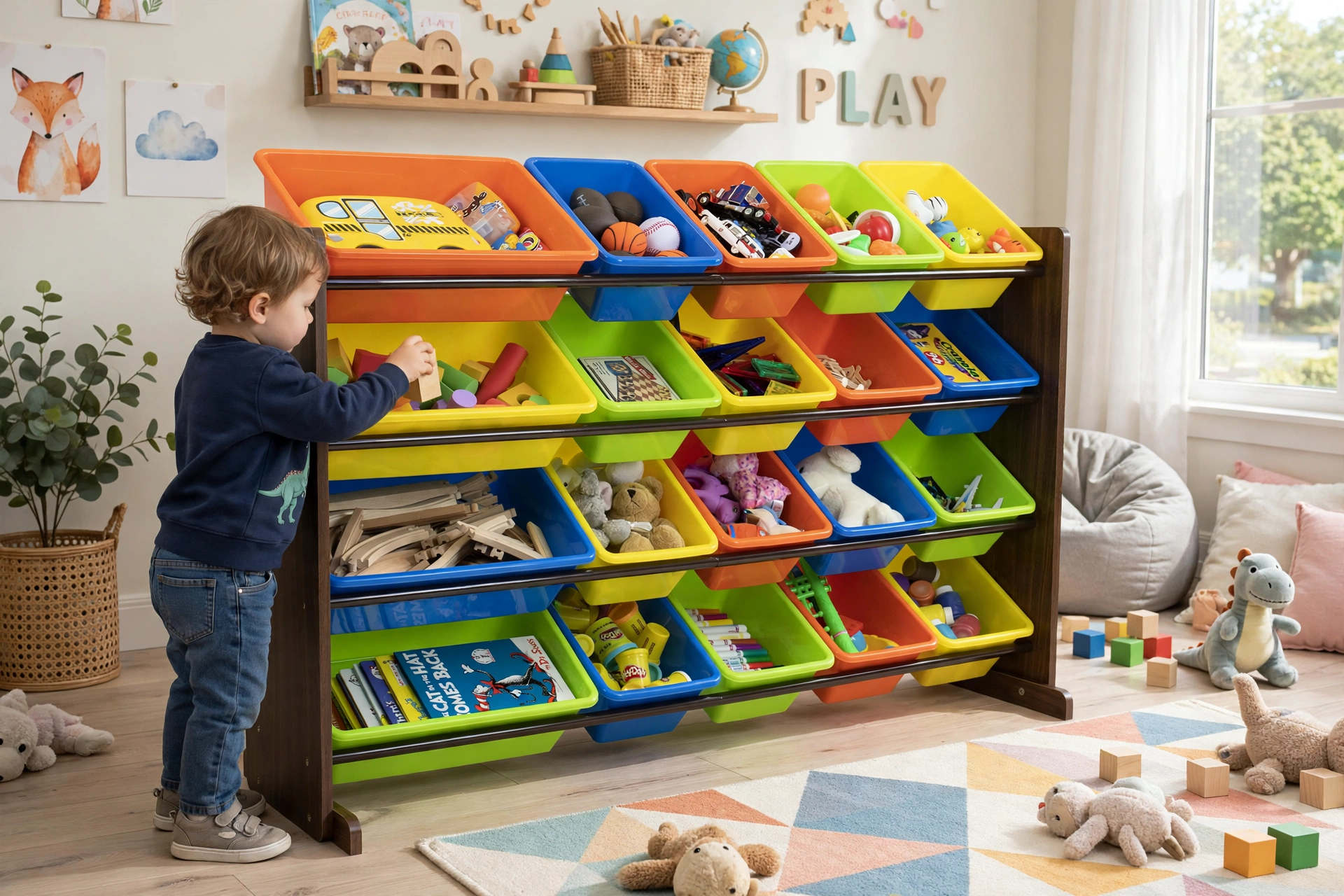
A toy with no home lives on the floor. That is the whole rule. Our fix was one low organizer with open bins a small person can reach, where the kids actually play. Everything has exactly one spot, the bins are shallow enough for a 2-year-old to see inside, and cleanup means carrying a toy to its bin. Keep the bins broad: blocks in one, cars in one, dolls in one. Twelve tiny categories is a system a toddler will never use.
The organizer we use is the Humble Crew Kids Toy Organizer with 20 Bins, a four-tier unit with 16 standard bins and 4 large ones, a sturdy engineered wood frame, and steel dowels. The listing says each level supports up to 20 pounds, and it has anti-tip straps. Anchor it to the wall the day it goes up, before the kids discover it.
Humble Crew Kids Toy Organizer with 20 Bins
20 removable bins in two sizes, a sturdy engineered wood frame, and anti-tip straps. The bins sit low enough for a toddler to reach alone.
Sarah’s note: buy the organizer for the room the toys already live in, not the room you wish they lived in. Ours went in the living room, and that is why it gets used.
2. Shrink the Pile Before You Organize It
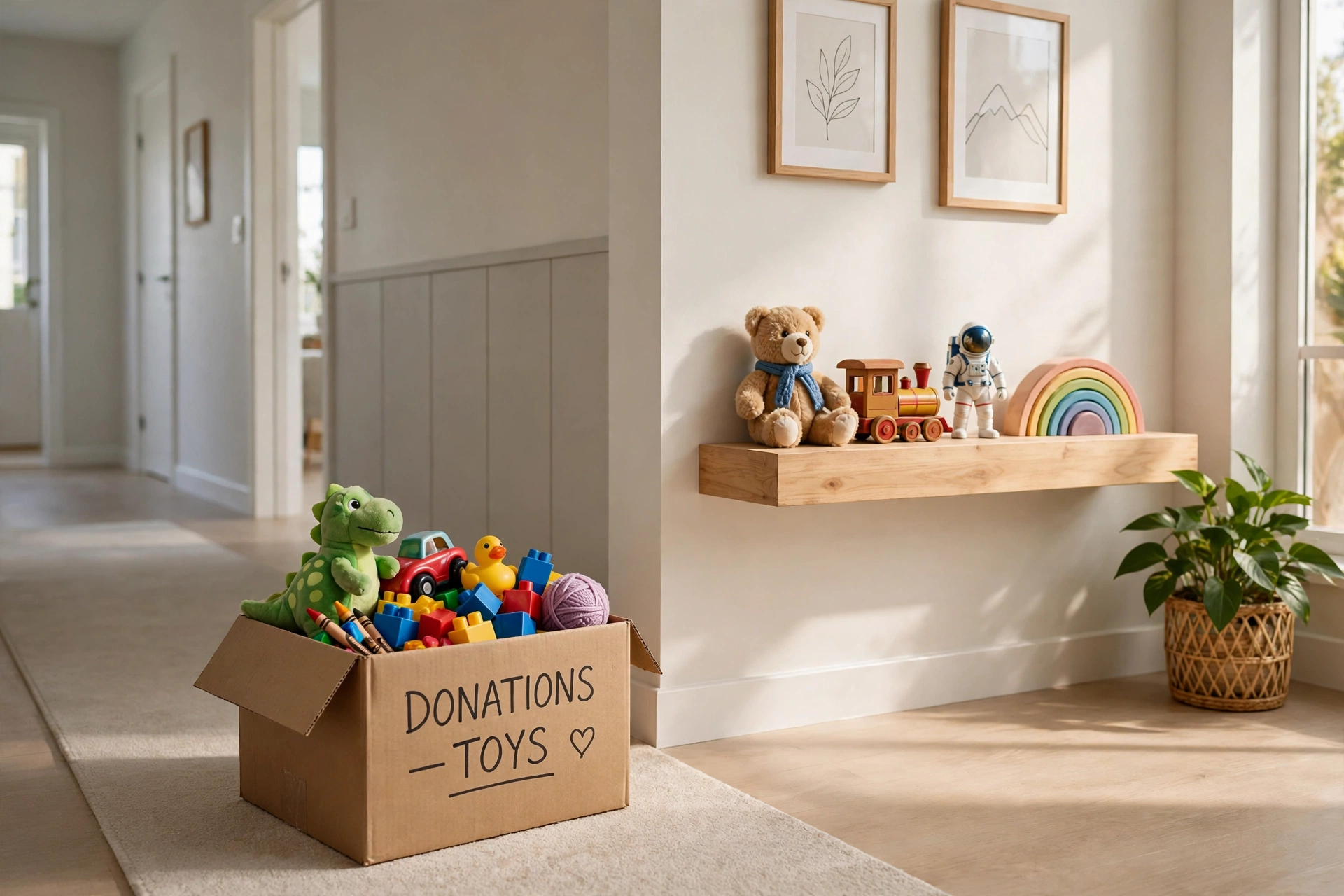
No storage system can hold a toy pile that keeps growing. Before we bought a single bin, we did one big sort: broken toys out, outgrown toys out, duplicates out, and untouched toys into a box by the door. The rule that keeps the pile small now is one in, one out. A new toy comes in, an old toy goes out to the donation box, chosen by our 4-year-old, which teaches her that letting go is a normal part of having things.
Do the big sort without the kids if you can, one afternoon, before the guilt sets in. Keep the favorites and the open-ended toys, and let the rest go. Fewer toys out means faster cleanup, less overstimulation, and a toddler who actually plays with what she has instead of dumping everything looking for something interesting.
3. Label It So a 2-Year-Old Can Read It
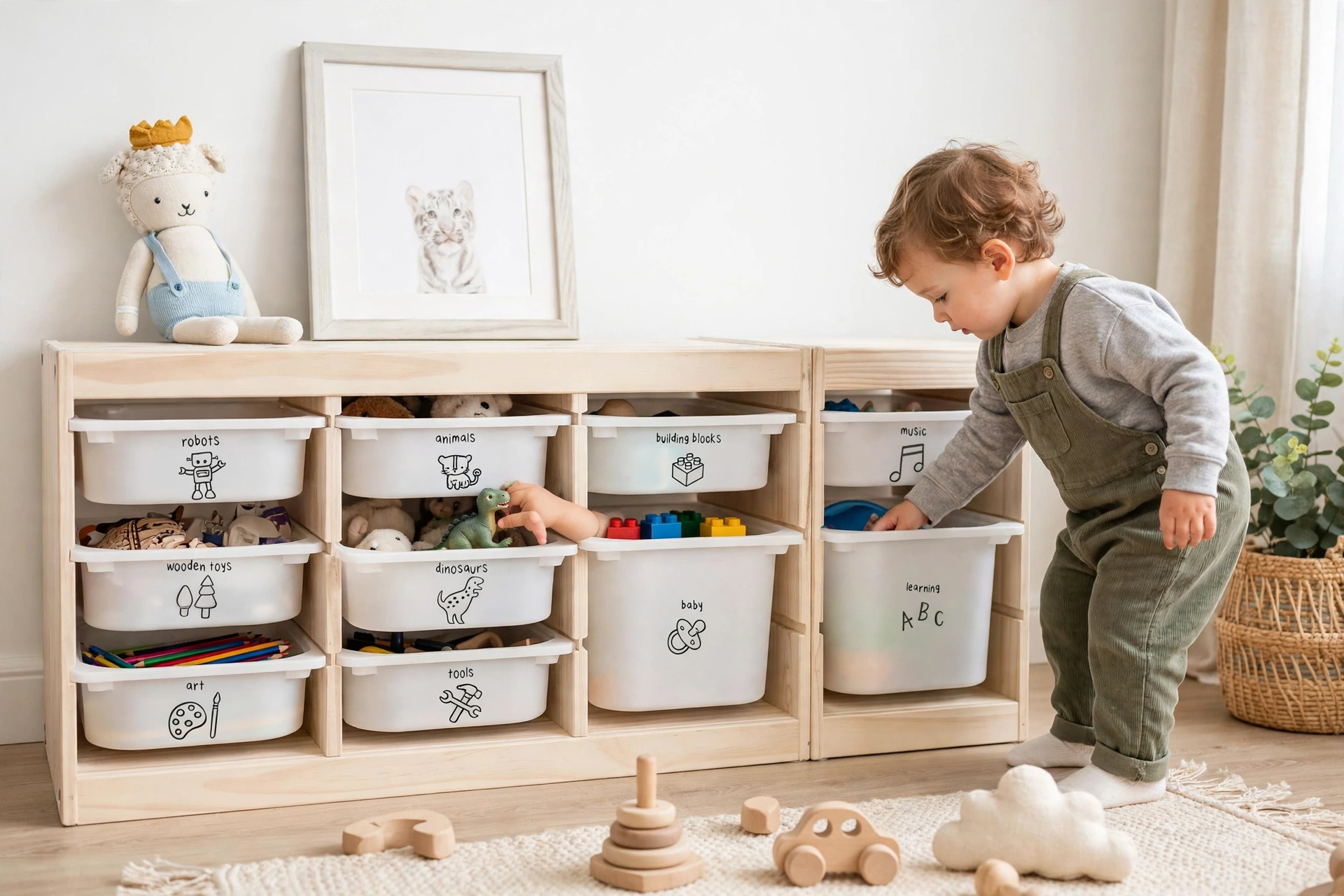
A label a toddler cannot read is decoration. Our bins are labeled with pictures, not words: a crayon car on the car bin, a block on the block bin, a doll on the doll bin. The pictures sit at toddler eye level on each bin, so cleanup is a matching game instead of a memory test. Our 2-year-old cannot read “blocks,” but she knows the picture of the red block.
For the words, we use the Talented Kitchen Playroom Organization Labels, 120 preprinted white stickers for bins, containers, folders, and cubbies. The listing describes them as water resistant. We put the word label on the bin, then draw the picture beside it, so the bin speaks both languages: the word for the grown-ups, the picture for the kids.
Talented Kitchen Playroom Organization Labels, 120 Pack
120 preprinted white stickers for bins and cubbies, water resistant. Pair each word label with a drawn picture so a non-reader can match it.
4. Let One Room Be the Mess Room
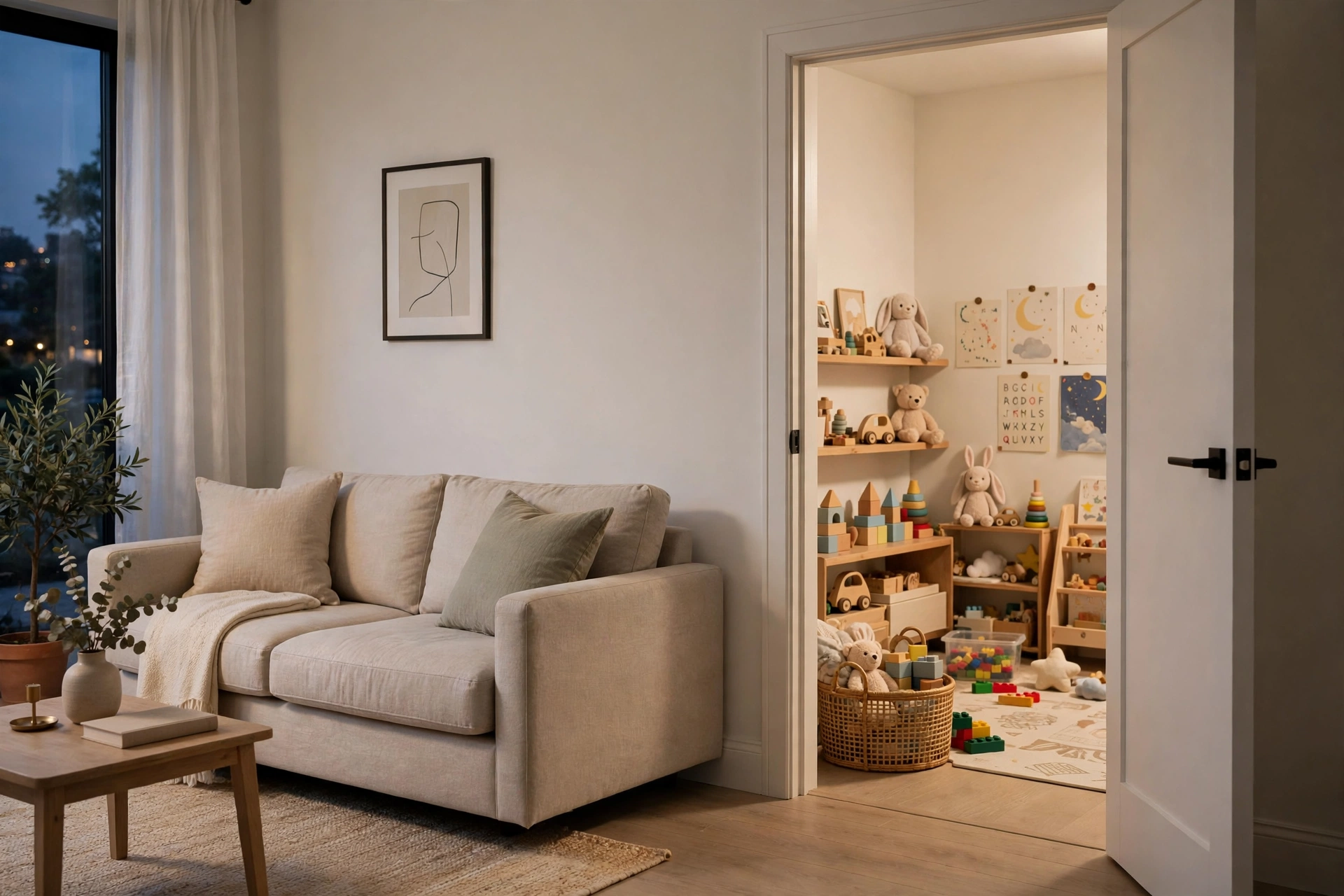
This is the system that saved our sanity: one room is allowed to be a mess, and the rest of the house is not. In our house it is the playroom, the spare bedroom. The kids can build, dump, and spread in there all day, and when guests come over, we close the door. The mess is contained, not eliminated, and containment is the whole point.
Pick the room with a door, and make the rule clear to everyone. Toys live in the playroom or the one basket in the living room. Food stays at the table, art stays at the art table. The rule works because a 2-year-old can understand it, and it gives the kids a place where mess is allowed. Our toddler parenting tips guide has the longer version of how we set boundaries a toddler can actually hold.
5. Give Them Their Own Tiny Tools

Toddlers want to help, and the fastest way to kill that instinct is to hand them a full-size broom and watch them fail. Our kids each have their own small tools: a child-size broom, a dustpan, a duster they can hold. Cleanup stops being a chore you nag about and becomes a game they ask to play, because the tools fit their hands.
The set we use is the Melissa & Doug Dust! Sweep! Mop! 6-Piece Pretend Play Cleaning Set, a wooden set with a broom, mop, duster, brush, and dustpan on a sturdy stand. The manufacturer age is 3 and up, so our 2-year-old uses the duster and dustpan with me while her big sister runs the broom and mop.
Melissa and Doug Dust! Sweep! Mop! 6-Piece Cleaning Set
A wooden broom, mop, duster, brush, and dustpan on a sturdy stand, made for ages 3 and up. Child-size tools turn cleanup into a game.
Sarah’s note: store the set where the mess happens, not in a closet. Ours hangs on its stand by the kitchen door, and the kids grab it without being asked.
6. Run the 10-Minute Family Tidy
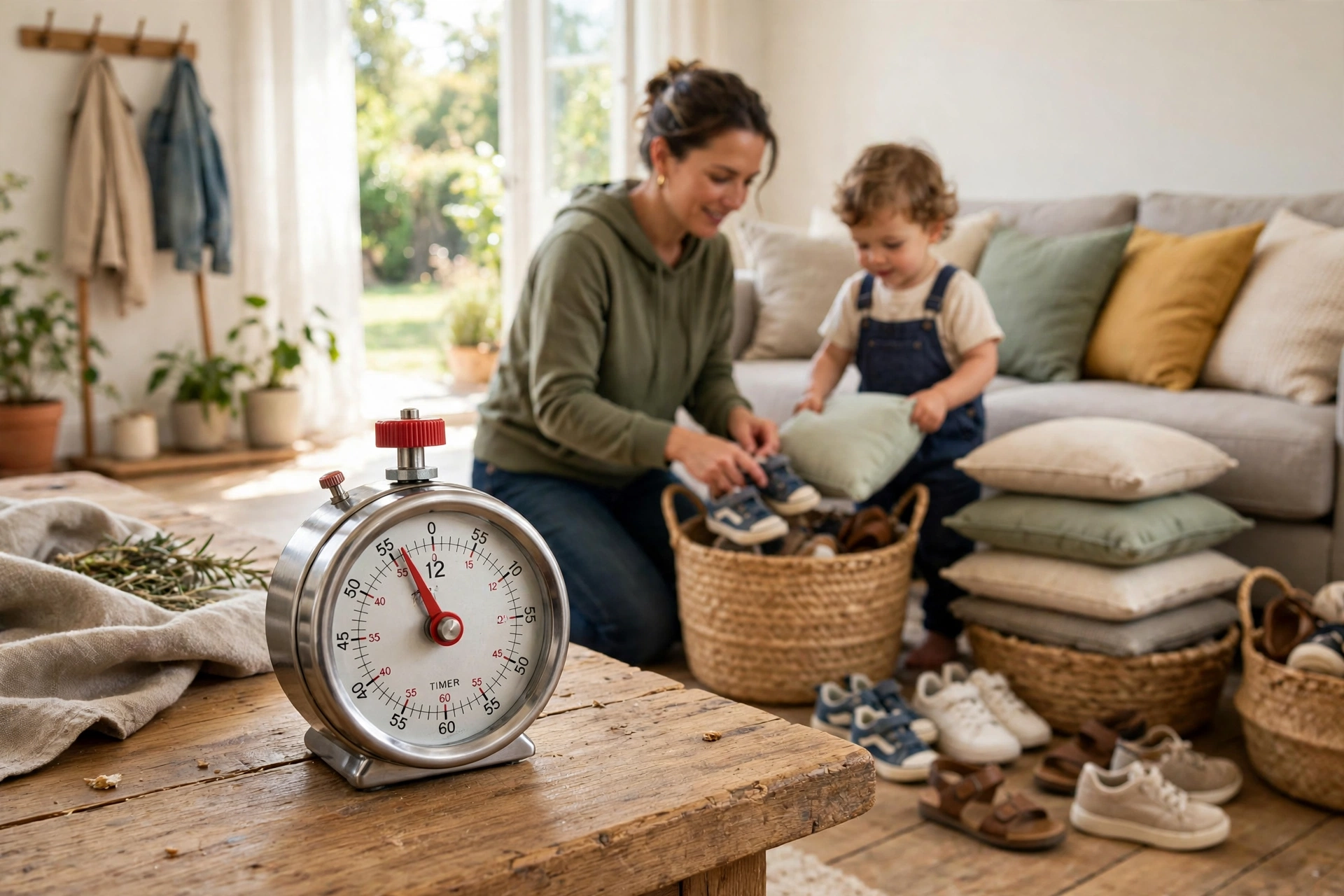
One hour of you tidying alone builds resentment. Ten minutes of four people builds a habit. Every evening before bath time, we set a timer, put on one song, and everyone rescues one room. The kids get jobs sized to them: cushions, shoes, anything with wheels. When the timer beeps, we stop, mid-mess if that is where we are. A tidy that always ends on time is a tidy nobody dreads.
Keep the jobs tiny and the same every night. Same song, same timer, same rooms, same jobs. Toddlers do not read clocks, they read sequences, and the tidy becomes just part of the evening, like brushing teeth. On the nights it falls apart, five minutes instead of ten is still a win.
7. Wipe as You Go
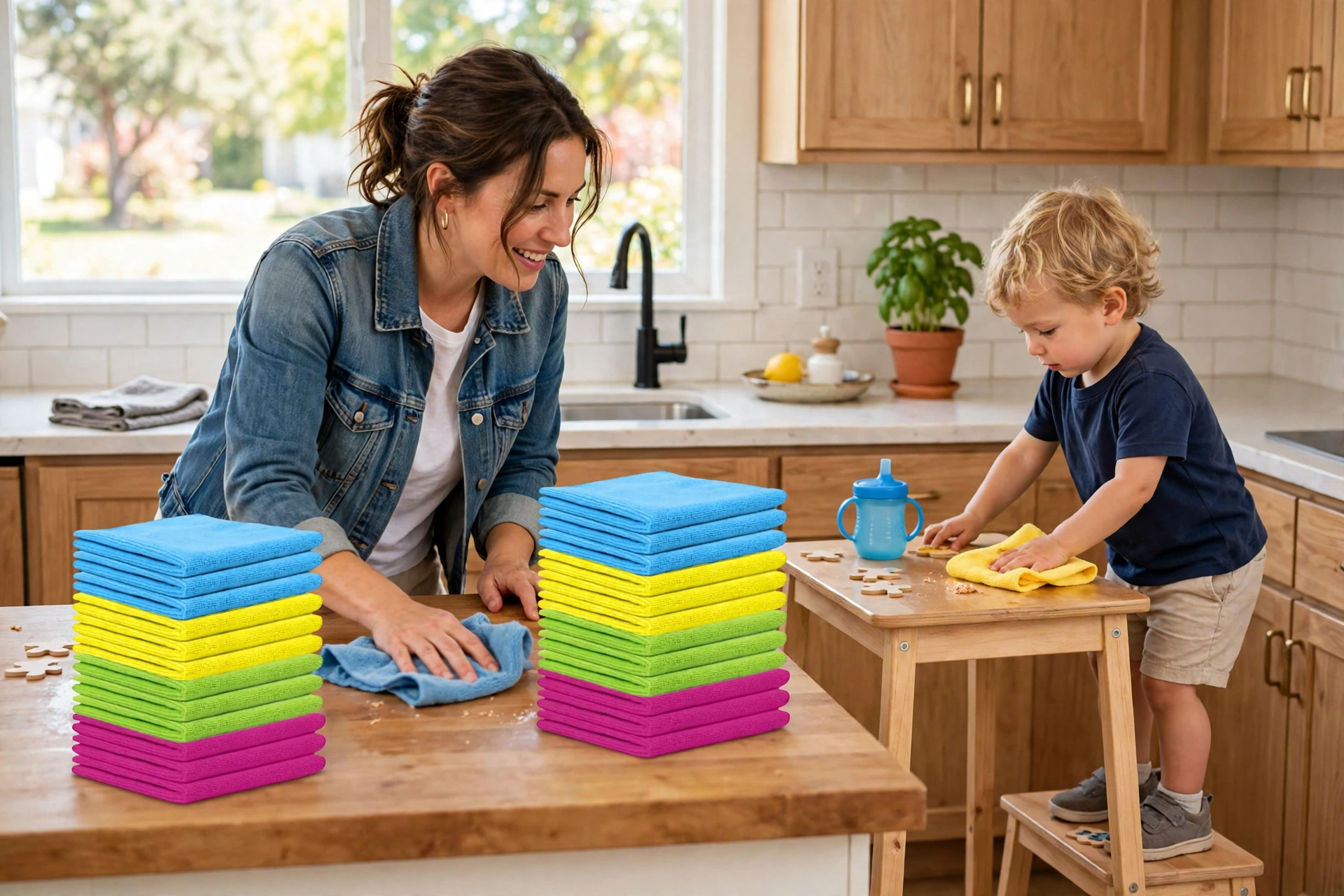
Sticky spots do not wait for cleaning day. The high chair, the table after lunch, the mystery smear on the wall: walk past it and it hardens, and by evening it needs scrubbing. Our fix is a small caddy of damp microfiber cloths in the kitchen and one in the bathroom. A quick wipe while the pasta boils, and the surfaces stay clean without a single dedicated cleaning session.
We keep a stack of Zwipes Microfiber Cleaning Cloths in each caddy, 24 cloths, 12 by 16 inches. The listing says they hold eight times their weight in liquid, can be washed hundreds of times, and give a streak-free, lint-free shine with or without cleaners. We use ours damp with plain water for the toddler zones, and toss the used ones in the laundry at night.
Zwipes Microfiber Cleaning Cloths, 24 Pack
24 soft cloths, 12 by 16 inches, washable and reusable. Keep a few damp in a caddy for ten-second wipe-ups.
8. Close the Kitchen Every Night

The kitchen sets the emotional weather of the next morning. Eight minutes before bed: counters wiped, dishwasher running, cups out, coffee maker set. That is the whole system, and it changes everything, because walking into a clean kitchen at 6 AM feels like someone helped you. Someone did: last night’s you.
Do it after the kids are down, not before. Keep it short on purpose. And on the nights you skip it, the house does not fall apart. You just close it the next night.
9. Rotate the Toys
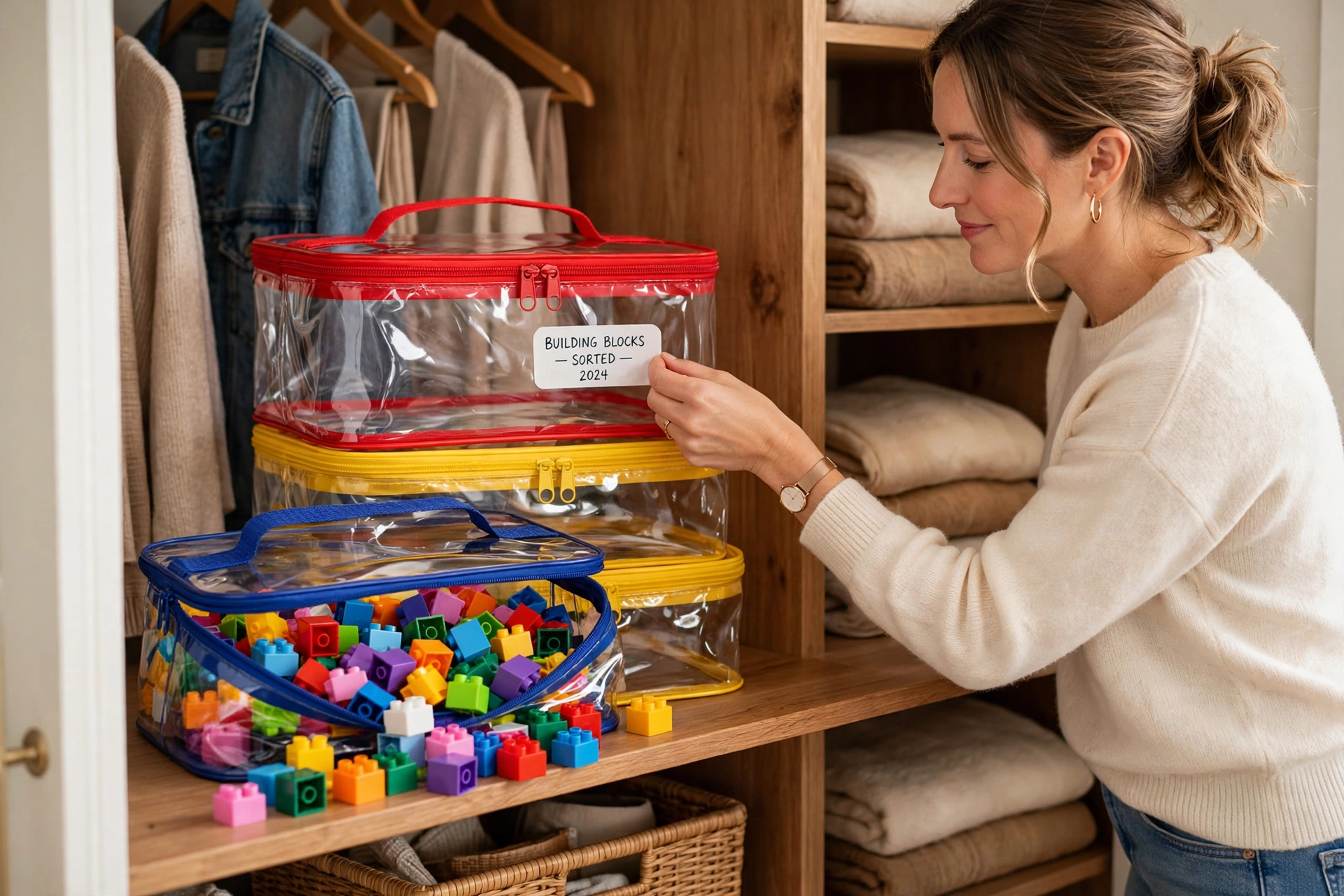
Half the toys live in the closet, and the kids never miss them. Once a month, we swap a few toys from the closet onto the low shelves. The rotated toys feel brand new, because to a 3-year-old, they basically are, and the playroom stays small enough to clean in ten minutes.
We store the off-rotation toys in clear zip bags with a label, so we can see inside without opening every bag. The Tatotato Toy Storage Bags are a 6-pack of reusable clear PVC bags with zippers, and the listing says labels and a pen come in the pack. One bag per toy set, stacked on the closet shelf where a toddler cannot reach them but you can.
Tatotato Toy Storage Bags, 6 Pack
6 reusable clear PVC bags with zippers, labels, and a pen included. One bag per toy set keeps the rotation visible.
Sarah’s note: rotate on the first Sunday of the month. A rotation with a date on it actually happens. When the toy pile grows again after a birthday or a holiday, our Boo Basket for Toddlers guide is a good reminder of how little a toddler actually needs.
10. Build a Launch Pad by the Door

Leaving the house with toddlers takes twenty minutes unless everything has one spot. Our launch pad is a low bench by the front door: a bin for shoes, hooks for coats and backpacks, a tray for keys and permission slips. Nothing migrates. When everything has exactly one home, “where is my shoe?” stops being the family anthem. The kids hang their own coats because the hooks are at their height, and that saves us five minutes every single morning.
Set it up with what you already own: a basket you have, a tray from the kitchen, hooks at the height your toddler can reach. Restock it when you come home, not when you are leaving. The same launch pad logic packs the car for a trip, and our Road Trip With Toddlers guide uses the same one-spot rule for the trunk.
11. Lower the Bar on Purpose
A good-enough house is a standard, not a failure. Your kids will remember the mom who sat on the floor and played, not the one with the folded fitted sheets. Guests are coming to see you, not to audit your baseboards. The systems above are not there to make your home spotless. They are there to make it calm enough to enjoy the people in it, and that is a much kinder goal than perfect.
So pick the one system that matches your worst hour. If the house still looks like a toy store exploded by lunchtime, that is not failure, that is a Tuesday with toddlers. The house does not need to be perfect. It needs to be kind, and kind is a bar you can actually reach. If the evenings feel heavy, our Baby Sleep Guide is the honest read for the bedtime side.
Shop This Post
Everything with a link in this guide:
| Product | Used for |
|---|---|
| Humble Crew Kids Toy Organizer with 20 Bins | A home for every toy (1) (Check Price) |
| Talented Kitchen Playroom Organization Labels, 120 Pack | Picture labels toddlers can read (3) (Check Price) |
| Melissa and Doug Dust! Sweep! Mop! 6-Piece Cleaning Set | Their own tiny tools (5) (Check Price) |
| Zwipes Microfiber Cleaning Cloths, 24 Pack | Wipe as you go (7) (Check Price) |
| Tatotato Toy Storage Bags, 6 Pack | Toy rotation storage (9) (Check Price) |
Frequently Asked Questions
How do I keep my house tidy with a toddler who destroys it daily? You do not fight the destruction, you contain it. One room is allowed to be a mess, every toy has a home, and the 10-minute family tidy runs every evening. It needs to reset to good enough once a day.
What is the best storage for toddler toys? Low, open, and shallow. A low organizer with open bins at toddler height, like the 20-bin unit in system 1, beats a deep toy box every time.
How often should I rotate my toddler’s toys? Once a month is plenty. Keep half the toys out and half in labeled bags, then swap a few on the first Sunday of the month. If a toy has not been touched in two rotations, let it go.
How do I get my toddler to clean up? Give them jobs their size, tools their size, and a reason to care. A child-size broom, a picture label they drew themselves, and a timer that ends the tidy on time will do more than any lecture. Our 9 Best Learning Toys for Toddlers That Teach Through Play has more jobs that teach while they tidy.
Is it realistic to have a tidy house with toddlers? A tidy house, yes. A perfect house, no. Tidy means every toy has a home, the kitchen closes at night, and the mess has a room. Lower the bar on purpose, and the house gets kind.
Start With One
Here is the whole philosophy in one line: pick the system that matches your worst hour. One small system, kept for a month, will change the texture of your days more than a total life overhaul abandoned by Thursday.
You are not behind, mama. You are running an entire household on love and very little sleep, and reading a guide like this one means you are already doing the job on purpose. Start with one. Keep it small enough to survive your worst week. A month from now, when the blocks land in the bin without anyone asking, you will feel it: the house got kinder.