
Surviving the 4 Month Sleep Regression: 14 Gentle Tips That Get Your Nights Back

Your baby was finally sleeping longer stretches, maybe even a five-hour block. Then, almost overnight, she started waking every hour, fighting naps, and crying at bedtime. If that sounds like your house right now, you are almost certainly in the 4 month sleep regression, and it is not your fault.
These 14 gentle tips are the ones that actually helped in our house when my oldest hit four months, and the same ones I leaned on again with my youngest. They cover nights, naps, the routine, and the 2 a.m. wakings, plus how to protect your own sleep. Nothing here asks you to let your baby cry alone, and nothing here promises a perfect sleeper by Friday. The regression is a normal part of how baby sleep matures, it usually lasts two to six weeks, and the goal is steadier nights, not a miracle tonight.
Heads up: this post contains affiliate links. If you buy through them, MamaKinder may earn a small commission at no extra cost to you. It helps keep these guides free.
What the 4 Month Sleep Regression Actually Is
Around four months, your baby’s sleep changes for good. Newborns cycle between just two stages of sleep, active and quiet. Around three to four months, their brain starts cycling through four stages, the same pattern adults follow, with light sleep stages in between. Each cycle lasts about 45 minutes, and your baby partly wakes between cycles. Adults roll over and fall back asleep without thinking. Your baby has not learned that part yet, so she calls for you instead.
That is the whole story. It is not a step backward. It is her brain growing up, and the waking is the price of the upgrade. Most babies hit this shift between three and a half and five months, often with new skills and a growth spurt.
Signs You Are In It
If three or more showed up in the same week or two, the regression is the likely reason: waking every one to two hours at night, naps capping at 25 to 35 minutes, harder settling at bedtime, extra fussiness even when fed and rested, and fighting sleep when she used to drift off easily.
How Long Does It Last?
The rough patch usually lasts two to six weeks. Babies who already had some practice falling asleep on their own move through it faster, and illness or teething can stretch things out. Instead of a clear “it is done” moment, you will notice longer night stretches and fewer wakings over a week or two.
Quick Picks: Where to Start Tonight
| When this is your problem | Start with |
|---|---|
| She wakes every hour | Tips 8 and 1 |
| Naps are 30 minutes | Tips 4 and 9 |
| Bedtime has become a battle | Tip 5 |
| She eats all night | Tip 10 |
| You are running on fumes | Tip 13 |
| You are not sure it is safe | Safe sleep, Tip 14 |
Safe Sleep Comes First
Before any tip, the safety rules that never bend: always place your baby on her back to sleep, on a firm flat surface, in her own sleep space with nothing in it (no pillows, blankets, bumpers, toys, or positioners). Share the room, not the bed. Keep the room near 68 to 72 degrees. Never use weighted sleep products; if the selling point is weight on a baby’s chest, skip it. If your baby is still swaddled, stop swaddling at the first sign of rolling.
Nights: Set the Stage
1. Put her down drowsy but awake. This is the most useful skill in this whole list. Watch for sleepy cues (slower blinks, rubbing eyes, zoning out), then put her in her crib while she is drowsy but still awake. She needs practice falling asleep where she wakes between cycles, so the place feels familiar at 2 a.m. instead of strange. The first nights she may fuss; stay nearby with a steady hand on her chest. My pick is the HALO SleepSack Swaddle: the wings adjust three ways, so once she shows any sign of rolling, use it arms-out as a wearable blanket.

HALO’s 3-way adjustable cotton swaddle, arms in, one arm out, or both arms out. The original wearable blanket, with an inverted zipper for easy diaper changes.
2. Make the room truly dark. Light is the strongest signal to a baby’s clock that it is daytime, and a surprising amount of it sneaks in around ordinary curtains. True darkness tells her clock it is night, and it helps her link sleep cycles instead of waking fully at every light change. For naps, darkness matters just as much as at night. If your curtains leak light, a portable blackout shade is the cheapest fix I know: it sticks to the window with suction cups and blocks the light completely. The Amazon Basics portable shade (moon and stars print, 50 by 78 inches) is the one we used in the nursery.

Amazon Basics portable blackout shade with suction cups, blocks outside light completely and turns any bright room into a sleep room. Moon and stars print.
3. Run white noise all night. Continuous white noise does two jobs at once: it masks the doorbell, the dog, and the older sibling’s footsteps, and it becomes a sleep cue your baby recognizes every time she surfaces between cycles. The key word is continuous. A machine that switches off after thirty minutes leaves her in silence right when the next light-sleep stage arrives. Keep the volume modest, about as loud as a running shower heard from the next room, and place the machine across the room from the crib, never inside it or clipped to it. The Yogasleep Dohm is the machine I landed on: a real fan inside makes the sound.

Yogasleep’s original white noise machine, soothing, natural sound from a real fan, with two speeds and adjustable tone and volume.
Work the Day
4. Follow wake windows, not the clock. At four months, most babies do best with one and a half to two hours of awake time between sleeps, and the first window of the day is usually the shortest. A baby who is overtired fights sleep hardest, and a baby who is under-tired treats bedtime like playtime, so timing beats willpower here. Watch her, not the clock: the window is a guide, and her cues are the decision.

5. Keep the same short routine every night. A routine is not a performance. It is the same four or five steps, in the same order, every single night, for about twenty to thirty minutes: feed, warm bath or wipe-down, pajamas and sleep sack, one short book or song, lights out. Babies are pattern-recognition machines, and the routine becomes a sleep cue in itself. The book is the calmest step: the same words, the same rhythm, the same lap, every night. Ours was Goodnight Moon, the board book edition, short enough to finish before she gets restless and sturdy enough to survive being grabbed.

The classic bedtime board book, short, sturdy, and made for little hands. The same calming rhythm every night.
6. Feed before bed, and keep night feeds short and boring. A four-month-old going through a growth spurt is genuinely hungrier, so a full feed right before bed is not a crutch, it is fuel. Offer it as the first step of the routine, not the last, so she does not need a feed to fall asleep. Then, when she wakes at night, feed her if she is hungry, but keep it short and boring: dark room, quiet voice, no play, no bright lights, back down as soon as she finishes. Most babies still need one or two night feeds at four months.

7. Offer the pacifier at bedtime. A pacifier can be a genuine help during the regression, because sucking is soothing and it gives her something to do with the restless energy between sleep cycles. Offer it when you put her down, once feeding is established, and let her keep it if it helps her settle. You do not need to replace it every time it falls out after she is asleep; most babies either find it or fall back asleep without it. The Philips Avent Soothie is the one hospitals hand out for a reason: a one-piece design in medical-grade silicone, sized for babies 0 to 3 months, and easy to clean in a sterilizer or boiling water. Replace pacifiers after four weeks of use, and check them regularly for wear.

Philips Avent’s one-piece medical-grade silicone pacifier for babies 0 to 3 months, supports healthy oral development and adheres to AAP guidelines.
When She Wakes Anyway
8. Pause before you rush in. When she wakes, wait two to three minutes before going to her. This is the hardest tip in the list and the most useful. Babies make a surprising amount of noise between sleep cycles (grunts, whimpers, half-cries) without being fully awake, and many settle on their own if nobody arrives to wake them up properly. Listen first. If the sounds are soft and fading, she is likely resettling. If they build into a real cry, go in, and keep it boring.

9. Rescue one nap a day. If every nap is a thirty-minute disaster, let one of them be a rescue nap: a contact nap, a stroller nap, or a car nap. One rescue nap keeps her from getting overtired without creating a pattern, and an overtired baby has a worse night, which makes tomorrow’s naps worse again. Pick the same nap each day if you can (the midday one is usually the best candidate), and let the other naps be crib practice. A rescue nap is not a failure.

10. Fix reverse cycling in daylight. Reverse cycling is the pattern where she snacks all day (too distracted to take full feeds) and then eats all night to catch up. The fix happens during the day, not at 2 a.m. Feed her in a quiet, dim room, away from the interesting things that pull her attention. Offer feeds more often in daylight hours instead of waiting for her to cry for one. Cut down the background noise during feeds: no television, no lively visitors mid-feed.

11. Keep nights boring: no lights, no play, no chat. Every night waking is a test of whether the night is interesting. If the lights come on, if there is talking and eye contact and a tour of the room, the night becomes worth waking up for. If the night stays dark, quiet, and dull, there is nothing to stay awake for. Keep a dim path to her room (the hallway glow is enough), change her only if she needs it, feed her if she is hungry, and put her straight back down. No new toys, no bright phone screen, no conversation.
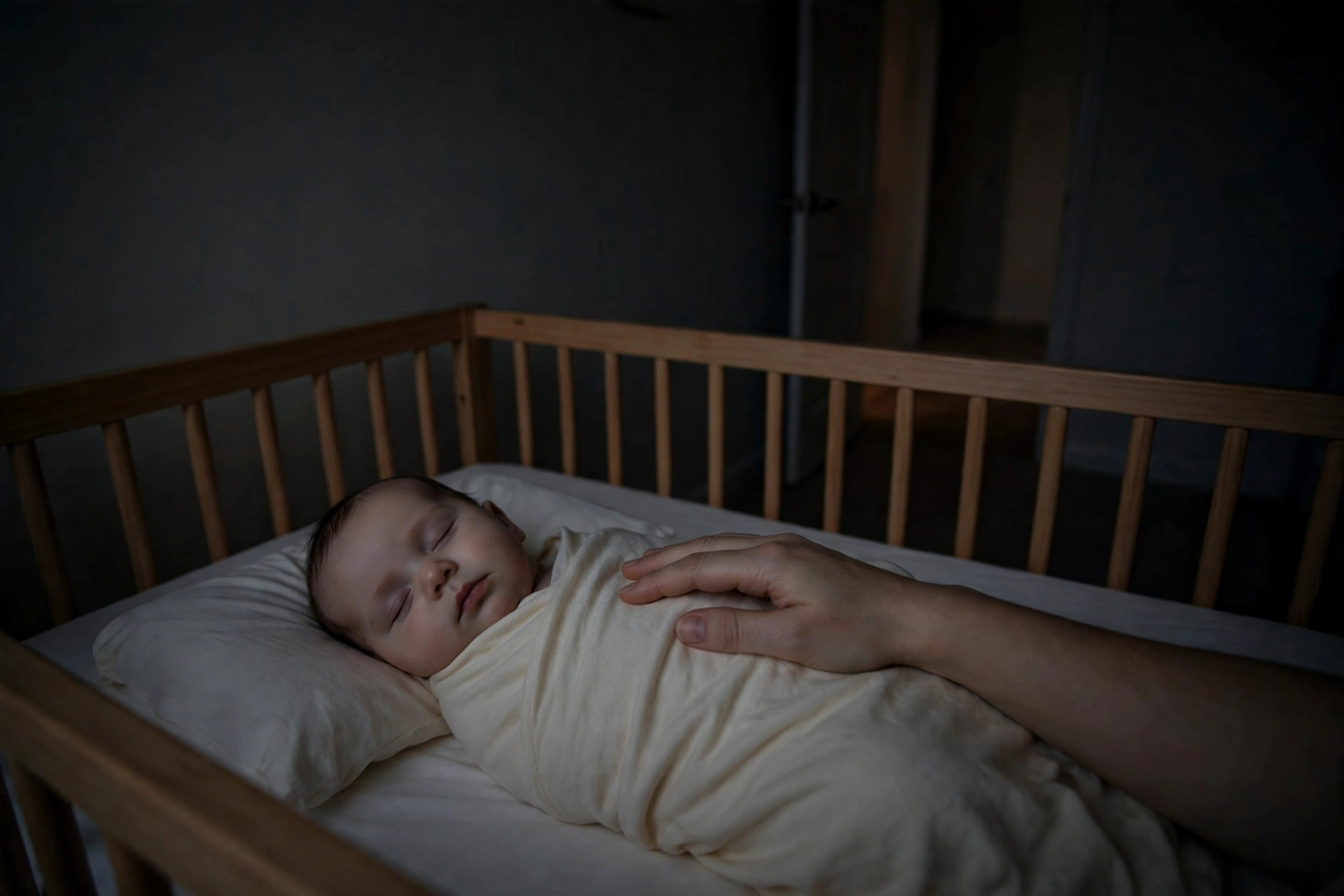
12. Dress her for the room, not the season. The comfortable zone for a baby’s room is roughly 68 to 72 degrees Fahrenheit. Dress her in about one more light layer than you are wearing, and match her bedtime layer to the room, not to the weather outside. Check the back of her neck or her chest: warm and dry is right, hot or sweaty means a layer comes off.

You, the Parent, Need a Plan Too
13. Split the night into shifts. Two tired parents are worse than one rested one. Split the night into an early shift and a late shift, so each of you gets one protected block of sleep. The off-duty parent sleeps in another room if you can manage it, with the door closed, and the on-duty parent handles everything in their block.

14. Know when to call the pediatrician. The regression is normal, but some sleep changes are worth a call. Contact your pediatrician if you notice a fever alongside the sleep changes, refusal to eat during the day and night, weight loss or poor weight gain, excessive sleepiness (hard to wake, floppy, not alert during awake time), no improvement after eight weeks of disrupted sleep, or loud, persistent snoring or pauses in breathing. These signs do not always mean something serious, but they are worth checking.

Want More Than 14 Tips?
The 14 tips above are free, complete, and enough to get most families through the regression. If you want the deeper version, we are putting together a 4 Month Sleep Regression Survival Pack: the 14 tips expanded to 30, with a sleep log and a wake-window card. There is no buy link yet, because the pack is still being built.
Shop This Post
| Product | Used For | ||
|---|---|---|---|
|
HALO SleepSack Swaddle, Cotton (1.5 TOG) | The swaddle that transitions arms-in to arms-out (Tip 1) | Check Price |
|
Amazon Basics Portable Blackout Curtain Shade, Moon and Stars | True darkness for naps and nights (Tip 2) | Check Price |
|
Yogasleep Dohm Classic White Noise Machine | Real-fan white noise, all night long (Tip 3) | Check Price |
|
Goodnight Moon Board Book | The short, calming book for the routine (Tip 5) | Check Price |
|
Philips Avent Soothie Pacifier, 0-3 Months, 4-Pack | The bedtime pacifier (Tip 7) | Check Price |
Frequently Asked Questions
How long does the 4 month sleep regression last?
Usually two to six weeks. It starts when your baby’s sleep cycles mature, between three and a half and five months, and it ends gradually: longer night stretches and fewer wakings over a week or two.
Is the 4 month sleep regression real?
Yes. It is a documented change in sleep architecture: around four months, babies move from two sleep stages to four, with light sleep stages where waking is more likely. The disruption is the adjustment period while they learn to link cycles.
Should I sleep train during the 4 month sleep regression?
There is no single right answer. Most pediatric guidance considers sleep training safe from around four months onward. Some families start gently now, others wait until five or six months. If you are not ready, focus on how she falls asleep at bedtime.
What should my baby wear to bed during the regression?
About one more light layer than you are wearing, matched to a room kept near 68 to 72 degrees. A wearable blanket or sleep sack is the usual choice. No hats, no hoods, no loose blankets, no weighted sleep products.
It Passes. Really.
The 4 month sleep regression feels endless at 2 a.m., and then one morning you realize she slept a five-hour stretch again and you cannot quite remember the last bad night. That is how it ends: not with a single breakthrough, but with a slow return to predictable. Pick one tip from this list and try it tonight. Not all fourteen, just one. One small change, kept steady for a week, does more than a whole new system abandoned by Thursday. You are not doing anything wrong. For the bigger picture, start with our Baby Sleep Guide.